
Guideline #14: Face Family Challenges Directly
February 16, 2026
How do you set priorities when dealing with parenting challenges? If you’re like most parents, you want to solve family problems in a win-win manner that helps everyone get on with life in a positive way. Nobody gets hurt or damaged. Is this fully under your control as a parent? No, and this is the hard part.
It’s impossible to raise kids without running the risk of something going seriously wrong. Suicide, car accidents, leukemia, cancer, drug overdoses, murder, serious crimes by kids, running away, mental illness, AIDS, rape, assaults, and a host of other dangers are out there. We hear about these every day. What do we do if something really bad happens? The only thing to do is cross that bridge if we come to it. Follow the example and take strength from those who have shown us how to carry on with dignity even when the worst happens.
This post is from my book Purposeful Parenting Handbook: Guidelines for Raising Capable, Confident, and Accountable Children
My name is Lane Lasater, a retired clinical psychologist. In gratitude for the life I have been given, I am sharing everything I learned during my career and personal life on my website http://www.LaneLasater.com and on my YouTube Channel Life Roadmaps from a Retired Psychologist https://www.youtube.com/@lane205
Each post contains my written material, an AI generated graphic, a 15-17 minute audio summary, and a 5-7 minute video summarizing the material.
Life Will Throw You Some Curves
Barring catastrophe, how do we chart our family course, letting our kids be more and more in charge of themselves as they grow up, even with all these dangers out there. There are no guarantees, unfortunately. You’re the only one who has all the information about your family to work with, so you have to judge what’s right for you and your family.
There’s no formula. Some parents deal with the risks of the world by trying to protect their children completely. That seems reasonable, but in the long run is hard to do. Most parents try to find some middle ground, giving kids a chance to practice taking responsibility, so they become self-directed decision makers able to act in their best interests.
There are plenty of pitfalls to helping young people grow up to be responsible and contributing adults. Things happen to throw you off track—family circumstances, children’s poor choices, health challenges, and other events outside your control. These things happen to everyone.
- You lose loved ones through accident or disease
- Your son or daughter may have a hard time in school
- Your child may break the law and get into trouble
- You son or daughter may lie, use cigarettes or smokeless tobacco
- You may lose a job you thought was secure and face financial insecurity
- You may go through the breakup of a marriage or relationship you thought would last forever
- Your child or teenager may start drinking alcohol or using drugs
Sometimes the parenting problems we face seem huge. But they’re usually not as bad as we think. Hard times are chances to learn, so learn all you can. Then you don’t have to go through them again. We learn from our mistakes or repeat them until we do. This handbook is intended to give information and skills to help you skip extra parenting challenges. Life hands out enough challenges already.
Adolescents are Challenging
If things have gone smoothly in the earlier years, that is wonderful! For most of us, however, the process of emancipation during adolescence is going to have some rough spots. Thankfully, if you have a strong bond with your children based on many shared learning and fun experiences, that foundation will carry you through. For most of us this friendship will re-appear in early adulthood if we can weather the storms thoughtfully.
What parenting challenges do you face? How long have these gone on? What steps have you taken to change things for the better? How do family challenges affect you and others in your family? These are painful but necessary questions for every person with parenting responsibility to answer, but they help you gain a clearer picture of your family situation. This clarity helps you prioritize the parenting changes you want to make.
As parents, it’s natural to focus on behavior and choices of the children we care for. When challenges develop, however, we encounter the painful reality we don’t control our children’s choices or behavior. When we try to control young people, they rebel and resist. Human beings are just made this way—our instinct is to maintain autonomy. When young people rebel, they often do so by making self-destructive choices–the exact opposite of what we want for them.
“You can’t tell me what to do!”
Joanna, 14, who was white, began dating Duncan, an African American friend from school. Joanna’s father, Nate, was prejudiced against blacks. He harshly put down both Joanna and Duncan. He grounded Joanna for two weeks and ordered her not to see Duncan any more. Joanna went to her Mother for support for continuing to date Duncan, but her mother didn’t feel strong enough to challenge Nate. Joanna secretly continued seeing Duncan. Within two months, Joanna went to the school counselor and told her that she thought she was pregnant. A pregnancy test confirmed this. When he heard about it, Nate was furious and told Joanna she had to either get an abortion or get out of the house. The school reported the situation to Social Services. Ultimately, Joanna decided to have the baby and continued to live at home. The whole family now had to come to terms with a larger challenge.
Alone and Desperate
Mary, a single Mom, sought help because she was exhausted and depressed about her son, Matt. The past year with Matt had been the most difficult of her life. As a high school freshman, Matt did well in school and was on the track team. That all changed during the summer after freshman year. Matt worked at a fast-food restaurant, and after closing hung out with kids he worked with. He started coming home at 3 and 4 a.m. Mary wondered if Matt was using drugs. What was hardest for Mary was his “attitude.” Matt and Mary had always been close. Now he was distant, hostile, and completely shut her out of his life. Mary felt rejected and abandoned.
Matt seemed to be a completely different person when he went back to school his sophomore year. He stopped participating in sports, and by October, he was failing two subjects. When Mary confronted him, Matt told her he didn’t like school or care about grades. Mary felt sick about the situation, but didn’t know what to do.
The school counselor asked Mary to come in for a conference. Teachers had noticed the changes in Matt and he had ditched a number of classes. Matt was suspended for two days and sent to the school truancy program, but he didn’t seem to care. By Thanksgiving, Mary’s fear about Matt’s drug use was confirmed. Matt was arrested with two other kids for possession of an ounce of pot. The judge ordered him to the juvenile drug court program in lieu of 30 days in detention. Mary was required to participate in the parent program connected to the drug court. Finally, Mary could share her worries with other parents who understood and supported her efforts to help Matt get back on track.
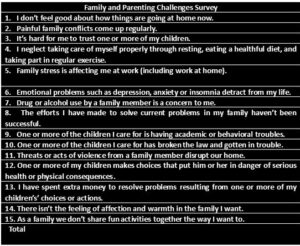
Complete the family and parenting challenges survey below to give yourself a picture of the parenting and family challenges you face.
Use a 0-10 scale to rate each factor, where 10 is very true of you.
Your Family and Parenting Challenges Score
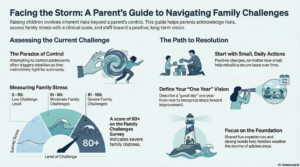
Your possible score on this survey ranges from 0 to 150. A total score of 50 or below suggests that you experience a low level of family and parenting challenges. Even though your overall score is low, however, you may still experience significant challenges if you have one or more very high scores. Scores between 50 and 80 suggest moderate family challenges, and scores between 80 and 150 suggest severe family challenges. Put a star by your three highest scores.
Even if your overall family challenge score is high or you have individual high scores, you can start today taking steps to change things for the better. Take things one day at a time. Positive actions, no matter how small, move things in the right direction. Over time, your actions help you get back on track toward creating a positive and secure base for each family member.
Identify Family Challenges to Improve
Describe in your parenting journal two specific family challenges that you most want to improve. Also describe exactly how you would like things to be. This information will guide you as you work with your co-parent other and to create a Family Development Plan in the next post.
Describe A Good Day in Your Family One Year From Now
No matter how challenging things are today at home, write down your vision for how you want things to be for your family in the future. Even if you don’t know exactly how to get there, describe a good day in your family one year from now in the space below. Write about the feelings, behavior, atmosphere, problem solving, activities and attitudes you want in your family. Re-read this vision for your family regularly so you can recognize small steps you can take toward creating this vision.