
Understand the Dynamics of Addiction
May 4, 2026
We now understand that addictions are complex, whole person, whole life phenomena with multiple contributing elements and variables. The diagram below guides you through these dynamics as they combine to envelop a specific person with his/her unique circumstances and physiology. These dynamics apply to both physical addictions such as alcohol and mood-altering drugs and behavioral addictions such as sex, gambling, compulsive overeating, bingeing and purging, compulsive social media and internet use, and others.
My name is Lane Lasater, a retired clinical psychologist. In gratitude for the life I have been given, I am sharing everything I learned during my career and personal life on my website https://www.LaneLasater.com and on my YouTube Channel Life Roadmaps from a Retired Psychologist https://www.youtube.com/@lane205
Each post contains my written material, an AI generated graphic, a 15-17 minute audio summary, and a 5-7 minute video summarizing the material.
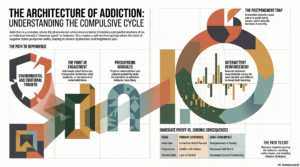
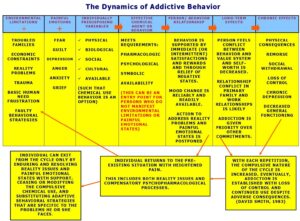
I explain each element of the chart below.
- Environmental Limitations: Commonly, but not always, persons who become addicted have faced some or all of the following environmental limitations: troubled family environments, economic constraints, trauma, reality problems, basic human need frustration, and faulty behavioral strategies.
- Painful Emotions: The result of the environmental limitations often include painful emotional states including fear, guilt, depression, anger, anxiety, anger, or others.
- Individually Predisposing Variables: An individual who becomes addicted may experience specific physical or biological vulnerabilities, and often lives in an environment where the addiction or behavior in question is socially sanctioned, culturally accepted, and readily available.
- Effective Chemical Agent or Behavior: Usually sometime after early adolescence, a person who becomes addicted encounters a chemical or behavior whose specific effects are particularly compelling to them such as providing relief of painful emotional states, a rush or excitement or euphoria, calming or soothing, relief of boredom, or the relief of inhibitions allowing a person to talk, dance or interact socially without shyness or self-consciousness. For a person who does not experience significant environmental limitations or painful emotions, this may be an entry point to an addictive process.
- Person/Behavior Relationship: Because the chemical or behavior provides specific effects that the individual values through providing immediate (or intermittent) rewards or relief of negative states, he she increasingly turns to the behavior. This is commonly repeated hundreds or thousands of times with intermmitent reinforcement which provides the most durable habit learning. With each repetition, the person postpones or avoids taking action to address whatever reality problems or painful emotions states he may be experiencing, and these problems steadily increase. Increased discomfort or reality concerns tends to drive the person back to the addictive chemical or behavior.
- Long-Term Effects: Over time, the person begins to feel conflict between their addictive action and their value system, and self-worth is decreased. A common pattern is that the person doesn’t do things they need to do, and does things that are not in their best interests. As this continues, relationship conflict in family and work relationships is likely as the person gives the addiction priority over meeting his or her responsibilities.
- Chronic Effects: The cumulative impact of repeatedly choosing an addiction over self-care and meeting one’s responsibilities can include physical consequences or disease, remorse, social withdrawal, feeling loss of control over the chemical or behavior, chronic depression and decreased general functioning.
With each repetition of the cycle of addictive behavior, the compulsive nature of the cycle is increased, and addiction is established with loss of control an continued use despite adverse consequences (David Smith, 1983). The individual returns to the pre-existing situation with heightened pain, including both unsolved reality issues and the natural compensatory psychopharmacological processes. (“For every high, there is an equal and corresponding low.”)
Escaping Addiction: The individual can exit from the cycle only by ceasing or modifying the compulsive chemical use or behavior, enduring and resolving the reality issues and painful emotional states with support, and substituting adaptive behavioral strategies that are specific to the problems that he/she faces.