
Decide Who You Allow Into Your Life
March 23, 2026
You can face setbacks and hurts that come along in life, but a critical part of Your Owner’s Manual is using your adult power, discrimination, and information to identify trustworthy people and environments that support you in becoming your fully functioning self.
My name is Lane Lasater, a retired clinical psychologist. In gratitude for the life I have been given, I am sharing everything I learned during my career and personal life on my website http://www.LaneLasater.com and on my YouTube Channel Life Roadmaps from a Retired Psychologist https://www.youtube.com/@lane205
Relationship Contracts
All relationships operate within explicit or implicit contracts about how things will be between us and others. For example, in romantic or marriage contracts, there is usually an agreement that both people will be sexually faithful. In employment, there is an expectation that I will be treated fairly as an employee, and the employer expects that I will in good faith do my best to advance the goals of the enterprise.
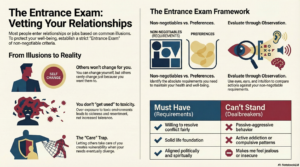
Contracts allow us to meet our needs in each relationship with relatives, friends, in choosing intimate partners, and in finding positive work environments. When we understand our deepest needs and vulnerabilities, as described in earlier posts, we can identify our non-negotiable requirements (vs. preferences) for each relationship or work environment.
Don’t Kid Yourself
While we gain experience, most of us make the mistake of entering either relationships or job situations based on illusions, and the results ranged from inconvenient to disaster. Here are five common illusions behind these faulty contracts:
- Things will change for the better.
- I can succeed where others have failed.
- I can get used to it.
- I can find a relationship or job situation where someone will take care of me, or
- If I don’t act on this opportunity, I’ll never have another chance.
We often learn through experience that we must revise these illusions to:
- I can change myself for the better, but other people won’t reliably change because I want them to;
- I can succeed where others have failed, if I have the resources and strength to act, and if my goal is not dependent upon the actions of others who don’t share this aim;
- I won’t get used to it—I’ll get sick of it. I’ll never recover a tolerance for toxic things I’ve been over-exposed to as a child or earlier during adulthood;
- If I choose to let someone take care of me, I’ll become a victim when my needs diverge from those of the person or organization that’s caring for me; and,
- If I feel compelled to act on a certain opportunity, it’s often a sign I’m overlooking some problem in myself or in the situation.
Your Entrance Exam
I suggest that you develop your personal “entrance exam” to guide your choices in both personal relationships and work environments. Your entrance exam defines your non-negotiable contract requirements.
Entrance Exam Instructions
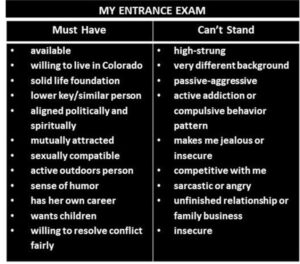
Based upon your experience with people and job situations, what are the non-negotiable requirements (as distinct from preferences) that you require in order to maintain your health and well-being? List two separate categories: (a) characteristics that I must have and (b) characteristics that I can’t stand. For example, here were my romantic relationships entrance exam requirements at the time I met my life partner:
Using Your Entrance Exam
Once you have your entrance requirements, evaluate all the information available about potential friends, partners, and job situations before you enter new contracts. People will show you directly or indirectly what you can expect from them during the initial interactions, but you must use your eyes, ears, and intuition. Pay attention to what people say and don’t say, what you learn about the history of the situation or person, and how you feel during and after the interaction. An example for me was a professional friendship where the person put me down during our first interaction, but had a smile on his face. It took me a long time to recognize that he was not really a friend.
Ask questions to get the information you need. Compare what you discover against your non-negotiable requirements and discuss questions and doubts with someone you trust. If your requirements are present, proceed with the next stage of commitment to the person or situation. Your entrance exam contains your implicit contract requirements. If what you require is missing, hold out for what you know you need, but be prepared to say goodbye respectfully if you can’t achieve this.
If you’re currently in a situation that doesn’t meet your entrance requirements, you can’t remain there too long without harming yourself. Do what is possible to negotiate for what you need, and if you can’t achieve this, find a healthier situation for yourself. Even if you only decide to move on, you’re empowered.