Know Your Addiction Risk
May 4, 2026
An important part ofYour Owner’s Manual is recognizing and taking into account your specific addiction risk profile. We all consider the implications for us if a parent or close relative has suffered from heart disease, high-blood pressure, breast cancer or other common health problems. I encourage you to also consider your risk for addiction. Earlier posts in Creating Your Owner’s Manual covered Understand Your Deepest Needs, Understand Your Vulnerabilities, and Inspect Your Life Foundation, I asked you to examine your childhood environment to identify basic human needs that were or were not well met, understand how adverse childhood events (ACEs) you may have faced create health vulnerabilities across your lifespan, and evaluate your developmental progress on the three essential pillars of your life foundation–Self, Work and Relationships.
My name is Lane Lasater, a retired clinical psychologist. In gratitude for the life I have been given, I am sharing everything I learned during my career and personal life on my website https://www.LaneLasater.com and on my YouTube Channel Life Roadmaps from a Retired Psychologist https://www.youtube.com/@lane205
This post and the following two posts under the category of “Bypass Common Road Hazards” are about understanding addictions from three perspectives;
- Know Your Addiction Risk
- Understand the Dynamics of Addictive Behavior
- Understand the Addiction Recovery Process
- Distinguish Helping from Enabling
Why is Understanding Addiction so Important?
I stress the importance of understanding addictions and recovery because we live in a society where more and more people are addicted to substances or behavior including alcohol, drugs, food, sex, social media, gambling, or shopping. If you don’t face addiction risk yourself, that is good news, but you are likely to encounter a family member, child, friend or relative who struggles with addiction, These posts provide guidance about how recovery takes place and how to offer support vs. enabling for people struggling with addiction. I define an addiction as:
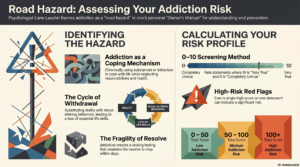
“A person becomes addicted when he or she chronically uses a mood altering substance or a behavior to cope with life, often neglecting health, relationships, and responsibilities, and feels unable to stop using despite the problems this behavior creates for themselves and/or others.”
How Addictions Create Problems
Problems from addiction build up over time in three ways:
- You use a substance or behavior to escape from reality and withdraw from life instead of facing reality and engaging with life to mature, grow, heal and learn new skills.
- You use a substance or behavior instead of taking care of emotions, relationships, health, responsibilities, finances, and spiritual self-development.
- You make negative choices related to using a substance or behavior—wasting money and time, placing yourself in unsafe or negative situations, taking safety and legal risks, neglecting your responsibilities and/or the people you love, and acting impulsively.
One day a light bulb goes on and you realize, “I need to use a substance or behavior less, only engage on this on weekends, or stop completely.” Unfortunately, when you become addicted this resolve usually weakens within a few days, and either you can’t quit or don’t try because you’re not sure you can—it’s a sinking feeling that leads back to using the substance or behavior.
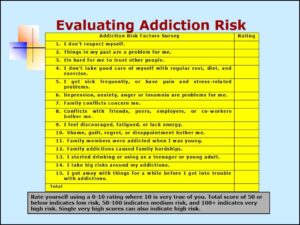
In working with many people struggling with addictions for many years, I developed the screening tool below that allows you to assess your personal addiction risk. Rate yourself on each statement using a 0-10 scale where 10 is Very True of You and 0 is Completely Untrue of You. A total scores of 50 or below suggests low addiction risk, 50-100 suggests medium addiction risk, and score 100+ suggests high addiction risk. However, a single very high score can indicate high risk.