
Navigate Your Own Path
March 17, 2026
Note: Tragically, there are situations in life where children and adults are victimized by others and have no control whatsoever in the situation, or ability to protect or remove themselves. The only power we have in those situations is to do everything in our power to heal, recover and move on as best we can.
This series on Creating Your Owner’s Manual focuses on your power to make deliberate and purposeful choices in life over those things you can control–specifically your decisions and actions. I introduced some of these concepts in previous series of posts including Transcending Family Trauma, Finding a Life Partner, and Purposeful Parenting Handbook, but I include them here because they assist you in navigating the terrain you cover during life. My name is Lane Lasater, a retired clinical psychologist. In gratitude for the life I have been given, I am sharing everything I learned during my career and personal life on my website http://www.LaneLasater.com and on my YouTube Channel Life Roadmaps from a Retired Psychologist https://www.youtube.com/@lane205
Each post contains my written material, an AI generated graphic, a 15-17 minute audio summary, and a 5-7 minute video summarizing the material.
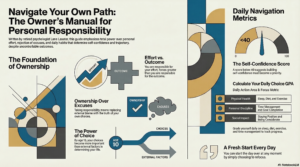
“You’re responsible for the effort and forces greater than you are responsible for the outcome.”
Anonymous
Take Responsibility for You
A critical opportunity and challenge in life is developing habits and policies that help you to purposefully create an environment in which you can thrive. The quote above is one of my favorites because it teaches me that my part is to do everything I can today with the resources and information I have, and leave the outcomes (which I don’t control) to forces greater than myself.
Too many times in life, I tried to make something happen. I told myself I had to have a relationship, land a certain job, or accomplish a certain goal. This approach left me filled with uncertainty and anxiety. Not surprisingly, things I sought to make happen often didn’t turn out the way I wanted. I realize looking back that when I did my best, even though the process had many more twists and turns than I could have anticipated, the outcomes were richer and more meaningful than what I thought I wanted.
Who takes responsibility for your life if you don’t? You know the answer—no one! When we don’t take responsibility, like a ship without a rudder, the wind and waves blow us off course. Sooner or later we find ourselves on the rocks. Family members and others do their best when we are children to get us going in the right direction, but by about age 10, our choices become more important than anything else in determining how life goes. It’s impossible to be 100% responsibile for oneself, but the more responsibility we can take, the better things generally are.
No Excuses
It’s tempting to make excuses and blame someone or something else for my problems and mistakes. We all do it! And, other people will do things that hurt and disappoint you. But, when I look closely, in many cases I see that I had often had some part in creating my difficulties. During this series, I ask you to focus on your choices and actions, not on what other people do. In later sections, I discuss how I can avoid putting myself in situations where I may be hurt or disappointed, and how to deal with difficult people and situations that I can’t avoid or escape. Most of us have plenty to do to keep our life on track. Improving yourself keeps you busy, so you don’t have to meddle in other people’s affairs. Here are frequent excuses and ways of blaming others we use and the common truths about the situation.
| Common Excuses | Truth |
|
|
| Common Ways of Blaming | Truth |
|
|
My Self Confidence
Taking responsibility means building my self-confidence. Then I don’t have to blame others or make excuses. When your self-confidence is good, you can go through your day feeling positive. You know you can handle whatever comes up. Self-confidence also helps you bounce back from disappointments. Lowered self-confidence shows up in ways like criticizing ourselves, perfectionism, and withdrawing. Many of us get afraid to try new things because we won’t be able to do them perfectly. Taking risks is an important part of confidence, because life regularly demands that we regularly try new things. Practice helps!
Rate your self-confidence on the following items where 0 = completely untrue of me, 2 = mostly untrue of me, 4 = moderately untrue of me, 6 = slightly true of me, 8 = mostly true of me, 10 = very true of me.
My Self-Confidence
- I’m able to change things needed to improve my life.
- I can forgive myself when I make mistakes.
- I can accept constructive feedback from people I trust.
- I’m can organize myself to get things done.
- I’m comfortable meeting new people.
- I’m able try new things comfortably.
- I do a good job on work at school or my job.
- How others see me matches how I feel inside.
- I’m compassionate with myself about how my life has developed.
- I feel hopeful about my future
Your Self-Confidence Score
Your scores can range from 0 to 100. A score of 40 or below suggest that building self-confidence needs to be a priority for you. If your score is between 40 and 70, you have moderate self-confidence. A score between 70 and 100 suggests that you have high self-confidence. On the inside we’re all the same because we’re human. Even if we feel confident today, we’ve all go through times of lowered self-confidence. Here are some tools to improve your self-confidence.
- If you have low or moderate self-confidence, the best thing to do is replace critical self-messages with positive self-talk. Find daily self-affirmations you like and use them every day. It really works!
- Push yourself outside of your comfort zone—even if you take small steps. Be more outgoing than you normally are, and practice sharing more about who you are on the inside.
- Be compassionate, Look squarely at the challenges you’ve faced in your life, know that many other people struggle with the same hardships, and understand that no matter what you face in your life, you can change your life for the better.
Positive Daily Action Choices
Daily actions either move us up to energy, satisfaction, happiness, and respect, or down to discouragement, regret, unhappiness, and rejection. We all take steps up and down, but as life goes on, hopefully, we learn to take more steps up, and fewer steps down. Two objectives of this series are to help you stop making things worse and start making things better. Weall know that our choices lead directly to finding ourselves in either positive or difficult situations. Negative action choices make it difficult for anything good to happen, yet positive action choices open the door for good outcomes. Here is a quick checklist to compute your daily choice GPA.
Your Daily Choice GPA
Give yourself a grade for your choices in each area for yesterday. Report your scores and your GPA for yesterday to the class
| Choices I Made Yesterday | My Grade | Computing My Choice GPA for Yesterday (A=4, B=3, C=3, D=2, F=1) |
| 1. Getting Enough Sleep | ||
| 2. Eating a Healthy Diet | ||
| 3. Exercising and Stretching | ||
| 4. Avoiding Tobacco, Drugs and Alcohol | ||
| 5. Using my Time Well | ||
| 6. Following Rules and Laws | ||
| 7. Staying around Positive People | ||
| 8. Getting my Work Done | ||
| 9. Being Considerate of People Around Me | ||
| 10. Meeting my Home Responsibilities | ||
| Total
(Add up numbers for 1-10 in Column 3) |
||
| My Choice GPA for Yesterday (Divide Column 3 total by 10 and enter here.) |
What was Your Choice GPA yesterday? If you did well–terrific! At the end of the day you feel good. If you didn’t make the best choices, you don’t end up feeling that great. The point is not to give youself a hard time. Nobody makes all good choices every day. Instead, make as many choices as you can that are right for you today. Compute your Choice GPA frequently, and try to raise your Choice GPA weekly. If you have a hard time making good choices in a specific life area, set up a personal action plan which I’ll cover later.
Life isn’t all or nothing. You get to make a fresh start every day. You can even start today over again when you need to. To do this, find a quiet place and take a few deep breaths. Say to yourself, “I got off track, so I’m letting myself start the day over. I’ll use the rest of the day to do things that I know are good for me.” It really works!