Creating Your Owner’s Manual
March 17, 2026
Introduction
This series of posts helps you develop a set of personal guidelines for your life that are specific to you. A critical task in life is understanding yourself, your strengths and limitations, and designing each dimension of your life in a way that helps you to be the best version of yourself.
I have discussed some of these concepts in previous series of posts and YouTube playlists including Transcending Family Trauma, Finding a Life Partner, and Purposeful Parenting Handbook, I add them here because they help you navigate the terrain you will encounter during life.
My name is Lane Lasater, a retired clinical psychologist. In gratitude for the life I have been given, I am sharing everything I learned during my career and personal life on my website https://www.LaneLasater.com and on my YouTube Channel Life Roadmaps from a Retired Psychologist https://www.youtube.com/@lane205
Each post contains my written material, an AI generated graphic, a 15-17 minute audio summary, and a 5-7 minute video summarizing the material.
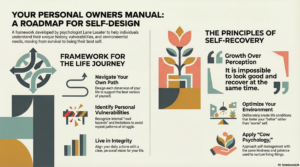
Creating the Best Environment for You
Here are the posts in this series to guide you in creating conditions where you can be at your best.
- Navigate Your Own Path
- Understand Your Deepest Needs
- Accept Your Vulnerabilities
- Inspect Your Life Foundation
- Create Your Life Vision
- Develop Your Entrance Exam
- Familiarize Yourself with Addictions
- Make Friends with Change
- Face Problems Squarely
- Follow Life Management Wisdom
- Maintain Resilience
- Help and Encourage Others
- Live in Integrity
Learning the Hard Way
As I described in my posts under the heading of Transcending Family Trauma, I arrived at adulthood not well prepared for life. I was emotionally and relationally handicapped through painful childhood experiences in my troubled family system. No one deliberately hurt me, in fact the opposite was true–my parents gave me everything they had and did their best to give me a good start in life. Unfortunately, I was profoundly affected by intense family conflict at home, by my own failed attempts to change things in my family, and by starting first grade too early (age 5), which positioned me behind the curve in maturity and learning readiness all the way through college. I learned to cope but lived in a constant state of anxiety and self-doubt and wasn’t able to understand the relevance of what I was being taught in school. When I took my first drink of beer at age 18 in Colorado, I felt “whole” for the first time, and went on drinking until I blacked out. I now recognize I was an instant alcoholic.
I had the good fortune to work as a psychiatric attendant after college where I discovered psychology and made the decision to pursue it as a career. When I started graduate school, I was finally fully motivated and hungry to learn everything I could about the field. I also recognized that I was unhappy and sought professional help. The counselors I saw were very kind people and helped me understand more about myself and my troubled family, but no one understood addiction and never suggested that I needed to stop drinking. In my mind, alcoholism meant a skid row drunk, so I didn’t think it applied to me. I just wanted to be a social drinker even though I never had been able to drink responsibly. Thankfully, I got to Minnesota at the end of my psychology training. When I saw a counselor there, he recognized almost immediately that I was an alcoholic and suggested I stop drinking. With much help from him and many other people, I haven’t had a drink since that day. Over the next several years, I was able to heal from my unfinshed emotional business from childhood and finally had a solid foundation for my work, for finding a life partner, and starting a family.
Learning Psychology from the Ground Up (Slowly)
Growing up on a cattle ranch, the only time I heard the term “psychology” was in the phrase “cow psychology,’ which referred to how to herd cattle by approaching them from a diagonal to which they would respond by moving in the direction you wanted them to go. My Father was amazingly knowledgeable about managing cattle and horses, always treating them with kindness and patience, and teaching each cow or bull on the ranch to eat out of your hand at weaning. The result was that the cattle were very gentle and you could approach them in the pasture and they would come up to greet you. As children, we knew and named many individual cows and bulls throughout their lives, My Mother was a consummate people person who knew how to nurture and sustain. She knew everyone by their first name, and would even pick up hitchhikers sometimes bring them home–much to my Father’s consternation. After I was privileged to heal from childhood traumatic experiences, I finally came to treasure all the lessons they taught me. I found that “cow psychology” applies quite well to people also, and I would visualize how my mother would care for the people who came to me for help.
I had a great deal of catching up to do in discovering how to create an environment where I could be my best self. The process was not pretty but I gradually learned to create a life and relationships that helped me be my better rather than worse self. In summarizing the experiences, I recognized that “It’s impossible to look good and recover at the same time.” I had to accept that I am a slow learner and work around my limitations and vulnerabilities. I describe a number of the lessons in this series of posts and hope it may be helpful to you as you learn and grow.
Creating Your Owner’s Manual Video
Disclaimer
This website is designed to give you information to help you be successful in your life decisions and relationships. The information and suggestions provided are for the reader’s education and consideration only. Providing information and practical tools to you about personal and relationship challenges and solutions does not constitute the practice of psychotherapy or medicine. Lane Lasater, Ph.D. has taken care to alert you to serious warning signs and encourage you to seek licensed professional help when indicated. The information provided here is not a substitute for assessment, diagnosis and treatment of any mental disorder and cannot substitute for the services of a mental health care professional or physician. It is intended for instructional purposes only. The use of this information is solely at your own risk.
Trigger and Content Warning: Please be aware that the website includes descriptions of trauma, PTSD, child abuse, alcoholism, family violence, drug addiction, sexual addiction, compulsive behavior patterns including overeating, bulimia, sexual abuse, depression, disability, divorce, anger, sex, and terminal illness which could disturb or trigger upsetting memories for certain readers.
Lane Lasater, Ph.D. shall have no liability for claims by, or damages of any kind to, a user of this information. Such damages include, without limitation, damages for personal injuries, emotional distress, and other non-monetary loss, as well as direct or indirect damages. I have made all reasonable efforts to include accurate information to you but make no warranties or representations as to its accuracy, completeness, or timeliness. Lane Lasater, Ph.D. assumes no liability or responsibility for any errors or omissions in the content of this written and electronic work. To the full extent permitted by law, we disclaim all warranties, express or implied. By using the information on this website, you are agreeing to the provisions of this disclaimer, and you waive all claims that may arise in connection with your use of this information and understand that you use this information at your own risk.