
Guideline #13: Help Each Child Build a Life Foundation
February 16, 2026
Before a young person can meet the challenges and responsibilities of adulthood, they need to mature and develop the essential self-knowledge and skills required in the adult world. A strong start on this learning provides the foundation for success in each area of adult life.
This post is from my book Purposeful Parenting Handbook: Guidelines for Raising Capable, Confident, and Accountable Children
My name is Lane Lasater, a retired clinical psychologist. In gratitude for the life I have been given, I am sharing everything I learned during my career and personal life on my website http://www.LaneLasater.com and on my YouTube Channel Life Roadmaps from a Retired Psychologist https://www.youtube.com/@lane205
Each post contains my written material, an AI generated graphic, a 15-17 minute audio summary, and a 5-7 minute video summarizing the material.
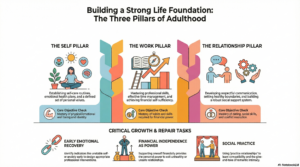
The Life Foundation
To illustrate the preparatory tasks each human being needs to accomplish, I use the image of three developmental pillars forming our life foundation— self, work, and relationships. These pillars encompass multiple developmental tasks we make progress on throughout childhood, as adolescents and emerging adults. Development of these dimensions then continues less dramatically throughout the rest of life.
Monitoring each child’s life foundation and support system (and making repairs as needed) is an essential step in preparing your children for independence and successful adulthood. There’s much to consider in this chapter, so you can revisit it periodically to identify progress and potentially needed resources for each child.
Some of us (me included) had much repair work to do on our life foundations during early adulthood. I had to invest time and effort (including therapy) before I had my foundation mostly in place at age 31, and was ready to form a life partnership.
Below I list essential tasks for each of life foundation pillars. You can use these lists to assess each child’s developmental progress periodically on their journey to independence.
Self-Development Tasks (SDTs)
The five self-development tasks below involve each child learning and incorporating self-care routines for physical and emotional well-being. Note that SDTs 1 and 2 refer to developing a recovery plan, if needed, for emotional challenges such as unstable self-worth, difficulty trusting, PTSD, or addictions.
In light of the public health approach to parenting I described earlier, I encourage you to recognize and design appropriate interventions as soon as possible, if needed, including seeking appropriate professional help.
SDT 1: Develop a recovery plan, if needed, for emotional challenges resulting from childhood experiences or later events.
Your child may need a recovery plan and possibly professional help if they encounter traumatic events during childhood. If left unaddressed, such experiences may continue to affect them throughout adulthood. The following are common indicators that can stem from traumatic experiences.
- Unstable self-worth
- unresolved emotions
- difficulty trusting
- depression
- anxiety
- anger
- post-traumatic stress disorder (PTSD)
SDT 2: Develop a recovery plan, if needed, for addictions. You child may need professional help if they struggle with an addiction, including:
- alcohol and drug abuse
- compulsive internet or social media use
- pornography
- over- and under-eating and bulimia
- compulsive sexual behavior
- compulsive spending,
SDT 3: Develop and practice a daily plan of diet, rest, exercise, and self-care to maintain your energy, health, and well-being.
Throughout childhood, we help each child to identify and balance fitness, dietary, and self-care needs. Establishing healthy habits and routines helps them optimize health and level of functioning for the rest of their life.
SDT 4: Define and practice interests and hobbies, personal spiritual/religious beliefs and practices, and political/ethical values and affiliations.
Throughout childhood, we guide each child as they try out different sports, hobbies, recreational activities, intellectual interests, spiritual practices and beliefs, and friendships. These trial patterns gradually solidify into adult identities.
Some of us grow up with a spiritual/religious tradition and political/ethical values that we embrace and make our own. Others don’t fully accept the traditions and values (or absence thereof) they grew up with and develop alternative beliefs, values, and practices. Following the principle of parental influence vs. control, ideally, we model our values and practices as our children grow up, giving each child opportunities to try these out and choose a pattern that is right for them
SDT 5: Define your economic and social aspirations, lifestyle, and geographic preferences, and begin to decide whether one wishes to have and raise children.
By early adulthood, each child has gradually defined their aspired economic level, social status, lifestyle, culture and climate where they wish to live.
Work Development Tasks (WDTs)
Beginning with carrying out one’s family job description covered earlier in the book, and through family or neighborhood jobs, children build work habits and skills that will serve them throughout life. These tasks prepare each person to ultimately discover fulfilling work that can fund their desired adult lifestyle. The ability to support oneself financially is an essential aspect of personal power in relationships because it gives one the option to leave an unhealthy relationship if needed.
WDT 1: Master the tools and experience required in the workplace using the mechanical, technical, writing, speaking, digital, and soft skills necessary to perform and advance in your field.
WDT 2: Organize your time and effort effectively to accomplish home, college or job duties.
WDT 3: Work cooperatively with others, including accepting direction, receiving performance evaluation, resolving work conflicts, and participating in diverse work teams.
WDT 4: Choose a career interest through job and life experiences and plan and complete (or undertake) education and/or training that provides a satisfactory career path.
WDT 5: Manage your money to support oneself and dependents, maintain a home, afford your chosen lifestyle, build a positive credit history, and establish savings for unexpected events, emergencies and retirement.
Relationship Development Tasks (RDTs)
These relationship development tasks prepare a child for future intimate partnership as well as satisfying friendships and work relationships.
RDT 1: Listen to and respond respectfully to others and communicate your ideas, feelings, and needs.
RDT 2: Practice courtesy, maintain appropriate personal boundaries, and learn to resolve conflict fairly.
RDT 3: Learn to be self-reliant and to live alone while widening your friendship circle, planning and carrying out satisfying social and recreational activities, and building a social support system.
RDT 4: Learn the social and dating skills for romantic and sexual relationship interactions and discussing intimate topics and needs.
RDT 5: Participate in practice relationships to understand the give and take between romantic partners, recognize another person’s intimate needs, gain insight into compatibility, and learn to resolve intimate conflicts.