
Guideline #15: Apply the Stages of Behavior Change to Family Growth
February 16, 2026
We now understand clearly the process of how to change behavior patterns. Prochaska and DiClemente first described this while studying cigarette smokers trying to quit. Understanding exactly how people change empowers us, and each step we make toward change becomes a waypoint on the journey toward our family goals. The stages of behavior change offer a clear map for parents and children during the process of family growth and adjustment as you replace emotional and behavior patterns that no longer work for you.
This post is from my book Purposeful Parenting Handbook: Guidelines for Raising Capable, Confident, and Accountable Children.
My name is Lane Lasater, a retired clinical psychologist. In gratitude for the life I have been given, I am sharing everything I learned during my career and personal life on my website http://www.LaneLasater.com and on my YouTube Channel Life Roadmaps from a Retired Psychologist https://www.youtube.com/@lane205
Each post contains my written material, an AI generated graphic, a 15-17 minute audio summary, and a 5-7 minute video summarizing the material.
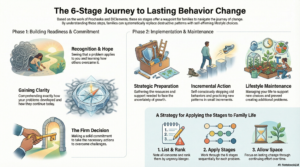
The Seven Stages of Behavior Change
- Recognition happens when you see that a problem or set of problems applies to you.
- Hope develops when you learn how other people have overcome similar problems.
- Clarity occurs as you comprehend exactly how your problems developed and how they continue.
- Decision is your firm commitment to take the actions necessary to overcome these challenges.
- Preparation involves gathering the resources and support you need to face the losses, confusion, and uncertainty required for growth and change.
- Action takes place over a long period and in small increments as you self-consciously stop old behavior and practice new patterns of action.
- Maintenance requires managing your life to support your new self-affirming lifestyle and choices and not creating additional problems.
As we go through the process of family growth, it’s helpful to list each problem or concern we face, then rank them in terms of how urgent that concern is. Then we apply these stages sequentially to each problem (or sub-problem) we face, beginning with those challenges that are most destructive or dangerous, and then progressing to the next on the list. We can also work simultaneously on more than one concern, but it is important to allow yourself time and space because lasting change cannot be accomplished without continuing effort.