Inspect Your Life Foundation
March 22, 2026
A useful exercise to keep your Personal Owner’s Manual up to date is to regularly monitor the three systems that you underpin full adult functioning–Self, Work, and Relationships. Operating efficiently in the increasingly complex world we live in requires mastering specific skills and updating them as life progresses. Ideally, most people are well on their way in building these skills by their early to mid-twenties. For me, and others who experienced basic human need frustration, trauma, and other impediments to development, our progress is delayed. For me, it was not until my early 30s that I had these systems relatively well in place. I gradually learned to be compassionate with myself and accept that I wasn’t able to complete these tasks on a faster timeline. Most of us do the best we can, but if you are behind your expected developmental timetable, be kind to yourself and move forward the pace that is realistic for you.
My name is Lane Lasater, a retired clinical psychologist. In gratitude for the life I have been given, I am sharing everything I learned during my career and personal life on my website http://www.LaneLasater.com and on my YouTube Channel Life Roadmaps from a Retired Psychologist https://www.youtube.com/@lane205
Each post contains my written material, in AI generated graphic illustration, a 15-20 minute audio summary, and a 5-7 minute video summary.
Three Life Pillars
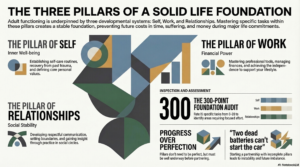
A solid foundation is essential for the responsibilities of long-term partnership and career commitments. To illustrate the preparatory tasks we need to accomplish, I use the image of three developmental pillars forming our life foundation— self, work, and relationships. These pillars encompass the multiple developmental tasks we make progress on through early adulthood then continue less dramatically throughout the rest of life.
Regularly inspecting your life foundation (and making repairs or adjustments as needed) prepares you to accomplish your major life tasks in each of these areas. If your foundation is already solid—great! But some of us (me included) had much work to strengthen our life foundations. I had to invest time and effort (including therapy) before I had my foundation mostly in place at age 31.
Self-Development Tasks (SDTs)
The five self-development tasks below help you establish and practice self-care and routines for your physical and inner well-being. Note that SDTs 1 and 2 refer to developing a s unstable self-worth, difficulty trusting, PTSD, or addictions. Undertaking recovery from these issues is a complex process which I describe in depth in my book Transcending Family Trauma: Your Essential Guide to Lifelong Recovery from Adverse Childhood Experiences and Their Adult Aftermath. That book outlines the process and resources of recovery that enabled me to stop drinking permanently and to make peace with emotional issues derived from childhood experiences.
SDT 1: Develop a recovery plan, if needed, for emotional challenges resulting from childhood experiences or later events. You need a recovery plan and possibly professional help if you’re facing problem emotional adjustments resulting from childhood or adult experiences, including relationship breakups or divorces, other losses, traumatic events, and unemployment. Childhood traumatic events can continue to affect us throughout adulthood until we learn to face and overcome them with professional help and using the resources and information of self-help groups. The following are common indicators that stem from traumatic experiences.
- unstable self-worth
- unresolved emotions
- difficulty trusting
- depression
- anxiety
- anger
- complex post-traumatic stress disorder (PTSD)
SDT 2: Develop a recovery plan, if needed, for addictions.
- You need a recovery plan and possibly professional help if you’re struggling with an addiction, including:
- alcohol and drug abuse
- over- and under-eating and bulimia
- compulsive sexual behavior
- compulsive spending, and
- compulsive gambling
SDT 3: Develop and practice a daily plan of diet, rest, exercise, and self-care to maintain your energy, health, and well-being. Identify and balance your fitness, dietary, and self-care needs. Establishing firm patterns and routines can help optimize your health and level of functioning for the rest of your life.
SDT 4: Define and practice interests and hobbies, personal spiritual/religious beliefs and practices, and political/ethical values and affiliations.
SDT 5: Define your economic and social aspirations, lifestyle, and geographic preferences, and decide whether you wish to have and raise children. Be clear about your desired economic status, social status, and lifestyle, and the culture and climate you wish to live in.
Work Development Tasks (WDTs)
These tasks are building blocks to achieve fulfilling work that can fund your desired lifestyle. Being able to support yourself financially is an essential aspect of personal power in relationships because it gives you the option to leave an unhealthy relationship if you need to.
WDT 1: Master the tools and experience required in the workplace using the mechanical, technical, writing, speaking, digital, and soft skills necessary to perform and advance in your field.
WDT 2: Organize your time and effort effectively to accomplish home, college or job duties.
WDT 3: Work cooperatively with others, including accepting direction and performance evaluation, resolving work conflicts, and taking part in diverse work teams.
WDT 4: Choose a career interest through job and life experiences and plan and complete (or undertake) education and/or training that provides a satisfactory career path.
WDT 5: Manage your money to support yourself, maintain a home, afford your lifestyle, build a positive credit history, and establish savings for unexpected events or emergencies.
Relationship Development Tasks (RDTs)
These relationship development tasks prepare you for long-term intimate partnership as well as satisfying friendships and work relationships.
RDT 1: Listen to and respond respectfully to others and communicate your ideas, feelings, and needs.
RDT 2: Practice courtesy, maintain appropriate personal and professional boundaries, and learn to resolve conflict fairly.
RDT 3: Learn to be self-reliant and to live alone while widening your friendship circle, planning and carrying out satisfying social and recreational activities, and building your social support system.
RDT 4: Learn the social and dating skills for romantic and sexual relationship interactions and discussing intimate topics and needs.
RDT 5: Take part in practice relationships to understand the give and take between romantic partners, recognize another person’s intimate needs, gain insight into compatibility, and learn to resolve intimate conflicts.
Assess Your Life Foundation Developmental Tasks
For each of the 15 life development tasks above, rate your progress from 0 to 20, where 0 = little accomplished, 5 = some tasks begun but recognize the need for progress, 10 = some tasks accomplished, 15 = most tasks accomplished, and 20 = fully accomplished. (Note: for the SDT 1 and 2 “if needed” items that don’t apply for you—rate yourself a 20.)
Understanding Your Scores
The maximum score for each pillar of your life foundation is 100, and it’s 300 for all three pillars. These scores are a snapshot of your developmental foundation and let you identify life areas that require more focused effort. You won’t (and don’t need to) fully complete each task before starting a life partnership, but it’s important you and your potential partner have these tasks well underway.
Building your life foundation takes concentrated time and energy, so if you need more time to solidify or repair (if needed) your life foundation, that’s fine. As I mentioned earlier, I needed repair work on my self pillar and wasn’t ready for a long-term partnership until I was 31.
Solidify your foundation now because bypassing this won’t work and costs time, suffering, and money later. We can of course improve ourselves at any age, but if you and a partner start a life partnership with one or more foundation pillars substantially incomplete, it throws the couple-ship off balance and won’t provide stability for the path ahead. Tongue-in-cheek conventional wisdom states, “Two dead batteries can’t start the car.” If you aren’t yet in a life partnership, as you solidify your life foundation, it’s reasonable to expect that your future partnership candidate is working just as hard to solidify his/her life foundation (even though you haven’t met them yet, and although they may not be thinking about it in this way). When the time comes, you’ll look for a person with a reasonable (not perfect) life foundation.
Analyze Your Life Foundation
An example of my foundation scores and analysis immediately follow these instructions.
Analyze your scores and progress for each pillar and your total life foundation score.
- Note the tasks (if any) you need to focus
- Set clear goals and identify specific, manageable action steps you’ll take for each task that requires more work (if needed).
- What additional information or resources do you need (if any) to move forward?
My Life Foundation Scores and Analysis
Here is my life foundation analysis at age 31 (from today’s perspective).
Life foundation scores: Self = 65; Work = 80; Relationship = 80; Total score = 225.
Self: I needed a complete recovery plan for childhood emotional adjustments and alcohol abuse. To accomplish this, I needed therapy, alcohol rehab, and self-help support. Although I understood a lot about myself, from today’s perspective, stopping drinking was the key to making progress in recovery from my childhood emotional challenges.
Work: My professional life was going well, but when I stopped drinking, I was finally living in integrity. Rather than facing a professional decline or disaster from alcoholism, I could now progress further in my professional sphere.
Relationships: I felt mostly prepared for a committed partnership. I learned from my relationship field research what couple combination worked best for me and discovered during our partnership trial run that I needed to improve my relationship problem-solving and communication skills.