
Guideline #19: Balance Family Power and Responsibility
February 18, 2026
Ideally, you’ll create a partnership embodying a suitable balance of power and responsibility. You and your partner negotiate fair and mutually beneficial sharing of responsibilities, roles, decision-making, and effort toward common goals.
This is an excerpt from my book Purposeful Parenting Handbook: Guidelines for Raising Capable, Confident, and Accountable Children.
My name is Lane Lasater, a retired clinical psychologist. Each post contains my written material, an AI generated graphic, a 15-17 minute audio summary, and a 5-7 minute video summarizing the material.
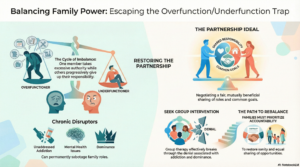
Critical Parent Coping Skill #3: Balance Family Power and Responsibility
As your children grow up, you naturally include them in family decision-making and also expect that they contribute time and effort to making the family enterprise run smoothly.
Overfunction/Underfunction
But power and responsibility sometimes get out of balance in families. This is known as “overfunction/underfunction,” when one family member takes on more and more responsibility and authority in the family, while other family members progressively give up or abdicates responsibility and authority.
When you created job descriptions for each parent and child, this ideally created a balanced system where responsibility and authority are shared appropriately.
It is natural that during the course of life, one or more family members will become vulnerable through illness, injury, surgery, job setbacks, etc. In these instances, it’s perfectly natural for the vulnerable person to depend heavily on other family members for a time. Many parents also accept the adjustments necessary when a child is born with or develops a disability and the family accommodations this requires.
When Overfunction/Underfunction Becomes a Problem
For other families, power and responsibility become quite unbalanced over time as the result of having children, changes in job responsibilities, addictions, mental health challenges such as depression or anxiety, or unemployment. And the overfunctioning parent may takes on excessive power and responsibility and the underfunctioning parent becomes more dependent, both people become increasingly dissatisfied. The overfunctioning person often feels exhausted, overwhelmed, and resentful, and the underfunctioning person feels dominated, resentful, disempowered, incompetent, and rebellious.
In family situations where one parent is highly dominant and controlling and the parent less so, the less dominant partner may gradually relinquish his/her decision choices and power and as a result feel trapped and unable to challenge the dominant partner. In domestic abuse situations, the dominant partner’s unacknowledged insecurity drives over-controlling, intimidating, and violent behavior toward the partner. The dominated person often becomes isolated from his/her support system and becomes unable to walk away from the partner even though facing significant abuse, physical danger, and risk of death.
The same thing can happen with children. If one or both parents over-protects or under-protects a child, he or she may fail to learn the necessary skills and responsibilities to prepare for adulthood, or may take on more responsibility than they are prepared for, with the result that they arrive at adulthood with a distorted sense of self and inability to withdraw from responsibility. I discuss the impact of troubled family systems on children in great depth in my book Transcending Family Trauma on Amazon and YouTube series on Transcending Family Trauma.
In cases of overfunction and underfunction where addiction is involved, as the illness progresses, the addicted person gives a substance or addictive behavior priority over everything else, including relationships, responsibilities, health, and personal values. These choices sabotage intimate relationship responsibility and participation. In psychology practice, I found that one member of a family often sought help because their partner or child was addicted, depressed, anxious, or otherwise disabled, and they couldn’t count on that person to meet his/her responsibilities, which resulted in conflict and unhappiness.
Depending upon how far the dominance or addiction has progressed, it’s often necessary for both the suffering person and his/her partner to seek specialized domestic violence or addiction treatment to start personal recovery. Both these behavior patterns are best addressed in group therapy situations rather than individually because the group has the objectivity and power to break through the defensiveness and denial that accompany both domestic violence and addiction.
Over time, with information and support, families can often rebalance their relationships back to the equal sharing of responsibilities and opportunities to look after themselves and have fun. If a person who is over-controlling, violent, or addicted or suffering from another disabling condition is unwilling to get help, it leaves the family with the tough decision about how to restore sanity to the household.