
Guideline #20: Use Strategic Parental Communication
February 17, 2026
Once you and your co-parent (if applicable) agree on your priorities and intervention options, you face the challenge of carrying these out. Parental influence is a powerful tool when used wisely. The challenge is you don’t control children’s choices so you have to use strategic communication tools and policies.
This is an excerpt from my book Purposeful Parenting Handbook: Guidelines for Raising Capable, Confident, and Accountable Children. My name is Lane Lasater, a retired clinical psychologist. My website is www.LaneLasater.com
Each post contains my written material, an AI generated graphic, a 15-17 minute audio summary, and a 5-7 minute video summarizing the material.
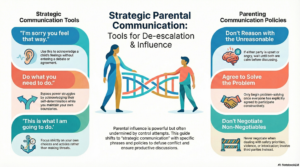
Critical Parent Coping Skill #4: Strategic Parental Communication
First, the good news:
- If you are co-parenting, two wills are more powerful than one child.
- If you are single parenting (or co-parenting) and focused on what is good for your family, you have right and reason on your side.
- Most children and teenagers care what their parents (or parenting figures) think and want, regardless of what they say or how they act.
- Even if your child is angry with you, apologizing and taking responsibility for your mistakes can start things going in the right direction.
- You’re not alone. Insights, experience and support from other parents and adults are important resources.
And now the challenges:
Children and teenagers are naturally programmed to become independent of you. Part of this quest for independence involves challenging your values (even though this is often temporary).
- Parent attempts at control often create rebellion and harden a child’s quest for autonomy. This is a good reason to focus your most powerful actions on non-negotiable priorities, and leave negotiable preferences for family problem solving discussions.
- You have to pit the strength of your internal stamina against the strength of your child’s will while simultaneously respecting his/her autonomy and avoiding power struggles.
- When you take a stand, your child is going to test you, and may call your bluff—so you have to be prepared to follow through.
- Children and teenagers have their own support systems that may pull them in the opposite direction of what you are trying to accomplish.
Strategic Parental Communication Tools
The following strategic communication tools help you avoid provocations, defuse confrontations, and avoid power struggles. For each tool, write down when and how you might constructively apply it in your family.
“I was wrong in what I did or said.” Clean up your side of the street without asking anything from your child. This models mature adult behavior.
“I love you no matter what.” I love you and will do my best to do what I think is best for you, even if you don’t see it that way. (This is not a discussion but a statement.)
“I’m sorry you feel that way.” When a child says something provocative—attacks you personally, uses a nuke, attacks something you hold dear like your religious faith, or some other important value, respond with “I’m sorry you feel that way.” This sends the following messages without entering an argument:
- I heard you.
- I don’t agree with you but we can agree to disagree
- You have a right to your opinion.
- I don’t have to change your opinion.
- I can still be OK without your approval; and
- I ‘m not going to debate you.
- “Do what you need to do.” When you take a stand, frequently a child or teen will test you by stating his/her intent to do the opposite of what you want. “Do what you need to do” acknowledges their self-determination, but bypasses trying to control them. If they can hook you into an escalation, they don’t have to take responsibility for the choice they make.
- “I understand what you did or are going through because I’ve done the same thing.” From time to time, share poor decisions you have made in life, so your children know you aren’t claiming to be perfect.
- “This is what I am going to do.” Talk about your choices, not theirs, without threats. Examples
- I’ll give you a ride to your friend’s house when you finish your chores.
- “We are unwilling to live in an environment where we don’t feel safe, so we (I) will call the police if you or another family member acts or threatens to act violently. I expect you to call the police if I act violently.”
Parenting Communication Policies
These policies remind us of things that seem obvious, that we often forget in the heat of the moment.
“Don’t reason with people who aren’t reasonable” and “Don’t try to reason when you’re not reasonable.” When we try to reason with someone who is not reasonable because they’re upset, angry, or just not ready to reason, we fail. Usually, something more negative happens instead. So, if we, or the person we’re trying to talk to isn’t reasonable, wait until they or we are before starting a discussion. If the situation is out of control, call in people trained, equipped and authorized to intervene like, counselors, police or medical personnel.
- Start solving problems when everyone involved has agreed to solve the problem. This is a variation of number one. If anyone in the discussion still feels unreasonable, or if anyone in the discussion hasn’t decided he or she is willing to participate, problems get created rather than solved. A counselor or neutral third party may help, but the first task for discussion is getting everyone to agree they are willing to have a constructive discussion, and what the ground rules are. Then problem solving can proceed.
- Don’t negotiate with people who aren’t able to negotiate. When you’re dealing with non-negotiable family priorities, the time for discussion is over and it’s time for action. Don’t negotiate with a person threatening violence, a person threatening suicide, or someone intoxicated on drugs or alcohol, mentally ill, or otherwise incapacitated. Bring in neutral third parties with the appropriate training, equipment and authority to intervene until safety is restored.