
Guideline #12: Control You and Influence Your Children
February 16, 2026
Responsibility is a critical ingredient for creating a healthy family. When you take full responsibility for your part (both positive and negative) in any family challenges you face, this prepares you to learn skills you need, and move toward being the parent you want to be.
This post is from my book Purposeful Parenting Handbook: Guidelines for Raising Capable, Confident, and Accountable Children
My name is Lane Lasater, a retired clinical psychologist. In gratitude for the life I have been given, I am sharing everything I learned during my career and personal life on my website http://www.LaneLasater.com and on my YouTube Channel Life Roadmaps from a Retired Psychologist https://www.youtube.com/@lane205
Each post contains my written material, an AI generated graphic, a 15-17 minute audio summary, and a 5-7 minute video summarizing the material.
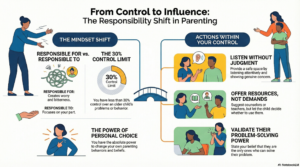
Being Responsible To Your Children
In parenting children who have reached middle school and beyond, it’s important to be Responsible To them, not become Responsible For them.
The difference is very important. If you are responsible for someone, on a scale of 0-100, how much control do you have over someone else’s problem? Usually the answer is some—but less than 30% unless you are dealing with a young child. So, if you are responsible for them, it means you have reason to worry—there’s no way you can control their behavior. If you try, it won’t work except to make you miserable, and probably make them bitter.
What does it mean if you are responsible to a child you parent? It means you are responsible to do your part. What is under your control when you parent a middle or high school child?
- You can listen attentively without judgment.
- You can show them you care and are concerned.
- You can offer suggestions (if they want them)—but it is up to them if they follow them or not.
- You can suggest resources they may use—like counselors, teachers, religious leaders, and service agencies.
- You can support them as they take action to solve their problem.
- You can tell them what you will do (I don’t mean threats—more on this later).
- Most importantly, you can state your belief in their power to solve their problem—no matter what it is. They are the only person in the world who can truly solve it.
The Choice is Yours
There are many pitfalls to being the kind of parent we want to be. Many of us find ourselves doing and saying things as parents that we resolved as children or teenagers we would never do. Parenting challenges and opportunities will be part of your life as long as you are involved in supervising young people. If you make your choices carefully, you can overcome each parenting challenge you face. This gives you great freedom and happiness. No matter what parenting difficulties you face today, or in the future, you can overcome them. You can also benefit from the experiences of other parents.
The goal of this handbook is to help you make positive parenting choices supporting what you value. You can replace negative parenting behaviors with positive behaviors. Do you have the power to change and improve your parenting? Absolutely! Are things always going to go the way you want? No–but that’s the way life is.
The biggest barriers to being the parent you want to be are often within yourself. Faulty beliefs about ourselves or the children we care for create problems for most of us. Our beliefs can become muddied through our own childhood experiences. So, sometimes we have to correct faulty beliefs and gain a clear picture of both our children and ourselves. Beliefs have to be based on reality. We all have beliefs that are not based in fact. An example of a true belief is–if someone uses drugs, this is likely to create problems. This is true. It does not mean it will happen the first time a person uses drugs, but if they continue to use, problems will come their way.