
Guideline #11: Develop Family Job Descriptions
February 15, 2026
As you guide children through the first few years of life, take the opportunity to continually teach them about how the world works. Everyone, starting the parents, has specific responsibilities—even if these aren’t written down anywhere. In an earlier posts, I suggested that you practice and teach each child about the guidelines for effective family communication. These are example of a family member responsibility. I suggest developing a family agreement that makes clear each person’s responsibilities in the family, as well as the benefits and consequences resulting from meeting or not meeting these responsibilities.
This post is from my book Purposeful Parenting Handbook: Guidelines for Raising Capable, Confident, and Accountable Children.
My name is Lane Lasater, a retired clinical psychologist. In gratitude for the life I have been given, I am sharing everything I learned during my career and personal life on my website http://www.LaneLasater.com and on my YouTube Channel Life Roadmaps from a Retired Psychologist https://www.youtube.com/@lane205
Each post contains my written material, an AI generated graphic, a 15-17 minute audio summary, and a 5-7 minute video summarizing the material.
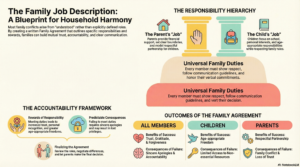
Develop an Agreement about Family Responsibilities
Family members frequently get off the track in fulfilling their responsibilities. This happens because most families don’t sit down and agree what their job descriptions should be in the first place. This post suggests the major responsibilities family members have. You may not agree with all these responsibilities, and you can revise them if you desire. My experience teaches me that these work well for most families. Ultimately, parents (or parent figures) make the final call about family responsibilities. When you have family responsibilities defined, you ask each family member to be responsible for doing his or her part in the family.
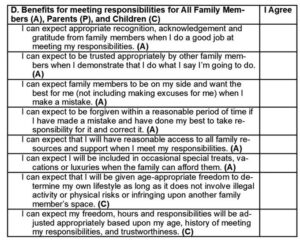
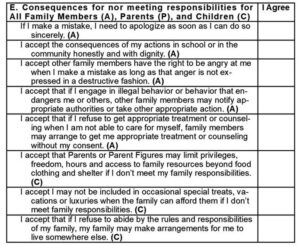
This family agreement makes clear each person’s responsibilities in the family, as well as the benefits and consequences resulting from meeting or not meeting these responsibilities.
We’re all familiar with “job descriptions.” We follow job descriptions throughout life. When we fulfill our job description at work, or in a family or community role we hold, we receive specific benefits and consequences that go with the job description. Benefits at a job include being paid, receiving health insurance, vacations, etc. An unwritten part of benefits we receive is often receiving recognition, or appreciation. In community or volunteer roles, sometimes the biggest benefit we get is the satisfaction of knowing we did the right thing, like helping people who’re vulnerable or need assistance.
Work or community consequences when we don’t fulfill a job description may include being corrected, put on probation, or fired. Consequences when we don’t meet our responsibilities at home often include other family members being disappointed or angry, family conflict, losing privileges, losing trust, having to live somewhere else, or divorce when adults are involved. If we’re doing our best to meet a job description but have trouble accomplishing it, we may have to renegotiate the job description, or ask for guidance, assistance, or counseling to figure out how to get it done.
Written versus “Understood” Job Descriptions
Some job descriptions are written, and some are “understood.” A simple example of an understood job description is when a neighbor a pre-teen to wash her car. They agree on when he/she will wash it, and how much she will pay you. You wash the car and she pays you.
The “understood” job description in goes something like this:
Bring out soap, bucket, sponge, window cleaner and paper towels.
- Hook up the hose and turn on the water.
- Spray the car with the hose to get off major dirt.
- Put soap and water in the bucket and sponge the car off, being careful not to scratch the finish.
- Rinse the car off with the hose, wipe it with a chamois or towel to remove spots, and let it dry.
- Use window cleaner and paper towels to clean the windows inside and out, being careful to wipe off any streaks.
The challenge with “understood” job descriptions in families (and elsewhere) is that people frequently have different “understandings” about responsibilities, benefits and consequences. Then challenges and conflict arise.
I don’t expect you to know completely how to meet all your family responsibilities today, but once they are clear, it gives you clear goals to strive for. When everyone does his/her best to meet family responsibilities, things start to change for the better.
Below, I offer the following:
- Suggested job descriptions that apply to all family members.
- Suggested family job descriptions for parents (or parent figures) with middle and high school age children, and
- Suggested family job descriptions for middle and high school age children.
- Suggested benefits and consequences for each family member depending upon whether he/she fulfills their family job descriptions.
Defining Family Job Descriptions
Go through family job descriptions below that apply to you, and put a check by each element of the job description, family benefits and consequences you agree with. All Family Members (A) applies to everyone. Parent (or Parent Figure) (P) applies to adults in the family. Middle and High School Age Children (C) applies to children who live at home. So, parents do A and P, and children do A and C. Remember parents (or parent figures) have to make the final decisions on job descriptions. Once everyone’s job description, benefits and consequences are clear, you have a Family Agreement (FA).
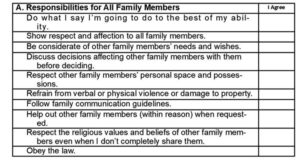
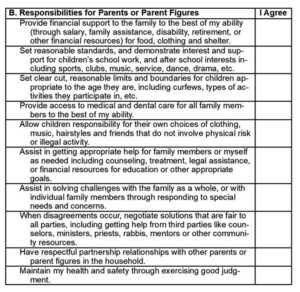
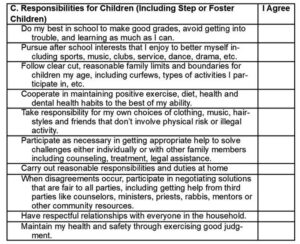
Family Benefits and consequences below are labeled A, P and C. Check each benefit and consequence applying to you that you agree with.
Finalize Your Family Agreement
Follow the eight steps below to finalize your Family Agreement.
- Review the job description for each member of the family and note any disagreements they may have.
- Write down any suggested additions you have to family job descriptions, benefits or consequences and indicate which section from these go with.
- For each item a family member disagrees with, that member explains their reasons for disagreeing. Other family members ask questions and comment (non-judgmentally) on their response to the reasons given.
- If differences of opinion can be resolved by small wording changes, good. Make these changes in each person’s job description. Add them to your Family Agreement.
- If family members agree upon additions to job descriptions, add these to your Family Agreement.
- If all family members agree on all responsibilities, benefits and consequences (including revised wording), you have a Family Agreement (FA). Each family member stands up and agrees to follow the Family Agreement to the best of their ability. You can revise your Family Agreement later if you need to add or change something.
- If the whole family can’t agree on all the items, write down the numbers of items you can’t agree on below. Parents (or Parent Figures) will discuss with each other the items that the whole family couldn’t agree on. Parents (or parent figures) report back next session on their decision about these family responsibilities. Parents (or parent figures) have ultimate responsibility in the family, so they have the final say in what goes into the Family Agreement.
- Each family member agrees to follow the Family Agreement to the best of their ability. You can revise your Family Agreement later if you need to add or change something.
Family Benefits and consequences below are labeled A, P and C. Check each benefit and consequence applying to you that you agree with.
Finalize Your Family Agreement
Follow the eight steps below to finalize your Family Agreement.
1. Review the job description for each member of the family and note any disagreements they may have.
2. Write down any suggested additions you have to family job descriptions, benefits or consequences and indicate which section from these go with.
3. For each item a family member disagrees with, that member explains their reasons for disagreeing. Other family members ask questions and comment (non-judgmentally) on their response to the reasons given.
4. If differences of opinion can be resolved by small wording changes, good. Make these changes in each person’s job description. Add them to your Family Agreement.
5. If family members agree upon additions to job descriptions, add these to your Family Agreement.
6. If all family members agree on all responsibilities, benefits and consequences (including revised wording), you have a Family Agreement (FA). Each family member stands up and agrees to follow the Family Agreement to the best of their ability. You can revise your Family Agreement later if you need to add or change something.
7. If the whole family can’t agree on all the items, write down the numbers of items you can’t agree on below. Parents (or Parent Figures) will discuss with each other the items that the whole family couldn’t agree on. Parents (or parent figures) report back next session on their decision about these family responsibilities. Parents (or parent figures) have ultimate responsibility in the family, so they have the final say in what goes into the Family Agreement.
8. Each family member agrees to follow the Family Agreement to the best of their ability. You can revise your Family Agreement later if you need to add or change something.