
Guideline #5: Trust Your Children
February 11, 2026
Effective parenting requires trusting children to make their own decisions. Overcoming overprotection and personal trauma allows parents to offer emotional support. By building self-confidence, parents foster resilience and healthy relationships.
Trusting our children is so challenging because we feel vulnerable through them.
It’s scary to watch them go out into the world. We may try to overprotect them or try to control their choices. Do you always do the right thing as a parent—No! Even when you intend to do something, once you get into the situation, you may do exactly the opposite. And, our children are going to make mistakes and we have to support them as they learn painful things they can only understand by walking through the experience.
My name is Lane Lasater, a retired clinical psychologist. In gratitude for the life I have been given, I am sharing everything I learned during my career and personal life on my website http://www.LaneLasater.com and on my YouTube Channel Life Roadmaps from a Retired Psychologist https://www.youtube.com/@lane205 Each post contains my written material, an AI generated graphic, a 15-17 minute audio summary, and a 5-7 minute video summarizing the material.
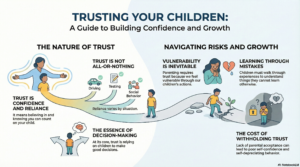
When I talk about trusting children, I mean placing confidence in, believing in, relying upon, and knowing that you can count them. Is this trust all or nothing? No—and there are different types of trust—for instance trusting a teenager to drive responsibly, trusting a child to do his/her best on a test, and trusting our children to make good decisions about sexual behavior. The essence of trust in children is relying on them to make good decisions. Trusting our children involves risk but the payoff is large. What happens when trust is broken? We have to find ways to restore it.
Ryan’s Journey to Emotional Freedom
Ryan’s childhood environment of rejection and criticism was debilitating. “My self-confidence is poor. I grew up in a strict family where I couldn’t have my own ideas. My parents didn’t approve of anything I did. I rebelled inside but went along with what they wanted because inside I was lost. They pushed me to become a lawyer, and I did, but I have never done well at my firm.”
With low-self efficacy, Ryan unwittingly married a women who didn’t accept him. The relationship ended after 10 unhappy years. Ryan needed support, guidance, and trust to leave behind his childhood limitations and create the life he wanted. He had limited parental access after the divorce. Ryan wanted desperately to be involved in his daughter Rebecca’s life. It was hard for him to watch the impact the divorce had on Rebecca. Rebecca had been very hurt by the breakup and bitter custody dispute, and Ryan could see that Rebecca was less confident than she had been during elementary school. His concern for Rebecca pushed Ryan to get his own life in order
Through counseling, Ryan learned to be compassionate with himself about the process of his life. “I understand that I did pretty well in light of the fact that my parents couldn’t accept me. I am ready to go on now and have the life I want.” Ryan understood that at work he expected to be misunderstood and mistreated in the same way he was in his marriage. He inadvertently set himself up for this by presenting himself in a self-depreciating way. As he felt better about himself, he was able to make a more positive self-presentation was treated more respectfully as a result.
Two years after his divorce, Ryan met Amanda, whom he felt was truly his soul mate. “I don’t trust myself to make good decisions. I feel bad about the way I run my life. Ryan decided to pursue the relationship with Amanda with his eyes open, letting go of the illusion that Amanda would be able to offset the hurts of the past. As his new life took shape, Ryan began to feel at peace within himself. He regained joint custody for Rebecca after taking his wife back to court. He was going on with his life determined to be a powerful and supportive father to his daughter.