
Guideline #1: Adopt Public Health Wisdom in Parenting
February 9, 2026
We constantly monitor and enhance each dimension of our children’s environments including diet, sleep, overall health, neighborhood, companions, school, special needs, and interests.
This post covers the first guideline from my book Purposeful Parenting Handbook: Guidelines for Raising Capable, Confident, and Accountable Children
My name is Lane Lasater, a retired clinical psychologist. In gratitude for the life I have been given, I am sharing everything I learned during my career and personal life on my website http://www.LaneLasater.com and on my YouTube Channel Life Roadmaps from a Retired Psychologist https://www.youtube.com/@lane205
Each post contains my written material, an AI generated graphic, a 15-17 minute audio summary, and a 5-7 minute video summarizing the material.
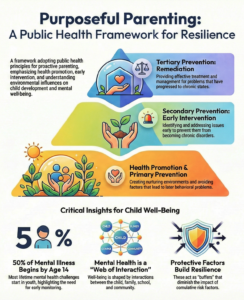
Monitor and Make Adjustments for Child Well-Being
Continually tracking our children’s well-being and making corrections as needed are core parenting practices described in public health as health promotion, and primary, secondary, and tertiary prevention.
- Health promotion means we establish to the best of our ability an environment that provides our children with safety, nurturance, healthy nutrition, multiple learning opportunities, encouragement, stimulation, opportunities to practice responsibility, learn from mistakes and develop self-awareness.
- Primary prevention refers to avoiding or offsetting those factors that lead to later health, mental health, or behavioral problems.
- Secondary prevention refers to early case-finding and intervention to prevent a health, mental health, or behavioral disorder from progressing to a more chronic state.
- Tertiary prevention refers to effective treatment and remediation of problems which have progressed to chronic disorders.
These four public health guideposts provide a valuable focus for our parenting efforts, and are critical themes in a recent publication of the U.S. Department of Health and Human Services at
https://www.hhs.gov/surgeongeneral/reports-and-publications/parents/index.html
The article highlights the following research findings relevant to all parents:
- “The majority of lifetime mental illnesses begin in youth. Half of all diagnosable lifetime cases of mental illness begin by age 14, and three-fourths of all lifetime cases start by age 24.
- The underlying premise of the public health approach is that it is inherently better to promote health and to prevent illness before an illness begins.
- For children, mental health is not seen as residing solely within the child, but within the web of interactions among the individual child; the family; the school, health, and other child service systems; and the neighborhoods and communities in which the child lives.
- While a single risk factor may provide some influence, it is the accumulation and complex interaction of risk factors that increase the probability of mental health problems. Children with greater numbers of risk factors have an increased likelihood of developing a mental health problem.”
- Protective factors provide ‘buffers’ that diminish the effect of risk factors and help build resilience in children.
- Early intervention efforts have demonstrated effectiveness in contributing to the overall mental well-being of children as well as in reducing delinquency, substance abuse, health-risking sexual behaviors, and school failure.”
Because health promotion and prevention of illness are such central tasks for parents, these are implicit in each of the parenting guidelines offered in this handbook. We practice secondary prevention when we continually observe, recognize, and make family adjustments as needed to any aspect of our child’s developmental environment that doesn’t foster health and mental health. Hopefully, you won’t need to utilize tertiary prevention, but if you are faced with a chronic problem with a child, tertiary prevention is part of your parenting toolkit.