
Resolve Couple Conflicts Fairly
February 3, 2026
As you saw during the post on couple combinations, the highest intensity relationships with the most conflict are high- strung + high-strung/different couples, but all couples must learn to resolve conflict fairly. As a marital counselor, I discovered many of us make the same mistakes over and over in conflict situations. We don’t resolve the conflict, and can also make things worse, often much worse. Through trying personal experiences, I developed the following conflict resolution guidelines.
My name is Lane Lasater, a retired clinical psychologist. In gratitude for the life I have been given, I am sharing everything I learned during my career and personal life on my website http://www.LaneLasater.com and on my YouTube Channel Life Roadmaps from a Retired Psychologist https://www.youtube.com/@lane205 Each post contains my written material, an AI generated graphic, a 15-17 minute audio summary, and a 5-7 minute video summarizing the material. You can download a fillable and printable PDF workbook that contains all the exercises that I developed to accompany the material here: Finding a Life Partner Fillable Workbook
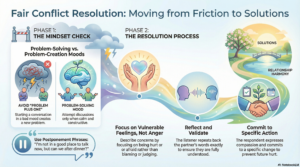
Create Conditions for Effective Conflict Resolution
- Be in a Problem Solving vs. a Problem Creation Mood. Problems get resolved when both parties are in a problem-solving vs. a problem-creation mood. You probably know immediately what your internal state is, so the first guideline is this: don’t attempt problem solving when you’re in a problem-creation mood. If you do—you end up with the original problem plus one. Here are some suggested responses you can use to postpone the discussion until a better time.
- “I’m not in a good place to talk right now.” A classic situation with couples is when one person arrives home from work after a really tough day. Just as they walk in the door, their partner wants to talk to them about an important issue. This frustrates the person arriving home tired and cranky. You know what happens. He/she responds poorly, sometimes with a nuke or insensitive comment, and inadvertently creates an additional problem. The constructive response is to say, “I’m not in a good place to discuss this now, but can we talk about this after dinner?”
- “I’m angry and can’t talk right now, but it’s not you.” A second version of this is when a partner comes home angry or frustrated about a situation at work or outside the home. They know that if they interact with anyone, including their partner, they’re likely to take their anger out on an innocent bystander—their partner. So, tell the other person you can’t talk right now, but it has nothing to do with them. This way, they won’t feel insecure, and you’ll fill them in later when you calm down.
- “I’m still not ready to talk after we took a time out.” When you and your partner have a discussion that gets heated, as discussed above, it’s best to take a cooling-off period for a specified time. But people sometimes restart the discussion before they’ve truly cooled off, so they end up digging a deeper hole. It helps to have the option to ask for a further cooling-off period before re-starting the discussion if needed. If one partner truly can’t get him/herself cooled off, then consider getting professional help and let your partner know the specific action you’re taking to get back into a better place before trying to solve the problem.
At the beginning of a couples’ counseling session, I would ask both partners, “Are you in a problem-solving mood?” If either or both were not, we needed to figure that out first to avoid creating a fresh problem.
Eight Steps for Couple Problem Solving
When couples are in the middle of an intense discussion, sometimes out of the blue, one person introduces another issue—often an old resentment. This escalates the tension level and often leads to creating additional problems (things said in the heat of the moment) while leaving the original issue unresolved. So, stay on topic and don’t chase rabbits. If you have several important issues to discuss, I suggest each person privately list everything they need to talk about going back to the start of the relationship, and then rank these into high, medium, and low-intensity subjects.
If many issues are medium or high intensity, it helps to bring in a couples’ counselor before taking these issues on one by one, starting with low-intensity issues and alternating between each person’s concerns. In this way, the couple gradually builds up skills and confidence to resolve these conflicts fairly. Here are the guidelines for these discussions:
- Both people must be in a problem-solving mood.
- No nukes.
- One person describes their concern without blaming or judging, focusing on how they were afraid, humiliated, or hurt—not angry (as this merely covers hurt and fear). Also, talk about the history that person has with feeling like this because commonly, the things we get triggered by subconsciously touch old feelings or hurts.
- The second person repeats back everything that the first person shared about their vulnerable feelings and their history with these feelings, using the same words as they did and without further any opinion or comment.
- The first person validates that the second person understood them correctly and thanks them for listening carefully.
- The second person then responds to the issue (not blaming, judging, or defending), expressing their compassion for how the other person feels now and in the past, and their willingness to learn from what they heard. They then commit to specific actions they’ll take to avoid hurting the first person in that way again.
- The first person accepts the acknowledgment and commitment of the other person, thanks them for their willingness to listen to them and non-defensively hear them, and agrees they’re finished with the issue and won’t bring it up again.
- Now, the other person raises one of his/her low- intensity issues, and the process starts again.