
Guideline #9: Complete a Partnership Trial Run
February 3, 2026
Prepare for Lifelong Love
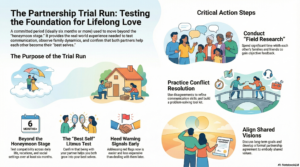
When you connect with a potential partner, commit to each other so you can experience the relationship over time— ideally for six months or more. If the other person doesn’t wish to make this commitment, they may not be truly available or may not view you as a potential partner. Try to understand what their concern may be, but unless there is some legitimate reason, it may be necessary to move on.
Your trial run gives you time to get beyond the honeymoon stage, identify any relationship challenges, and to test your compatibility in a variety of settings. You’ll share daily life, spend time with each other’s family and friends, and perhaps vacation together. When you inevitably encounter disagreements, it lets you understand your relationship in depth and answer the following basic question: does your potential partner help you be your best self (and vice versa)?
My name is Lane Lasater, a retired clinical psychologist. In gratitude for the life I have been given, I am sharing everything I learned during my career and personal life on my website http://www.LaneLasater.com and on my YouTube Channel Life Roadmaps from a Retired Psychologist https://www.youtube.com/@lane205 Each post contains my written material, an AI generated graphic, a 15-17 minute audio summary, and a 5-7 minute video summarizing the material. You can download a fillable and printable PDF workbook that contains all the exercises that I developed to accompany the material here: Finding a Life Partner Fillable Workbook
“Being deeply loved by someone gives you strength, while loving someone deeply gives you courage.”
Lao Tzu
Action Step #19: Carry out a Partnership Trial Run
If you haven’t done so already, I suggest sharing this book with your prospective partner so he/she understands the process and completes the exercises just as you have. When you’re ready, share your vision and goals with each other as a bonding exercise, to deepen your mutual understanding and appreciation. In the next chapter, you’ll develop your partnership agreement, which embodies your shared relationship vision and goals.
Family and friends you spend time with during your trial run usually have a pretty good idea about what’s going to work, and they’ll give you feedback if you ask them. Romeo and Juliet syndrome exists, where family disapproval drives a couple closer—but usually family and friends just want what’s best for us. They can observe objectively without the blush of early romance, but consider any prejudices you know they have.
If you realize a potential partnership won’t work, it’s hard to call it quits. We hate to burst our “happily ever after” fantasy at the beginning of a relationship. But, remember, “It’s pay now or pay later with 25% interest.” If your relationship field research is complete, you’ve paid enough interest. Just accept your disappointment, tell your trial partner the truth in a kindly way, and move on.
Your trial run lets you refine couple communication and problem-solving skills as you deal with whatever challenges come up and learn to accommodate each other’s habits and emotions. A final critical task during your trial run is developing your partnership agreement, covered in a future post. Below, I describe my partnership trial run with Nancy and the trial run experiences of Brianna, Nicholas, and Amber. In subsequent posts, I explain the guidelines for effective couple communication and problem solving Nancy and I have used throughout our relationship and I’ve taught these skills to many other couples. Your trial run is the perfect time to practice using these communication techniques so they become part of your problem-solving tool kit.
Trial Run Examples
My Trial Run with my Life Partner Nancy Larson
When I asked out Nancy, as described earlier, I had to clarify whether she was “available” for a relationship. Having survived that first hurdle, we went out to dinner after she got off work and we ended up talking until four in the morning at a coffeehouse. It was a lively conversation, and everything on my entrance exam checked out. Nancy told me she was starting graduate school that fall to become a clinical social worker, which fit in perfectly with my career and interests.
During our long conversation, I asked Nancy my critical entrance exam question about whether she would live in Colorado. She answered, “Yes.” She told me she’d worked on a ranch in Montana and backpacked in Montana, California, Utah, and Nepal—amazing! At the end of the evening, I asked her if we could date each other exclusively, and we made that commitment. I felt quite certain Nancy was the woman I wanted to marry, but I thought a six-month trial would help us both be sure.
Nancy’s parents and brother lived in Minneapolis, so I met them a few weeks after we’d begun dating. They were warm and delightful people, and I felt welcome and accepted in their family. Her father and brother drank heavily during our visits with her family, but this was before I had stopped drinking, so that suited me fine. A few months later, Nancy and I attended a professional conference in Toronto, visited my college roommate and his wife in New York, and went backpacking in Wyoming. We had a great time traveling together, visiting my friends, and sharing the always hair-raising adventure of backpacking in grizzly bear country. As we drove back to Minnesota from Wyoming, we came through Colorado so Nancy could meet my parents. By then, I had answered all my questions about my relationship with Nancy, so on our last night in Colorado I asked her to marry me, and she accepted.
Tragically, at that same time, my mother was diagnosed with terminal breast cancer. Nancy met my parents during a period of great stress but handled herself beautifully. My mother’s illness rocked me emotionally, and when I got back to Minnesota, I contacted a therapist. He asked many questions about my life during our first meeting, and as we began our second session, he told me he thought I was in trouble with alcohol and suggested I stop drinking entirely. I haven’t had a drink since that day.
One of the greatest gifts I’ve received during recovery from alcoholism was the opportunity to become close to my mother during the last two years of her life. Nancy and I traveled to Colorado several times to visit her, and through my emotional growth, we developed a wonderful warmth and trust that we’d never shared before. My mother loved Nancy, and she supported my choice to become a psychologist in a way other family members couldn’t. It was heartbreaking that our close time together was so short, but this shared love gave me a peace and appreciation for my mother’s gifts that I treasure deeply.
Because drinking was a big part of Nancy’s family, my getting sober was a shock to her family and they pulled back from us. We recognized this stemmed in part from their denial about her brother’s alcoholism. We didn’t see them much over the next year until Nancy’s brother asked for help. He then entered recovery, which affected her entire family in a good way.
It was a blessing to be sober and fully present for our wedding, and sobriety has been the essential foundation for my married life. If I hadn’t stopped drinking, I would have destroyed our relationship and my career. At the suggestion of my therapist, I entered outpatient alcohol treatment a few months after the wedding. This unique program had a parallel track for spouses and family members of alcoholics which Nancy attended, so we shared this valuable growth experience. Treatment was a big step forward in helping me come to terms with my childhood emotional issues that would have also sabotaged our marriage. Though we lived nearby, Nancy developed good boundaries with her family, which established us as a separate and autonomous unit and she was a wonderful ally for her brother when he entered recovery.
Brianna and Matthew
Brianna continued dating while she completed her master’s degree in nutrition and wellness. In that time, she had a brief relationship with a fellow graduate student and met several men online, briefly dating three before she met Matthew online. She recognized him right away as a potential partner. Matthew was a physician just completing his residency in family practice. He’d grown up in a large Italian-American family in Chicago, and Brianna enjoyed how his familiarity with the city and unique background enriched her appreciation of the city. She loved how his family welcomed her.
Brianna and Matthew committed to a trial run and got married after dating for a year and a half. Matthew was more high-strung than Brianna, but the couple developed a constructive give and take in problem solving and enjoyed the balance of stimulation and mutual appreciation. Brianna was still unsure about starting a family, but Matthew definitely wanted children. As they talked this through, they compromised by deciding to have one child. They enjoyed spiritual exploration for several months before deciding to join a non-denominational church where they got married.
Because Brianna came from a small family and small Illinois city, she enjoyed Matthew’s extensive family network, but they chose a neighborhood closer to the geriatric services agency where Brianna worked after finishing her degree. Their apartment was a half hour from where most of Matthew’s relatives lived and this provided a useful boundary for their couple unit. They gathered with his extended family on big occasions but created their own small family traditions around holidays and birthdays. Matthew enjoyed visiting Brianna’s family two hours away and became good friends with her parents and brother. They each maintained individual close friends and developed several couple friends who often came over for intimate evenings. On vacation, they enjoyed canoeing and fishing in the upper peninsula of Michigan.
Nicholas and Isabella
After a year of therapy and attending self-help meetings twice a week, Nicholas understood more about how his traumatic family experiences had led to his difficulty trusting women, chronic overeating, and low-grade depression. At the suggestion of his therapist, he attended a week-long therapy workshop for adults from troubled families.
This leap of faith provided a breakthrough for Nicholas, and at the workshop he expressed his deep sadness about childhood losses. Processing this grief in the presence of a supportive group gave Nicholas a feeling of lightness and belonging he’d never experienced before. After feedback from his counselor and other participants, Nicholas accepted that he was a compulsive overeater who’d used sugar and high fat processed foods for comfort as far back as he could remember. When he returned from the workshop, Nicholas joined Overeaters Anonymous (OA) meetings and began abstaining from sugar and high fat processed foods and following a structured eating plan. These recovery choices freed him from constant food cravings and bingeing, and as he succeeded with healthy eating, Nicholas felt a new self-respect emerging.
With a more solid life foundation, Nicholas was finally ready to search for a life partner. After many online contacts and 10 first dates, Nicholas connected with Isabella, a high school special education teacher dedicated to environmental conservation, a cause Nicholas also believed in. Two years before, Isabella had ended a serious relationship with a verbally abusive man and went into therapy, a self-discovery journey that paralleled Nicholas’ recovery.
Isabella grew up in a nurturing home but had to learn to protect herself from mistreatment and maintain her relationship boundaries. Nicholas got along well with her parents and younger sister, and being around her family gave him an experience of intimacy and belonging he’d always yearned for. The couple found common ground in cycling, hiking, and environmental campaigning.
Isabella was in good shape and a healthy eater and supported Nicholas’ eating recovery plan. During their trial run, Isabella confronted the moodiness and intensity he often brought home from work. Her experience dealing with an abusive partner prepared Isabella to set good boundaries with Nicholas, and she didn’t hesitate to tell him when he was out of order and ask him take responsibility for his moods rather than take it out on her or anyone else. This clear limit setting aided Nicholas’ diligence in maintaining his daily recovery.
They decided they would start a family after they’d been together for several years. The couple worked out regular social contacts with Isabella’s family and a more limited relationship with Nicholas’ parents and siblings. They married after dating for a year.
Amber and Ethan
Two years after Ryan abandoned her, and a year after the divorce was final, Amber felt her life was back on track. She’d transitioned at work to supervising a probation caseload of women with trauma and substance abuse issues. After she took him back to court, Ryan paid child support more reliably and Amber could pay off the credit card debt he’d left her with. His relationship with their daughter Emilia was intermittent, and Amber was grateful she’d sought sole custody, which let her insulate Emilia somewhat from his irresponsibility.
Through therapy and learning about violence in intimate relationships, Amber recognized she’d been naïve in choosing Ryan as a husband and father for Emilia by underestimating his immaturity and substance abuse before they married. She realized she’d learned to accept irresponsible behavior from watching her mother compensate for her father’s drinking and failure to meet family responsibilities beyond just financial support. Her painful experience with Ryan and wish to protect Emilia from his choices provided new clarity about being strong-willed in her relationship choices. She observed the women on her probation caseload living out the devastating consequences of their traumatic backgrounds and making choices leading to disastrous relationships and addiction.
With new clarity and power, Amber was extremely careful as she selected among the potential partners she met online and in person. She insisted on having only phone or video conversations for the first month, and with the man’s permission reviewed his financial and criminal history and shared hers. When everything checked out in conversations and in the background review, she met four men in person over a three-month period, but none worked out.
Finally, Amber met Ethan when she joined a sailing club with sailing classes for Emilia and adult regattas. Ethan was divorced with a seven-year-old daughter, Charlotte, for whom he shared custody with his ex-wife. He’d divorced her after three years of marriage because of disagreements around her rigid religious beliefs. Their shared parenting was rocky because his ex-wife wanted to enroll Charlotte in a conservative religious school. Ethan favored public school, but they compromised on a charter school built around academic integrity and character development.
Ethan was a sales engineer for a tech company, originally from Sacramento. Because of their shared interest in sailing, he and Amber discussed buying their own boat at the right time. With both coming out of conflicted relationships, Amber and Ethan sought good alignment of their values and needs and discussed in depth what they wanted from a long-term relationship. Ethan was more low-key than Amber, and when they moved in together after four months, they meshed comfortably. Fortunately, Emilia and Charlotte also got along well.
Since Amber’s family was out of state and Ethan’s several hours away, they could easily regulate the space they needed from relatives. After thinking it through, they agreed to have one child of their own, and learned to work around Charlotte spending every other week with Ethan’s ex-wife. After two years, they got married at an ocean-side hotel near their sailing club.
A Successful Trial Run
When everything checks out in both directions, congratulations—you’re ready for a long-term committed partnership. Your relationship trial run has let you get to know each other much better, work out the conflicts you’ve encountered, become more acquainted with each other’s family and friends, and become more confident that you know what you’re getting into and that you’re ready to commit.
Key Takeaways from This Chapter
- Your trial run provides extended experience of who you are individually and as a couple.
- If warning signals from your entrance exam or elsewhere come up, heed these signals now as it’s much more difficult and expensive to do so later.
- Practicing couple communication and problem solving using the tips in this passage will give you the confidence to address differences as they arise.
- A key finding of the trial run is confirming that your partner helps you be your best self, and vice versa.
- Use everything you know about your partner to be sensitive to and affirm their deepest feelings and needs.