
Guideline #6: Analyze Your Field Research
January 19, 2026
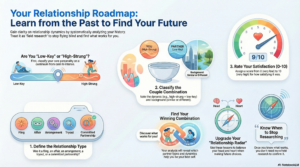
In the last two posts, you learned to classify couples using the levels of sexual relationships, relationship availability, low-key and high-strung personalities, similarity and differences in background, the couple combination matrix, and balance of power and responsibility. In this post, you use all this information as you analyze your past and current relationships and identify patterns and lessons learned about what kind of relationship works best for you.
My name is Lane Lasater, a retired clinical psychologist. In gratitude for the life I have been given, I am sharing everything I learned during my career and personal life on my website http://www.LaneLasater.com and on my YouTube Channel Life Roadmaps from a Retired Psychologist https://www.youtube.com/@lane205 Each post contains my written material, an AI generated graphic, a 15-17 minute audio summary, and a 5-7 minute video summarizing the material. You can download a fillable and printable PDF workbook that contains all the exercises that I developed to accompany the material here: Finding a Life Partner Fillable Workbook
“To get the full value of joy, you must have someone to divide it with.”
Mark Twain
Study Your Love Relationships
The goal of your relationship history and analysis is to be clear about what kind of romantic relationship you’re ready for, and the pros and cons of different couple combinations for you. Once you’ve distilled this information from your past relationships, there’s no reason to conduct more relationship field research just to confirm what you already know. Once you feel prepared for a partnership, it’s ideal to remain unattached and devote yourself to your search.
In your analysis, you’ll classify yourself on the continuum of low-key vs. high-strung, review your major relationship couple combinations, and rate how they worked for you. Your analysis gives you the big picture of how different couple combinations work for you. Read through my relationship history and analysis and the other examples to give you an idea of how this works, then follow the instructions below for completing your own.
Relationship History Examples
My Relationship History and Analysis
I’m very high-strung. During relationship field research, I dated both low-key and high-strung women, including two women with very different backgrounds from mine. Before deciding to become a psychologist, I had tryout relationships with several low-key women that were quite peaceful and satisfying, but I wasn’t available then for a long-term relationship.
During graduate school, I had tryout relationships with several professional women—high-intensity, high-conflict, high-strung + high-strung/different relationships. These women enriched (and challenged) me as I experienced high intensity and high conflict. I now understood the old saying, “When it was good, it was very good, and when it was bad, it was awful!” I learned a great deal about love, conflict, communication, feelings, and pain. As previously mentioned, at age 25, I asked one high-strung woman from a very different background to marry me, but painfully, she said no. She recognized I had too much unfinished family business. As I absorbed this humiliation, I realized it was a blessing that she understood something I couldn’t yet see.
Ultimately, I recognized that a high-intensity relationship wouldn’t work for me—I got too insecure during conflicts. I still had healing to do from my relationship with my mother. For me, it’s wonderful to work professionally with high-strung and different women and men. But in contrast to my childhood environment, I wanted a stable and peaceful home where our children could feel secure. I chose Nancy because she was more low-key than me, and we had similar backgrounds. This worked out beyond my wildest dreams and has given me the stability and peace I most needed.
Brianna’s Field Research
Are you a low-key or high-strung person, and how strongly? Somewhat low-key. Relationships below:
- RS, affair, low-key + high-strung, different, satisfaction 3. It was a roller coaster, and he was too wild for me.
- BL, arrangement, low-key + low-key, different, satisfaction 6. We were together for two years in college, and it worked pretty well, but then he moved to California.
- DK, arrangement, low-key + low-key, similar, satisfaction 4. It was very stable, but I wanted to expand my horizons, and he really didn’t.
- RL, affair, low-key + high-strung, different, satisfaction 5. He was a co-worker at my job and from a different culture. It was fun but didn’t feel long-term to me.
What are your conclusions? I’m drawn to people different from me, and that provides interest and excitement, but I don’t want to be with a super high-strung person. I want to be with someone who shares my interest in learning and growing.
Nicholas’s Field Research
Are you a low-key or high-strung person, and how strongly? Very high-strung. Relationships below:
- SS, arrangement, high-strung + high-strung, similar, satisfaction 4. We got together in law school, and it was great when we shared that, but after we graduated, she went into corporate law—we had a lot of differences in political views and grew apart.
- LS, fling, high-strung + high-strung, different, satisfaction 5. A friend introduced us when I was in Seattle on vacation, and we just clicked. It was a fantasy because we were ocean kayaking in beautiful surroundings. She didn’t want to live on the East Coast, so we both knew it was short-term.
- ]VK, affair, high-strung + high-strung, similar, satisfaction 4. She was a lawyer who I worked closely with on a case out of town. It just happened—highly intense and passionate. It went on for a while. We didn’t have any illusions, but it was a way for me to try out closeness.
- RL, arrangement, high-strung + low-key, different, satisfaction 6. She was the first person I met online, and I found that her lower intensity agreed with me because my work is high stress—but she was not at my educational level and I decided it wasn’t a good fit long-term.
What are your conclusions? I’ve been in therapy for six months now, and I’m sorting out a lot of childhood issues. I get jealous and threatened if I feel like I’m competing with my partner. Nurturing women are more relaxing for me, and I crave low-key evenings after an intense week dealing with clients. I’m not ready for a commitment until I find someone who fits into my world.
Amber’s Field Research
Are you a low-key or high-strung person, and how strongly? High-strung—medium. Relationships below:
- WT, arrangement, high-strung + low-key, similar, satisfaction 6: He was a high school boyfriend, and we were together for a I was looking for more excitement when I got to college.
- RS, fling, high-strung + high-strung, different, satisfaction 7. He was a football player, and it was intense, but women were always throwing themselves at him, and that made me crazy.
- RC, arrangement, high-strung + high-strung, different, satisfaction 7. I had two minor flings during my sophomore year. Then I met Ryan—on the ski team. I was in a sorority, and his fraternity was next door. There was a big party scene, and I figured college was the time to have fun.
- RC, partnership, high-strung + high-strung, different, satisfaction 2. When Ryan and I finished college, we stayed together and then moved to a small city near San Diego where Emilia was born. I was ready to settle down and assumed that Ryan was too, but he continued partying after work.
What are your conclusions? I recognize now that my dad was a functional alcoholic. He worked hard but drank heavily at night and on weekends watching football. It seemed okay then, but now I see how my mom compensated for him in a lot of ways. Ryan was charismatic and fun, but with a young child and him partying after work, it was a real disaster. I pressured him to change, but he rebelled and became violent. I think he started the affair as payback. I recognize after going to my divorce group how I’ve connected with men who’ve never really grown up. Ryan cured me of that, and when I date again, I’m looking for someone mature and stable.
Action Step #14: Complete Your Relationship History and Analysis
In your relationship journal, answer the relationship history questions below chronologically for your significant sexual relationships, including your current relationship (if applicable).
- Are you a low-key or high-strung person, and how strongly?
- Classify each significant sexual relationship in terms of level of sexual relationship (affair, hookup, fling, tryout, arrangement, false start, trial run, or committed partnership), where the relationship fell on the couple intensity and conflict matrix (levels 1–6), and how satisfying the relationship was from 0 = very low to 10 = very high.
- After reviewing the above, what kind of relationship works best for you?
Key Takeaways from This Post
- Analyzing your relationship field research clarifies your relationship experience so you can focus your partner search.
- Reflect on what type of partner helps you be your best self.
- You’re no longer “flying blind” as each relationship dimension covered enhances your relationship radar and guides your choices.
- You don’t need more field research if you already know what works for you, but it takes discipline to apply this self-knowledge.
- Understanding the relationship landscape and your history lets you balance information and self-knowledge with your heart’s guidance.