
Guideline #5: Explore Couple Combinations and Dynamics
January 18, 2026
Personalities, Differences and Power
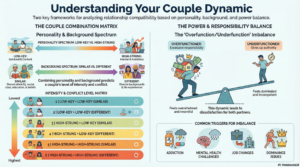
Opposites attract, or do they? Statistical odds favor the probability that you’ll marry someone similar to you in terms of intelligence, height, and body mass index (BMI). A study of thousands of couples revealed that we predominately, but not universally, seek people whose characteristics closely match our own. Beyond intelligence and body type, what are the implications for couples who differ in other ways? Throughout this series, my goal is to inform you about essential relationship dimensions to consider as you create a complete profile of a person with whom you can find long- term compatibility and fulfillment. In this post I describe the pros and cons of how different combinations of personality and background affect compatibility. Then I alert you to another important couple characteristic—the balance of power and responsibility between partners. This fluctuating dimension of the couple’s relationship can have a significant impact on couple satisfaction and cooperation.
My name is Lane Lasater, a retired clinical psychologist. In gratitude for the life I have been given, I am sharing everything I learned during my career and personal life on my website http://www.LaneLasater.com and on my YouTube Channel Life Roadmaps from a Retired Psychologist https://www.youtube.com/@lane205 Each post contains my written material, an AI generated graphic, a 15-17 minute audio summary, and a 5-7 minute video summarizing the material. You can download a fillable and printable PDF workbook that contains all the exercises that I developed to accompany the material here: Finding a Life Partner Fillable Workbook
“They say marriages are made in Heaven. But so are thunder and lightning.”
Clint Eastwood
1. Low-Key vs. High-Strung Personalities
During each serious relationship, our individual personality types and differences in backgrounds shape the quality of that relationship. As I counseled hundreds of individuals and couples, I zeroed in on two significant dimensions of each individual within the couple in shaping compatibility.
- How low-key or high-strung is each partner?
- How similar or different are the individual partners in background?
Individual differences (or similarities) of romantic partners in personality and background culture make for some lively couple combinations and can dramatically impact compatibility. We can all refine our basic personality type somewhat, and we can broaden our cultural background through education and experience, but for most of us these basic characteristics are relatively stable.
We naturally classify people along the continuum of low-key vs. high-strung personalities. Low-key people are more subdued, content, steady, etc., and high-strung people are more intense, ambitious, assertive, etc. The more pronounced your qualities are in either direction, the more low-key or high-strung you are. Before we discuss how these combinations work for couples, use the next action step to classify yourself on the continuum of low-key vs. high-strung so you have a personal frame of reference.
Action Step #11: Rate your Low-Key vs. High-Strung Characteristics
Rate yourself between 1–10 on each low-key vs. high-strung word pair below, where 1 means the low-key quality on the left is very true of you, and 10 means the high-strung quality on the right is very true of you. Then add up your scores.
- subdued intense
- contented driven
- serene excitable
- other-oriented self-centered
- secure vulnerable
- cooperative controlling
- easy going aggressive
- independent needy
- diplomatic confrontational
- traditional adventurous
Your total score can range between 10 and 100, with a score of 10 implying you’re very low-key and 100 implying you’re extremely high-strung. A score of 50 implies you’re someone with a mix of low-key and high-strung qualities. My observation—not scientifically validated—is that very high- strung people (myself included) become that way in part through genetic inheritance and innate personality, and in part because of childhood need frustration and the impact of trauma.
2. Similar vs. Different Backgrounds
Members of a couple can come from very similar or very different backgrounds in terms of ethnicity, social class, level of education and religious and/or political beliefs. Very similar couples often fit comfortably into each other’s social atoms, but couples with very different backgrounds may not. The more different their backgrounds are, the more these differences influence the character of the relationship.
In working with many couples, I found that the more high- strung and different the individual members of the couple were, the greater the intensity and conflict in the relationship. Intensity refers here to the couple’s general level of energy in conversation, sex, arguments, attitudes, competitiveness, interests, and friendships. Conflict for a specific couple means how frequently and strongly they disagree, encounter differences to resolve, clash over attitudes and values, or must renegotiate responsibilities. From now on, I will refer to couples who are both high-strung and from different backgrounds as high-strung + high-strung/different couples. Similarly, a low-key person coupled with a high-strung person from a similar background would be a low-key + high- strung/similar couple.
The Couple Combinations Matrix
The couple combinations matrix illustrates my observations about the combinations of personality types and different backgrounds. It ranges from lowest conflict and lowest intensity couples to the highest conflict and highest intensity couples.
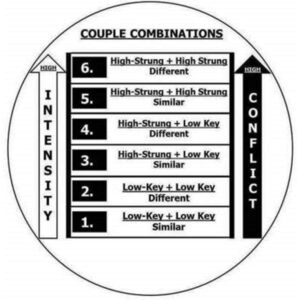
Varied Couple Combinations Suit Particular People
Some of us like spicy food and others can’t touch it. One of your partnership preparation tasks is figuring out what couple combination helps you be the best version of yourself. It’s interesting to watch high-strung + high-strung/different couples, and we all marvel at movie star romances and other dramatic relationships. Through the years, I’ve counseled many very high-strung/different couples. For this kind of relationship to succeed, both people must be reasonably secure, agree to collaborate and not compete, and learn to resolve conflict fairly. When they overcome these challenges, these couples can accomplish amazing things. If they don’t— stand back!
Action Step #12: Using the Couple Combinations Matrix
The matrix is a descriptive continuum of couple intensity and conflict, not a scientific model, but it helps clarify your relationship experiences and choices. In your relationship journal, classify you and your current intimate partner or potential partner (if applicable) in terms of low-key or high- strung, and as similar or different from each other in backgrounds. In the next chapter, you’ll analyze your important relationships using these classifications to gain more clarity about what couple combination works best for you.
3. Balancing Power and Responsibility between Members of a Couple
I stressed earlier how valuable it is when you and your partner solidify your life foundations, including each being able to earn a living and live as a single person. These capacities empower you to end an unhealthy relationship if necessary. Ideally, you’ll create a partnership embodying a suitable balance of power and responsibility. You and your partner will negotiate fair and mutually beneficial sharing of responsibilities, roles, decision-making, and effort toward common goals. If done well, you’ll have the space to maintain your health and well-being while also laughing and playing together and enjoying each other’s company and sexuality.
Overfunction/Underfunction
But power and responsibility sometimes get out of balance in viable life partnerships. We call this “overfunction/underfunction,” when one partner takes on more and more responsibility and authority in the relationship, while the other partner progressively gives up or abdicates responsibility and authority.
When we commit during relationship vows to support our partner “in sickness and in health,” we understand that during the normal course of life, one or both partners may become vulnerable through illness, injury, surgery, job setbacks, etc. In these instances, it’s perfectly natural for the vulnerable person to depend heavily on their partner for a time. Many people also commit to partnerships with full understanding and acceptance of their partner’s disability, and the couple accommodations this requires.
When Overfunction/Underfunction Becomes a Problem
For other couples, power and responsibility become quite unbalanced over time as the result of having children, changes in job responsibilities, addictions, mental health challenges such as depression or anxiety, or unemployment. As the overfunctioning partner takes on excessive power and responsibility and the underfunctioning partner becomes more dependent, both people become increasingly dissatisfied. The overfunctioning person often feels exhausted, overwhelmed, and resentful, and the underfunctioning person feels dominated, resentful, disempowered, incompetent, and rebellious.
In couple situations where one person is highly dominant and controlling and the partner less so, the less dominant partner may gradually relinquish his/her decision choices and power and as a result feel trapped and unable to challenge the dominant partner. In domestic abuse situations, the dominant partner’s unacknowledged insecurity drives over-controlling, intimidating, and violent behavior toward the partner. The dominated person often becomes isolated from his/her support system and becomes unable to walk away from the partner even though facing significant abuse, physical danger, and risk of death.
In cases of overfunction and underfunction where addiction is involved, as the illness progresses, the addicted person gives a substance or addictive behavior priority over everything else, including relationships, responsibilities, health, and personal values. These choices sabotage intimate relationship responsibility and participation. In psychology practice, I found that one member of a couple often sought help because their partner was addicted, depressed, anxious, or otherwise disabled, and they couldn’t count on that person to meet his/her responsibilities, which resulted in conflict and unhappiness.
Depending upon how far the dominance or addiction has progressed, it’s often necessary for both the suffering person and his/her partner to seek specialized domestic violence or addiction treatment to start personal recovery. Both these behavior patterns are better addressed in group therapy situations rather than individually because the group has the objectivity and power to break through the defensiveness and denial that accompany domestic violence and addiction.
Over time, with information and support, couples can often rebalance their relationship back to the equal sharing of responsibilities and opportunities to look after themselves and have fun. If the person who is over-controlling, violent, or addicted or suffering from another disabling condition is unwilling to get help, it leaves their partner with the dilemma discussed later in Guideline #7, Know When to Say Goodbye.
My Experience of Overfunction/Underfunction
In retrospect, I recognize I was in one relationship in which I became the underfunctioning member of the couple while she was overfunctioning. I didn’t understand what was happening then, but I felt increasingly disempowered when she naturally took over the responsibilities I neglected because of my drinking. I ultimately ended the relationship because I was discontented, but didn’t recognize the overfunction/underfunction dynamic until I learned about it later. The general principle I learned from this was don’t let someone do something for you that you need to do for yourself, and vice versa.
Fortunately, with professional guidance, I accepted I was an alcoholic before I finished my training as a psychologist and before Nancy and I got married. I’ve abstained from alcohol ever since. A few months after our marriage, on the advice of my therapist, I entered outpatient alcohol treatment to help me deal with my underlying emotional and family issues. Self- help programs such as AA or Al-Anon also provide powerful information and support as people strive to make individual healthy choices in recovery. During our treatment process, Nancy and I went through couples’ counseling. Even though we had only been in a relationship for a year, this experience helped us rebalance the overfunction/underfunction which had already taken hold, and we learned conflict resolution skills we’ve used ever since.
Action Step #13: Analyze Your Parents’ Couple Combination
Considering the couple combination matrix and balanced sharing of power and responsibility in couples covered in this chapter, analyze your parents’ (or the relationship experience of the people/person who raised you, such as a single parent) couple combination and how it worked for them. Because you may have a lot of first-hand information about their relationships, this gives you a close-up view of how couple combinations and power dynamics work in practice.
My Parents’ High-Intensity, High-Conflict Marriage
I see now my mother and father were both overfunctioning people, in a type 5 relationship (high-strung + high- strung/similar) with high intensity and high conflict. When they were in alignment and working together, what they could accomplish was impressive. But tragically, they couldn’t stay in emotional alignment, and lacked the information and skills to resolve the high-intensity emotional conflicts that developed. Earlier, I described my unsuccessful childhood attempts to stop these destructive conflicts, but I didn’t have the information and skills to be helpful. Much later, I learned how to work with couples like this.
There’s no right answer in choosing the couple combination that’s right for you—it depends on what your relationship field research (next chapter) tells you about what couple combination relationship suits you best. You’ll also want to consider your basic human need fulfillment growing up and specific needs you want to prioritize.
Key Takeaways from This Chapter
- Each pair of individuals within a couple falls along the continuum of a low-key vs. high-strung personality and similarity difference.
- You can classify yourself and your former and potential partners in terms of the couple combination matrix of intensity and conflict.
- The balance of power and responsibility within each couple can be an important predictor of happiness and satisfaction.
- There is no right or wrong with couple combinations, but these concepts let you make useful distinctions and choices based on your relationship experience.
- Observing the couple combinations and dynamics of your parents or guardians can act as a useful case study.