
Guideline #4: Navigate the Love Landscape
January 18, 2026
Very few people marry their high school or college sweetheart and live happily ever after. Most of us need more time and relationship experience before we’re ready for a long-term relationship. I refer to all your previous intimate relationship experience as your “relationship field research.” Our experiences as we date or become intimately involved let us satisfy our natural curiosity about intimacy and sex, learn how to communicate sensitively with a romantic partner, and figure out how to resolve normal relationship conflicts. This chapter describes important relationship factors to consider if you’re dating now or looking back at your previous dating experience if you’ve now entered a serious relationship.
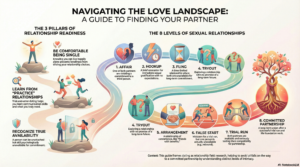
People who haven’t experienced trial relationships sometimes yearn for these later in life, which can lead to affairs or messy midlife sexual acting out. Practice relationships allow us to meet sexual and intimacy needs while we work to construct or repair our life foundations. This chapter highlights specific skills and distinctions to be aware of during your relationship field research. It breaks these down into (1) be comfortable being single, (2) learn from practice relationships, (3) recognize relationship availability, and (4) choose among the levels of sexual relationships.
My name is Lane Lasater, a retired clinical psychologist. In gratitude for the life I have been given, I am sharing everything I learned during my career and personal life on my website http://www.LaneLasater.com and on my YouTube Channel Life Roadmaps from a Retired Psychologist https://www.youtube.com/@lane205 Each post contains my written material, an AI generated graphic, a 15-17 minute audio summary, and a 5-7 minute video summarizing the material. You can download a fillable and printable PDF workbook that contains all the exercises that I developed to accompany the material here: Finding a Life Partner Fillable Workbook
“No relationship is ever a waste of time. If it didn’t bring you what you want, it taught you what you don’t want.”
Anonymous
Be Comfortable Being Single
Remember back to Relationship Development Task #3: “Learn to be self-reliant and to live alone while widening your friendship circle, planning and carrying out satisfying social and recreational activities, and building your social support system.” The statistics about relationship failure and divorce reviewed earlier remind us we’re likely to be single sometimes and may find ourselves alone again when a relationship ends or our love passes away.
Ideally, we learn to live as a single person during early adulthood and learn to cope with intermittent unpleasant experiences of loneliness and isolation. You’ve undoubtedly gone through planning how to fill your weekend when you’re single. Inevitably, sometimes your plans fall through and you have to figure out a last-minute alternative to fill this time. It might be an event with new friends or one that you found online. You might be a stranger in unfamiliar settings, which pushes you outside your comfort zone. It takes courage to try new things and meet new people.
As census data showed, many relationships or marriages people start during their late teens or early twenties don’t work out long-term. Eventually, life requires most of us to learn to build a home base and sustain ourselves physically, emotionally, and socially without the comfort of a built-in companion and support system. When you know you can live relatively comfortably as a single person if you must, loneliness and self-doubt won’t drive your relationship choices.
Learn from Practice Relationships
Relationship Development Task #5 for developing your life foundation is “Take part in enough practice relationships to understand the give and take between romantic partners, recognize another person’s intimate needs, gain insight on compatibility, and learn to resolve intimate conflicts.” Practice relationships are trial-and-error opportunities to learn new skills and get clear about what we offer and what we’re looking for from a romantic partner. In my case and that of others coming from troubled families, it’s common to fall behind in developing relationship skills because of unfinished family issues and addiction.
My work for two years as a psychiatric attendant after college taught me a great deal. First, I discovered psychology and the world of human emotions, relationships, mental illness, and healing which I chose as my career. Second, because the hospital nursing staff was a matriarchy, I learned to work for and with women. This was an enriching contrast to the patriarchy of my agricultural family. Third, I experienced romantic and non-romantic friendships with women that began breaking down my trepidation about women that originated with the alienation from my mother.
Your romantic and non-romantic friendships—in school and work situations, shared sports activities, churches and religious groups, special interest groups, and volunteer organizations—let you practice your relationship skills. These practice relationships prepare you for romantic intimacy with your partner when you finally meet.
Recognize Relationship Availability
Your romantic relationship status may change when you move to a new city, enter a new job or school, or end a sexual relationship. At those times, you have an “intimate partner relationship role opening” in your social atom that you automatically seek to fill. Therefore, you naturally look for a person who has a matching “role opening” in his/her social atom. You scout for and notice people who might fill that role and assess their “availability.” When you encounter someone who’s already “filled” the intimate relationship role in his/her social atom, they can’t fill that role for you. You’ve probably experienced this when you meet someone and “really click,” but they don’t reciprocate your advances to develop the relationship further.
It’s natural to assume someone who’s unattached is available for a relationship, but relationship availability (or unavailability) is sometimes deceptive. Even if a person is technically unattached, they may be psychologically unavailable, as described next under levels of sexual relationships. Realizing that you or the person you’re interested in isn’t available is an unpleasant surprise, so take relationship availability into account as you review your past relationships and when you choose a potential partner.
Choose Among the Levels of Sexual Relationships
Sexual relationships fall into the following eight levels of intimacy:
- Affair
- Hookup
- Fling
- Tryout
- Arrangement
- False start
- Trial run
- Committed partnership
1. Affair
An affair is a sexual relationship where one (or both) participant(s) violates a commitment of sexual loyalty to a third person (whether married or unmarried). Both participants in an affair are part of this betrayal, so each is out of integrity with him or herself. This often means their life foundation self pillar isn’t solid and requires repair. People start affairs with different motives, including dissatisfaction with their current relationship, wondering if the grass is greener, looking for sexual intimacy without commitment, acting out unfinished childhood issues, anger or revenge, or sexual addiction, among others. Having an affair suggests a need for therapy, so if you’re involved in an affair, consider getting professional help because—as you already know—this isn’t a path to happiness.
2. Hookup
A hookup is a brief sexual encounter with no expectation beyond immediate sexual gratification. Hookups are most frequently spontaneous, impulsive, and often fueled by drug or alcohol intoxication. Recent studies of North American college students report that 60–80% have taken part in a casual sexual encounter, and 82% of men and 57% of women reported feeling okay about it, but the others reported more mixed feelings. Hookups appear to carry a higher risk of unprotected sex, sexually transmitted infections, sexual assault, and for women in particular, risk of feelings of regret, feeling used, or shame.
3. Fling
A fling is a time-limited sexual relationship between two participants who, though uncommitted to others, are not available for a long-term relationship with each other. A fling is easiest to understand with a fictitious example.
A Successful Fling
Marisa from Moscow and Ben from Los Angeles are among the attendees at a two-week training conference in Paris. Neither is in a committed relationship, and neither intends to move from his/her home base—so they’re not candidates for a long-term partnership with each other. It’s spring, they’re attracted to each other, have evenings, weekends, and nights free during the conference, get along, and decide to enjoy their time together with no strings attached. When the conference ends, they go home renewed and with memories to treasure.
4. Tryout
Tryouts can range from short-term romances up to a couple living together without a long-term intention. These relationships rest on an implicit understanding that both participants are exploring the relationship realm, so there’s no promise of long-term commitment. As the tryout continues, one or both participants will usually decide to more clearly define the future status of the relationship. At that point, they may decide to end the relationship or classify it as an arrangement or trial run as described below.
5. Arrangement
An arrangement is a sexual relationship of convenience between two otherwise uncommitted participants. You may have heard this referred to as a “friends with benefits.” An arrangement normally lasts longer than a fling, but participants may or may not live in the same area and/or see each other regularly. Details vary depending on what the participants negotiate. The relationship may be public if both people attend social or business functions as a couple, or private.
Both participants understand the relationship is not a long- term commitment and can end with little or no warning. The lack of long-term commitment may be for any of the following reasons:
Either or both parties are unavailable for a long-term partnership because they are (a) working on life foundation issues, (b) bouncing back from a relationship breakup, (c) planning to move, or (d) some other reason.
Either or both parties don’t consider the other to be a candidate for a long-term partnership (more on this later). Person A wants a long-term partnership, but person B communicates that he/she doesn’t. Person A takes part anyway. They may hope that person B will change his/her mind, but this seldom works out. If person A truly wants a long-term partnership, they are usually wasting their time.
6. False Start
A false start is a sexual relationship that both parties believe (mistakenly) is a partnership trial run. The relationship is objectively an arrangement because one or both parties aren’t available for a long-term relationship. However, they believe they are. False start relationships often involve both parties kidding themselves (usually non-maliciously) about the truth of the relationship. There are two common forms of false start relationships:
False Start Type I (Rebound)
Two people meet and make a good connection. Person A is rebounding from a long-term relationship but hasn’t completed the process of separation (possibly including divorce, custody, grieving, freedom, solitude, playing the field, etc.), so he/she isn’t available for a trial run relationship although he/she thinks they are and wants to be.
Person B is available for a trial run partnership. Because person A has the attributes person B is seeking, and seems to be available, person B makes a significant emotional investment. The relationship hits a crisis when person A unexpectedly realizes that he/she needs “space” or feels a need for more distance. This devastates person B, who feels abandoned. False start relationships are often a reason someone, usually person B, enters therapy. Unfortunately, these relationships seldom work out because when person A does become available, person B or both are no longer interested.
False Start Type II (If Only)
This is when one or both people still have much to do in repairing or solidifying their life foundations. Their unfinished developmental tasks prevent them from participating in more than an arrangement. An example of this is when one or both participants still have much to do to resolve unfinished emotional business from childhood or face an addiction before they’re available for a long-term partnership. These issues will sabotage the relationship if not faced early on.
7. Trial Run
This is a trial partnership in which both parties are available, meet each other’s criteria for a life partner, and give each other a reasonable period to see how things go. This might be six months to a year during which they spend a lot of time together, meet each other’s families and social networks, may live together, work through differences in individual habits and preferences to live together comfortably, and identify any major problems or issues to address. Pre-commitment counseling can be very productive during this time.
For partners who already have children, they negotiate step- family relationships and boundaries. Both partners develop relationships with significant members of each other’s social atom inner circle and intermediate network, including friends, parents, siblings, etc. Working out all these interrelationships is a complex and important dimension of the trial we’ll explore later. At the end of a trial run, I suggest participants develop a partnership agreement specifying major details of the life they want to share, including deciding whether they want children and, if so, how many. When the couple has completed their partnership trial run, both parties are ready emotionally and practically to commit to a life partnership. Whether they decide on a formal marriage or a civil union is at the discretion of the parties, but traditional principles like “for richer, for poorer” and “until death do us part” apply.
8. Committed Partnership
When participants have completed sufficient relationship research and worked through life foundation developmental tasks, they have the elements of a life partnership that can stand the test of time and the inevitable changes and challenges that life presents.
Action Step #10: Analyze Your Relationship Availability and Level of Sexual Relationship
In your relationship journal, write about your relationship availability and that of your most recent partner to get a feel for how this works and describe any issues this created. Here are several questions to consider: (1) Are you comfortable living as a single person if you need to? (2) What level of relationship do you feel ready for right now? (3) What level of relationship was the last person you dated ready for and did this correspond to your own (if applicable)? (4) If you’re currently dating, do you have more work to do in building your life foundation?
Key Takeaways from This Chapter
- Your ability to sustain yourself as a single person provides freedom and independence as you conduct your relationship field research.
- Practice relationships help you develop essential communication skills and knowledge about your wants and needs.
- Consider relationship availability and the levels of sexual relationship for each relationship decision. It’s easy to kid ourselves about availability, so when we’re very attracted to someone, it helps to discuss the circumstances with someone we trust.
- Understanding the levels of sexual relationships lets you choose the level of relationship you’re ready for and communicate clearly to the other person where things stand.
- Understanding these sometimes hidden relationship patterns lets you look beneath the surface to understand why relationships don’t work out when we unwittingly overlook these important dynamics.