
Transforming Your Life
December 30, 2025
The Transformation Process
What did we really want and need when we developed our childhood survival patterns? We usually needed things like stability, affection, self-worth, and support. You’ll find constructive ways to provide these things to yourself during recovery, maybe for the first time. Be thankful you found even desperate ways of surviving your difficulties, but now through recovery you have many new options. This chapter describes how to overcome addiction. The next post describes how to replace self-defeating life patterns, and subsequent posts cover how to overcome enduring emotional adjustments, maintaining your recovery and creating relationships that support recovery. Now that you have your self-care plan in place and have written your recovery plan, you’re ready for positive recovery action.
My name is Lane Lasater, a retired clinical psychologist. In gratitude for the life I have been given, I am sharing everything I learned during my career and personal life here on my website http://www.LaneLasater.com and on my YouTube Channel Life Roadmaps from a Retired Psychologist https://www.youtube.com/@lane205 Each post contains my written material, an AI generated graphic, a 15-17 minute audio summary, and a 5-7 minute video summarizing the material. A printable and fillable PDF “Exercises to Support Recovery from Family Trauma Syndrome” with each exercise I describe in my videos can be downloaded here: Transcending Family Trauma Workbook
Transforming Your Life
“Don’t let yesterday take up too much of today.”
Will Rogers
It helps to focus on one recovery priority at a time. Even though you’re mindful of all your recovery goals simultaneously, it’s usually necessary to confront addiction early in the process because addictions actively create additional problems and threaten self-worth, health, and safety. Once you have an addiction recovery plan in place (if needed), the next logical focus is changing self-defeating life patterns because these also can create significant complications.
As you make progress ending addiction and replacing your self-defeating life patterns, you develop the confidence and focus needed to overcome enduring emotional adjustments. Sometimes, however, it’s necessary to deal with childhood feelings before you’re able to replace an addiction or self-defeating life pattern. “Always fly by our own instruments,” (with professional guidance and consultation if needed), deciding what makes sense for you at that moment. Your progress in one recovery area strengthens and prepares you for growth in another. If you’re quite wounded, as I was, it takes some time to do all these things, but each step forward counts.
Replacing Addiction
We may say to ourselves, “I just want to feel good.” Unfortunately, our desire to avoid reality through addictive escapes was leading instead to disaster. Many recovering people regard their years of pursuing addiction as an expression of “misguided yearning for fulfillment.” Age-old wisdom suggests the correct path to happiness in four guidelines for daily living:
- Be thankful you are alive.
- Live your life the best way you can while being true to yourself.
- Take care of yourself and meet your responsibilities to those around you.
- Contribute to your community and the wider world using the abilities you have.
These guidelines outline the essence of a recovery lifestyle. Addictions directly threaten our ability to live by these principles, so we develop personal addiction limits to stop addiction from continuing to undermine our well-being
Personal Addiction Limits
For most of us, recovery means stopping our addictive behavior for good. We can’t safely continue using substances or behavioral addictions to escape once we’re caught in the addiction process. This is true for two reasons: (1) By the time a substance behavior pattern becomes addictive, we’ve exhausted its life-enhancement value; and (2) almost no one succeeds in re-establishing a moderate reliance upon a substance or behavior that has become addictive.
Therefore, alcohol or drug abusers find it necessary to abstain permanently from all mood-altering substances. People who addictively eat sugar, wheat, flour, and high-fat foods usually learn that their personal limit is to eat no foods in these categories under any circumstances. Addictive spenders may decide in recovery that they must buy nothing on credit. People who have become sex addicts recognize that recovery means being sexual only with a committed partner.
A classic diagnostic cue for addicted people is the hope they can return to “social drinking,” eating high sugar baked goods or other addictive foods moderately, or illicit or addictive sexual behavior only occasionally. Almost always, the person discovers through painful experience that if the door to the addiction is still open, they’ll go through it and find themselves in trouble again. Alcoholics Anonymous’ classic wisdom states, “If you don’t want to get drunk, don’t take the first drink.” This holds for all addictions. Once we start any addictive behavior, most people ultimately lose control.
Recovery Exercise #18: Your Addiction History
If you have become addicted to a substance or behavior, write a history of your experience with each substance or addictive behavior pattern that troubles you. (Use Zach’s recovery plan for alcohol abuse in the previous post as a model).
- Describe your experience with that escape behavior up to the present, beginning with your first memory of using that escape. How frequently have you used the escape (look at time periods of about three months)?
- What problems in your life result from your addiction? How does your addiction affect your moods? Did you do things that harmed your health, self-worth, finances, relationships, or job (be specific)?
- What are the costs and benefits of each addiction in your life now? Is it worth it?
- What personal addiction limits make sense for you?
Living Within Your Personal Limits
It’s never convenient to experience the discomfort of facing life without your customary escape. Today is as good a day as any to face the world with full consciousness! Tackle addictions one at a time, starting with the substance or behavior pattern that is most troublesome. You can replace other addictions more easily once you’ve taken on “the big one.” Replacing an addiction means deciding one by one not to act on your desires to escape. Cravings (psychological or physical) will pass within a short time if you do something else instead. Drink fruit juice, take a walk, call a friend, or go work out. Take care of yourself physically, mentally, and spiritually using your self-care plan.
Recovery programs teach “HALT,” never get too hungry, angry, lonely, or tired. You are most vulnerable to relapse when you’re in a weakened state. You can break destructive habit patterns by making fifty to one hundred pro-recovery decisions. You can live within your personal limits.
Desires to return to your addiction will come up in circumstances in which you relied upon those behavior patterns in the past. The wish for cake and ice cream at a birthday tantalizes a food addict. A problem drinker might envision “a cold beer on a scorching afternoon.” A person with a sexual addiction might fantasize about a “one-night stand” with a new person they’ve just met.
Resisting the Urge to Use Cocaine
Clint stopped taking cocaine without great difficulty during his junior year. At the end of the year, he suddenly had a powerful urge to get high again with his former companions, a reward he’d used in the past for sticking to arduous tasks. He resisted this urge because his written addiction history showed his drug use was ruining his health. The power of the desire showed the power of his dependence on this chemical, and he decided he needed to join a self-help group.
Addictions provide the illusion of making things better. Recovery knowledge allows you to make alternative choices in situations where your choices were absent or invisible to you before. Absolute clarity about the truth of an addiction in your life is the best inoculation against the temptation to return to it. You need to develop stark mental images of your behavior choices to help keep your recovery priorities clear.
Image 11 portrays the knowledge vs. illusion choice for a problem drinker.
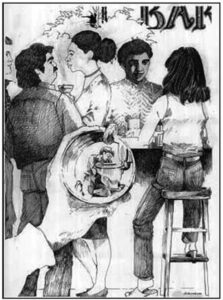
Look through the Bottom of the Glass: An attractive lounge beckons the drinker, promising relaxation, sophistication, companionship, and fun. The ultimate truth of the evening is humiliation, degradation, embarrassment, and sickness, as the drinker embraces his loyal friend, the toilet.
When you replace an addiction, you adopt a new identity that sets you apart from others. As you live within your limits, you notice many other people who don’t—and they all seem to get away with it! Later, you observe those people who eat carefully and drink carefully or not at all, who don’t smoke, and are loyal in their sexual relationships. You recognize looking forward to an addictive behavior, carrying it out, enduring the physical consequences, and feeling bad about yourself ate up a lot of time and energy. Breaking free from all that is a tremendous accomplishment. Your time and effort are now available to devote to things you couldn’t get done before.
Without the anesthetic of addiction, you’ll probably become more aware of the costs of your self-defeating life patterns and enduring emotional adjustments. You can now devote some of your extra energy and confidence to changing these survival patterns.
Key Takeaways from this Chapter
- The process of recovery takes place step-by-step. For some of us, like me, it took several years before I’d accomplished my recovery goals.
- Because active addictions threaten our health, safety, self-worth, relationships, and ability to make a living, often these are the logical first step in your recovery. If you need to, be sure to get professional guidance as you design and carry out your recovery plan.
- An essential beginning to recovery from any addiction is specifying the exact personal limits necessary for you to recovery. For most people, the only effective approach is to abstain from the substance or behavior which has become addictive completely. Painful experience teaches that if we engage in even a single episode of addictive behavior, we are at high risk of triggering the entire pattern.
- Once you have addiction recovery underway, you have the energy and focus to address self-defeating life patterns and enduring emotional adjustments effectively. Always remember, you don’t have to do it alone. The wisdom, support, and example of other people show us the way.
- No matter how many steps there are in your recovery path, just focus on taking as many recovery steps as you’re able today, and celebrate what you’re doing. Every step counts.