
Replacing Self-Defeating Life Patterns
December 30, 2025
Self-defeating life patterns originate with our childhood attempts to survive and meet our needs in troubled families. We needed recognition, affection, autonomy, attention, and accountability. If we become compulsive achievers, we probably needed parental recognition. Those of us with co-dependency often needed affection and security. When we became lightning rods and generalized rebels, we often needed respect for personal autonomy. Those of us who become casualties needed compassionate parental support and teaching. If we developed under-responsibility pattern, we may have needed accountability and encouragement to be responsible. You may have needed several of these forms of love.
Our childhood attempts to meet our needs could only partially succeed because we couldn’t escape or change the family challenges described in an earlier post. Our parents often couldn’t parent constructively because they struggled with their own survival patterns and didn’t have the information and resources to overcome them. But now we have all the information and resources to change our self-defeating life patterns—once we decide to do so.
My name is Lane Lasater, a retired clinical psychologist. In gratitude for the life I have been given, I am sharing everything I learned during my career and personal life here on my website http://www.LaneLasater.com and on my YouTube Channel Life Roadmaps from a Retired Psychologist https://www.youtube.com/@lane205 Each post contains my written material, an AI generated graphic, a 15-17 minute audio summary, and a 5-7 minute video summarizing the material. A printable and fillable PDF “Exercises to Support Recovery from Family Trauma Syndrome” with each exercise I describe in my videos can be downloaded here: Transcending Family Trauma Workbook
“The only thing you have to change is everything.”
Anonymous
How to Replace Self-Defeating Life Patterns
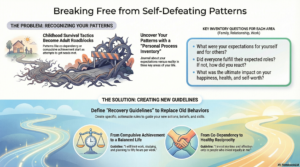
To replace your self-defeating life patterns, you must first recognize how these patterns play out in your life and how they work against your best interests. Then define recovery guidelines for each pattern which applies to you with revised beliefs and learned new skills to meet your needs.
Recognize Self-Defeating Patterns
Self-defeating life patterns are rarely effective at furthering our goals in our relationships and at work. We may have done our best in our childhood families, but other people didn’t do what we hoped and expected. We then tried to get them to change but couldn’t. We bring these same expectations and sense of powerlessness to our adult relationships and work environments, and may unintentionally choose relationships and workplaces that don’t meet our needs. In this way, we continually replay childhood themes.
Recovery Exercise #19: Your Personal Process Inventory
In your recovery journal, complete a “personal process inventory” examining the self-defeating life patterns you may use to clarify what needs drive these patterns and recognize where things went off the track. Before writing about your personal process, read through the inventory instructions and example below to understand how this works.
Inventory Instructions
- Write about how you wanted things to be in (a) your family during childhood and adolescence, (b) in a significant romantic relationship or marriage (if applicable), and (c) one work situation.
- What was your “job description” or expectation for yourself in each situation? Did you fulfill your job description?
- What was your “job description” or expectation for the other central people in each situation? Did they meet these expectations?
- If you didn’t carry out your “job description” in a relationship or work situation, what happened then? Did you change your behavior, defend yourself, counterattack, try to conceal your failure, or leave the situation?
- If other people didn’t meet your expectations in a relationship or work situation, what happened then? Did you try to make them do what you expected by trying harder at your job, reasoning with them, complaining, withdrawing emotionally, being angry, or being self-destructive? Did they change?
- What happened to your happiness, health, self-worth, use of addictions, satisfaction, and spirituality in each situation?
Brittany’s Personal Process Inventory: Fighting for Her Needs
Brittany was a medical student who faced enduring emotional adjustments, co-dependency, generalized rebellion, and alcohol abuse during recovery.
In Her Family
“I wanted a happy family, parents who got along, a mother who didn’t drink and was good to me, a father who respected me and spent time with me, no fighting, fun activities together, everyone loving each other. My job was to be a good kid, do my chores, do well in school, stay out of trouble, and be considerate. I did these things. My parents’ jobs were to love each other, love us, enjoy spending time with the family, overcome depression, not drink, and get help if they needed it. They didn’t do any of these things.
“To change things, I counseled my parents, supported them individually, confronted my mother’s drinking, tried to get my father to treat her better, asked him to spend more time with me, pulled back from them, rebelled, got angry, started drinking. Nothing I did made things better.
“I ended up depressed and angry about my family. I’m ashamed of them and don’t enjoy going home. I wish I didn’t come from this family. I’m having a lot of emotional problems that go back to them.”
With Her Boyfriend
“I want Jim to love me, affirm his commitment, plan our life together, share activities and accept me. My job is to care about him, do what I say I’m going to do, be loyal, be fun to be with, express affection, not over drink. I do these things; except he objects to any drinking. He doesn’t want to date exclusively or be together every weekend, doesn’t accept my drinking, and criticizes me and my family.
“I’ve tried to show Jim I’m a good person. I do things he wants to do. I’m kind to him. I’ve asked him to commit to me. I’ve slowed down my drinking. He doesn’t want a long-term relationship, so I’ve pulled back. I feel insecure and angry and don’t respect myself because I can’t seem to just let go of him. The whole thing depresses me and I drink more even though he objects to it.”
At Work
“At the clinic where I work, I want support for a research project I’ve proposed. I want a warm emotional climate for patients, and I want to move toward a more holistic model of patient care. My job is to deliver excellent patient care, continue learning, develop research ideas, and do my best to create a healing climate for patients. I do these things. The administration’s job is to improve patient care, welcome new ideas from staff, support research, and support a healing climate. They don’t do these things to the extent I think they should.
“I have pushed my research proposal, written memos, talked to administrators, argued in staff meetings, and distributed articles on holistic medicine. I haven’t had the impact I want. Some people would like to see me leave. I’m labeled a troublemaker and I dread going to work.”
Brittany failed to create the family relationships, romantic relationship, and work environment that she needed. Her efforts to change other people and systems led to more pain, which she suppressed with over-drinking. Her recovery challenge was to find successful ways to meet her needs for affection, recognition, and encouragement.
Developing Self-Defeating Life Pattern Recovery Guidelines
Exactly as you did in defining personal addiction limits in the last chapter (if applicable), define recovery guidelines to regulate each self-defeating life pattern that applies to you, revise the mistaken beliefs that perpetuate these patterns, and replace them with realistic information and experience and add new skills to balance your life. Here are examples of recovery guidelines, revised beliefs, and new skills for the five people whose lives illustrated the self-defeating life patterns described earlier.
Justin’s Compulsive Achievement Recovery Guidelines
- I study, work, work out and plan for these activities only fifty hours per week.
- I’m expanding my identity by developing additional dimensions of myself, including recreation, service to others, and friendships.
- Every week I plan intimate time with family and friends.
- I developed and am implementing my diet, exercise, and rest self-care plan.
- I recognize and accept that academic and athletic success alone won’t fulfill me.
- I’m gradually learning to relax during unstructured time.
- I practice expressing feelings and being intimate with others.
Justin’s Recovery Process
Justin didn’t seriously change his compulsive achievement until they’d been separated for several months. Initially, he enjoyed living alone because he could work to his heart’s content, but soon felt empty and lonely, even after accomplishing a lot. Justin realized his open-ended achievements were progressively less fulfilling. He set an income goal to provide for a reasonable family lifestyle and decided he could achieve this by working fifty hours per week. This left him more free time to spend with his wife and children. He stopped smoking and reduced his drinking. He began getting in shape and rediscovered skiing and hiking, which he’d enjoyed before. He educated himself about relationships through self-help groups, reading, and workshops. When the couple ended the separation, he’d developed the skills to create new intimacy with his spouse.
Ashley’s Co-Dependency Recovery Guidelines
- I invest my time, energy, and affection in people who invest equally in me.
- I honor my wishes, needs, and values in my relationships.
- I take responsibility for only my part in what goes wrong in my relationships.
- I let other people take responsibility for and worry about themselves.
- I can’t make anyone care about me, so if someone doesn’t care about me, I look for a relationship with someone who reciprocates.
- I pay attention to my feelings and needs in personal and school situations.
- I’m learning to protect myself from unfair criticism or abuse.
Ashley’s Recovery Process
Ashley recognized over the course of a year that her marriage would never provide a healthy environment for her. Her husband refused to see a marital counselor. Ashley was unwilling to continue with the financial insecurity and intermittent emotional attention he provided. After much preparation, she filed for divorce, entered graduate school in social work, and moved out on her own. She felt better about herself almost immediately. She took better care of her health and started losing weight. She felt more energy and enthusiasm than she had in years.
This initial high faded after a few months, however, and she periodically felt fearful and lonely. She began attending Codependents Anonymous (CODA) meetings and for the first time sought and found friends who were enthusiastic about her. With their support, she could face the financial changes and uncertainty of life on her own. After two years, Ashley met a man who gave her the warmth and respect she’d always craved.
Joseph’s Generalized Rebellion Recovery Guidelines
- I identify my personal and work responsibilities and do my best to meet them.
- I don’t have to be the “heavy” in most situations.
- I’m not responsible for changing what’s wrong with other people and organizations. I evaluate each situation according to whether my attempts to help will make things better or worse.
- If I get angry about something, I use this as a warning that I may start a fight I’m powerless to win.
- I focus my efforts on what I can change because there are many people and things I can’t do anything about.
- I try to let issues pass without challenge if they aren’t really my business.
- I’m finding people who support me in letting go of things that I can’t change.
Joseph’s Recovery Process
Joseph’s preoccupation and anger about work finally led his wife to insist he get help. He started attending Adult Children from Alcoholic Families (ACOA) support groups. A friend there told him, “You don’t have to save the world, just don’t make things worse!” This shocked Joseph, but he recognized his continual campaigning had become destructive. He realized his reform movements began with his attempts to change his family as a child.
Joseph had to leave behind his resentment about his childhood. As he shared his hurt and anger about his troubled family and found that other people had been through similar experiences, he could stop struggling so hard to change his co-workers. He searched for a job with an organization he didn’t feel compelled to reform.
Elizabeth’s Casualty Syndrome Recovery Guidelines:
- I clearly communicate my wants and needs to others in situations that affect my well-being.
- I recognize I can’t rely upon anyone to take care of me as an adult.
- I don’t expect other people to understand my feelings and needs unless I tell them directly.
- Other people can advise me about how I live, but I make the final decisions.
- I can’t trust everyone and recognize and avoid people who aren’t reliable.
- I identify my feelings and needs in personal and professional situations.
- I can protect myself from unfair criticism or abuse.
Elizabeth’s Recovery Process
Elizabeth was in a financial trap with four children and few career skills. Feeling desperate, she entered psychotherapy at a reduced fee through a pastoral center. Elizabeth needed the encouragement and direction she’d missed as a child to solve her own problems. Through therapy and the support of her church, Elizabeth released the fantasy of finding someone to rescue her. It was scary to know she had to provide for herself. Elizabeth took assertiveness training and practiced standing up for herself with her children and other adults. She won a grant to complete training as a data processor. Over a two-year period, she learned she could manage her own life and build security and stability.
Jacob’s Under-Responsibility Pattern Recovery Guidelines
- I do what I say I’m going to do.
- I take responsibility for myself.
- I don’t ask people to make allowances for me.
- If someone gets angry at me, I’ll look at whether I provoked this reaction through under-responsibility.
- It hurts my self-worth if I feel I’m getting away with something.
- I understand that life is a balance of effort and rest, and I achieve very little of value without hard work.
- Jacob’s Recovery Process
Jacob’s wife started attending Co-Sex Addicts Anonymous (COSA), a self-help group for significant others of people with compulsive sexual behavior. After a few months, she informed Jacob she would end the marriage if he didn’t end his affair and give her control over his business spending. Jacob accepted these conditions to save his marriage and business. He needed someone to hold him completely accountable. Because his wife could do this, both his marriage and business survived. Jacob recognized he couldn’t afford to have people close to him let him get away with under-responsible behavior. He felt the beginnings of genuine self-worth as he accepted responsibility for his life.
Recovery Exercise #20: Your Recovery Guidelines
What guidelines, beliefs, and skills will guide your recovery from self-defeating life patterns? Write these down, apply them at your own pace, and adjust as you need to. As you reduce problems from self-defeating life patterns in your daily life, you’re ready to take on the next phase of recovery.
Key Takeaways from this Chapter
- Because we’ve repeated self-defeating life patterns so many times over many years, it’s challenging but possible to change these entrenched behaviors.
- As with each recovery step we take, clearly understanding how these patterns show up in our lives and what they cost us guides us as we replace them.
- For self-defeating life patterns, it’s normal to make gradual behavior changes over time as we identify faulty beliefs and learn replacement behaviors.
- Writing and journaling are powerful tools that help us confront mistaken beliefs and strategies from childhood.
- Neutral allies such as other members of self-help groups provide examples of recovery and support for the changes we make.