
Guideline #2: Practice “Authoritative Parenting”
February 10, 2026
My name is Lane Lasater, a retired clinical psychologist. In this post, I point you toward foundational conceptual and parenting research done by Dr. Diana Baumrind that provides clear and practical direction for all parents.
Psychologist Diana Baumrind (1966), in ongoing research[1], and in an article entitled “Rearing Competent Children”[2] originated the description of parenting styles, which has been widely studied and refined since that time. The American Psychological Association[3] describes the following three dominant parenting styles derived from Baumrind’s work that have been researched around the world.
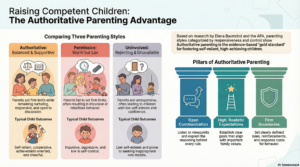
“Authoritative: In this parenting style, the parents are nurturing, responsive, and supportive, yet set firm limits for their children. They attempt to control children’s behavior by explaining rules, discussing, and reasoning. They listen to a child’s viewpoint but don’t always accept it. (Italics added) Children raised with this style tend to be friendly, energetic, cheerful, self-reliant, self-controlled, curious, cooperative and achievement-oriented.
Permissive: In this parenting style, parents are warm, but lax. They fail to set firm limits, to monitor children’s activities closely or to require appropriately mature behavior of their children. Children raised with this parenting style tend to be impulsive, rebellious, aimless, domineering, aggressive and low in self-reliance, self-control and achievement.
Uninvolved: In this parenting style, parents are unresponsive, unavailable and rejecting. Children raised with this parenting style tend to have low self-esteem and little self-confidence and seek other, sometimes inappropriate, role models to substitute for the neglectful parent.”
Gwen Dewar, Ph.D. on her website, The authoritative parenting style: An evidence-based guide provides a thorough description of the authoritative parenting approach, describes what it looks like in actual parenting scenarios, and reviews extensive research on positive developmental outcomes for children raised with this philosophy around the world, including some cross-cultural differences. Extensive research about authoritative parenting confirms that this approach provides a useful philosophical foundation and general guidance for all your parenting activities.
This research on authoritative parenting supports including the following elements into your parenting:
- Listening to your child, allowing him/her to have their own opinions, and providing emotional support and affection
- Creating high yet realistic expectations (including your most important values addressed separately in this handbook.)
- Setting clearly defined limits, rules, boundaries, reinforcements and response costs.
- Explaining rules, discussing why they are important, and reasoning with your children.”
- Implementing the universal parenting practices identified in the long-term British study described next.
[1] Baumrind D. 1966. Effects of authoritative parental control on child behavior. Child Development, 37(4), 887-907.
[2] Baumrind D. 1966. Effects of authoritative parental control on child behavior. Child Development, 37(4), 887-907.
[3] https://www.apa.org/act/resources/fact-sheets/parenting-styles