Meeting Your Basic Human Needs During Childhood and Now
December 19, 2025
Basic Human Needs
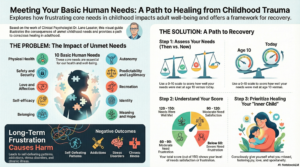
Another useful way to understand how we coped with our childhood environments is our ability to meet basic human needs, a concept introduced by Abraham Maslow (Motivation and Personality). When we can’t fulfill our basic human needs, we’re at greater risk of developing enduring emotional adjustments, self-defeating life patterns and addictions. My doctoral research explored the connection between health and well-being and our ability to meet our needs in our environment. I focused on these 10 basic human needs.
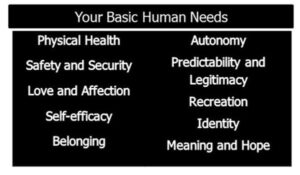
Most of these needs are self-explanatory—but legitimacy refers to exercising human rights and receiving fair and just treatment, and identity means defining and understanding our personal strengths, limitations, philosophy, and moral values. When our basic human needs are frustrated, we experience fear, anger, sadness, grief, or guilt. As frustration continues, we may turn to addictions in misguided attempts to meet or suppress our basic human needs. When we’re unable to meet our needs for extended periods of time, we’re prone to stress disorders, frequent viruses, and ultimately, chronic illnesses such as heart disease, diabetes, cancer, and arthritis.
This post gives you an overview of my research on basic human needs and how these apply to children (now adults) who grew up in troubled home environments.
My name is Lane Lasater, a retired clinical psychologist. In gratitude for the life I have been given, I am sharing everything I learned during my career and personal life here on my website http://www.LaneLasater.com and on my YouTube Channel Life Roadmaps from a Retired Psychologist https://www.youtube.com/@lane205 Each post contains my written material, an AI generated graphic, a 15-17 minute audio summary, and a 5-7 minute video summarizing the material. A printable and fillable PDF “Exercises to Support Recovery from Family Trauma Syndrome” with each exercise I describe in my videos can be downloaded here: Transcending Family Trauma Workbook
Recovery Exercise #3: Your Basic Human Needs While Growing Up and Now.
Use the following questionnaire to assess how well you could meet your basic human needs while growing up and now.
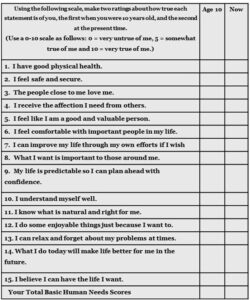
Your Basic Human Need Scores
Your total basic human need scores at age 10 and now can range from 0 to 150. Scores below 60 suggest you endured or currently endure severe need frustration. Scores in the 60-90 range suggest moderate need frustration. Scores in the 90-120 range suggest moderate need satisfaction. Scores of 120-150 suggest that your needs were or are well met.
If your childhood scores fall below 90, you grew up in an environment without enough resources for you (as you already know). If this was the case, pay special attention to finding a lot of support during recovery through resources such as self-help groups, therapy, close friends, and church and community groups.
Your answers to this questionnaire highlight the needs you were or are most and least able to satisfy. During recovery, make those unmet needs a conscious priority. Think in terms of that little boy or girl inside of you and how you can give back to him or her every day the things they needed then but didn’t receive. When you consciously give back to yourself in recovery those things you missed along the way—that inner child will in time repay the care you provide to him or her through the joy, love and spontaneity that are the essential nature of our child selves.
Few families are completely troubled or totally healthy. If we depict family well-being in a bell-shaped curve, the midpoint would represent families with both moderate strengths and moderate problems. About 64 percent of families would fall into this middle range. Approximately 18 percent of families would be very troubled with few resources, and approximately 18 percent would have exceptional resources and well-being.