Introducing Childhood Challenges and Childhood Resources
December 11, 2025
Why do so many of us face family trauma and other adverse experiences during childhood? We now know that family troubles pass from generation to generation when children adapt to the limitations of their parents, and then as adults unknowingly convey these limitations to their own children. As we reach adulthood, we strive to emancipate from our families and attain behavioral and emotional freedom from our childhood limitations. We often find it’s more difficult to separate than we realized, but now we can access the resources and information we need to interrupt these multigenerational patterns of family troubles and addiction. This module provides an overview of childhood challenges and childhood resources as you prepare to explore more deeply the specific challenges and resources you faced with self-assessments in subsequent modules.
My name is Lane Lasater, a retired clinical psychologist. In gratitude for the life I have been given, I am sharing everything I learned during my career and personal life here on my website http://www.LaneLasater.com and on my YouTube Channel Life Roadmaps from a Retired Psychologist https://www.youtube.com/@lane205 Each post contains my written material, an AI generated graphic, a 15-17 minute audio summary, and a 5-7 minute video summarizing the material. A printable and fillable PDF “Exercises to Support Recovery from Family Trauma Syndrome” with each exercise I describe in my videos can be downloaded here: Transcending Family Trauma Workbook
How do Childhood Environments Lead to Adult Challenges
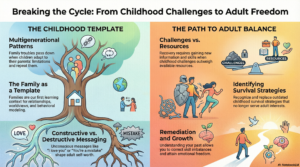
How do our childhood environments lead to adult emotional and behavioral problems? How do we evaluate difficult childhood experiences? This chapter helps you understand both the challenges you faced and the resources you received from your childhood family and community. The resources we received helped offset the impact of adverse experiences and trauma, but unfortunately, for many of us, our challenges outweighed our resources. So, we must work hard during recovery to gain additional information and learn new skills to bring ourselves into balance as functioning adults. Because our family is our first learning context, it serves as the template for adult behavior. We watch our parents and model their behavior, and learn directly and indirectly from our families about relationships, how to view the world, and how to behave. We receive (often unconscious) powerful constructive and destructive messages from parenting figures such as “I love you,” “You’re a good girl,” “It’s okay to make mistakes,” “I’m glad you’re here,” “Get a good education,” or “You’re stupid,” “You don’t belong here,” “That’s not good enough,” “Don’t bother me,” “Don’t expect too much,” and “You’re a mistake.”
Siblings often experience quite different family environments because of changes in family finances or parents’ relationship, the progression of addictions, the departure of older siblings, and whether grandparents or other relatives are available to us. We rarely knew too much about other families, so we assumed our family was representative. If problems predominated over family strengths, we instinctively learned that our goal was to survive. The more we understood ourselves and developed emotional and relationship skills, the more choices we had and the more enhanced our lives became, or vice versa.
Coping with our troubled families frequently required us to over-learn certain skills while not learning others, so we become adept at the skills we practiced frequently. Our pattern of skills and deficits then prepared us either well or poorly to cope with adult responsibilities and challenges. Your family may have provided an environment rich in emotional expression, yet lacking in encouragement for intellectual curiosity and development. You may have found it necessary to take responsibility beyond your years, but because of an unsupportive emotional environment and your lack of preparation, these responsibilities were overwhelming and filled you with fear. You may have learned that adults relax and have fun by drinking alcohol, or that playing games and working on hobbies is fun, or that adults never relax because they’re always working. Now you have the power, information, support, and resources to identify and correct the emotional and skill imbalances you experienced. During recovery you recognize and replace beliefs, skills and survival strategies that don’t serve your best interests. This website leads you through the process of evaluating your child and teenage experiences so you can effectively remediate their adult aftermath.