How to Be an Effective Psychologist
December 15, 2025
In this post I want to explain to you how I helped people understand themselves and find enduring solutions to the challenges they faced. Throughout my career, I used ordinary language descriptions rather than psychological diagnostic terminology (except for PTSD and Chronic PTSD) to describe people’s recovery experiences. Psychiatric and psychological diagnoses were originally developed to be a helpful shorthand for professional communication, but the unintentional result has been that many people feel dehumanized and disempowered by such labels. The essence of recovery for me is embracing our shared humanity, and through informed individual choices, making the best of our lives no matter what challenges we encounter.
My name is Lane Lasater, a retired clinical psychologist. In gratitude for the life I have been given, I am sharing everything I learned during my career and personal life here on my website http://www.LaneLasater.com and on my YouTube Channel Life Roadmaps from a Retired Psychologist https://www.youtube.com/@lane205 Each post contains my written material, an AI generated graphic, a 15-17 minute audio summary, and a 5-7 minute video summarizing the material. A printable and fillable PDF “Exercises to Support Recovery from Family Trauma Syndrome” with each exercise I describe in my videos can be downloaded here: Transcending Family Trauma Workbook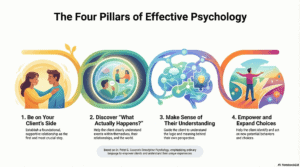
Among many wonderful teachers whom I studied with during my training as a psychologist, my most important mentor was Dr. Peter G. Ossorio, who has now passed away. Dr. Ossorio was a Professor in the University of Colorado Department of Clinical Psychology and was a brilliant thinker, teacher, therapist and a wonderful human being. He developed a school of psychology called “Descriptive Psychology” that allowed professionals to precisely describe people’s choices and behavior in everyday language without judgment. Dr. Ossorio’s taught me and many others how to be most helpful to people as a psychologist building on four simple yet profound instructions:
- Be on your client’s side.
- Help your client understand “What actually happens?” within themselves, relationships, families, and the world.
- Help your client understand the sense they make as they understand “What actually happens?” above.
- Empower your client to expand their potential choices and behavior within their world.
Because I grew up in a troubled family system and had to recover from Family Trauma Syndrome and alcoholism, I understood firsthand many of the challenges that people described who came to me for help. Combining personal experience with professional training then allowed me to understand and precisely answer the question “What actually happens?” in troubled families for children and what is required during recovery as adults. The clarity I developed about how troubled families work and what recovery requires empowered me in my life, and I found this information was very helpful to my clients. As I followed Dr. Ossorio’s four instructions above, I developed self-help books and materials to share this understanding with as many people as possible. This website (www.LaneLasater.com) and my YouTube channel (Recovery Roadmaps from a Retired Psychologist) are intended to share everything I learned during my career.