
Guideline #9: Suggestions for Family Decision-Making
February 14, 2026
Families are not democracies, where everyone has an equal voice in making decisions. But, children of all ages have a right to their opinions, and need to give their ideas on decisions that affect them. Parents or parent figures, as adults, have final responsibility for family decisions, except in cases where parents can’t or won’t meet their responsibilities. Then a Social Services agency or Court takes charge of the children.
This post is from my book Purposeful Parenting Handbook: Guidelines for Raising Capable, Confident, and Accountable Children. My name is Lane Lasater, a retired clinical psychologist. In gratitude for the life I have been given, I am sharing everything I learned during my career and personal life on my website http://www.LaneLasater.com and on my YouTube Channel Life Roadmaps from a Retired Psychologist https://www.youtube.com/@lane205
Each post contains my written material, an AI generated graphic, a 15-17 minute audio summary, and a 5-7 minute video summarizing the material.
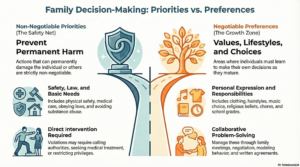
Suggestions for Family Decision Priorities
Before you finalize your Family Agreement in a forthcoming post, I suggest the following important guidelines for setting family priorities. Following these guidelines lets you effectively focus your family energy and resources.
Teenagers are preparing for independence where they’re fully in charge of their actions. The older children are, the more I recommend that parents exercise influence, rather than control, unless it’s an emergency. To give you an idea of family emergencies that require someone to take control, I sort family behavior into non-negotiable priorities and negotiable preferences.
These help you figure out what is an emergency versus what only feels like an emergency. Then, you can respond deliberately and rationally to other family member’s choices and behavior rather than reacting impulsively and emotionally. When any of us respond to challenges on the spur of the moment, we often make the situation worse. It helps to carefully think through our priorities and options beforehand.
Non-Negotiable Priorities
Do everything you can to prevent actions by anyone that can permanently damage or harm him or her or others. When non-negotiable priorities are met, family members can at least carry on with their daily lives and work (including school), even though the family atmosphere may be tense or uncomfortable. Non-negotiable priorities apply to parents as well as children, so make sure you “walk your talk” in these areas. Examples of non-negotiable priorities for most families are:
- Maintaining physical safety
- Meeting basic needs for food, clothing, shelter and medical care
- Obeying the law
- Safe driving and wearing seat belts
- Avoiding drug and alcohol abuse
- Eliminating violence or threats of violence
- Not endangering self or others (including others in the community)
- Responding to threats or risk of suicide
- Not carrying Weapons (unless legally permitted)
- Avoiding unsafe sexual behavior
- Attending school and meeting work responsibilities (at home or in the community)
When a family member (adult or child) violates a non-negotiable priority, you can consider the following intervention options:
- Call the police and press charges
- Notify authorities of illegal behavior or acts endangering oneself or others
- Seek mental health care, addiction treatment, medication or hospitalization
- Remove weapons from the house to safekeeping
- Restrict transportation or money
- Limit or remove the privilege to use family vehicles
- Develop alternative living arrangements
Negotiable Preferences
Negotiable Preferences are things we may have strong feelings or opinions about. But these don’t usually lead to permanent damage or harm. Negotiable preferences ideally are usually discussed and debated during family life. Negotiable preferences involve values, lifestyles, and individual choices that each human being must make decisions about as they mature. Examples of negotiable preferences are:
- How a family member dresses
- Using profanity
- Getting good grades and setting educational goals
- Choosing friends and companions
- Completing chores and home responsibilities
- Maintaining a job
- Hairstyles
- Choosing the music one listens to if it doesn’t disturb others
- Wearing jewelry, body piercing or tattoos
- Engaging in safe sexual practices
- Attending Church, Synagogue or Mosque, and one’s level of religious participation
- Personal religious or spiritual beliefs or lack thereof
- Political philosophy
Consider the following problem-solving options for dealing with Negotiable Preferences
- Family meetings
- Parent and Family counseling
- Individual counseling
- Obtaining relevant information
- Negotiation
- Modeling
- Written agreements
- Assistance from friends and relatives