
Practice Effective Couple Communication
February 3, 2026
A frustrating thing about intimate relationships is when we most need to communicate positively, we’re least able to. We get mad, stressed, hurt, or scared, and do and say things we wish we hadn’t, or we don’t feel like talking at all. Unhelpful communication, or no communication, makes everything worse. Below, I alert you to common couple (and family) communication pitfalls and suggest constructive guidelines on how to improve this skill. I use the word “communicating” rather than “talking” because a lot of what couples (and all human beings) communicate is non-verbal, through body language, actions, making faces, or gestures.
I’d tried to understand couple communication since my unsuccessful childhood attempts to moderate my parents’ arguments. As a psychologist, I quickly discovered that having couples sit in my office and scream at each other was a disaster. People said destructive and sometimes irrecoverable things. They were doing their best, but unintentionally making things much worse. I recognized I had to teach couples (and families) specifically what and how to communicate effectively. The following guidelines will help you and your partner communicate successfully.
From the classic couple peeve of whether he/she puts the toilet paper roll facing front or back to truly important issues like money management and child-rearing approaches, there will be many adjustments during the partnership. Decide what’s really important and what you can accept and live with, then just let the latter things go. Focus on your entrance exam and what you must have or can’t stand in a relationship. There will be clashes—hopefully smaller ones because you’ve screened for issues that would present unresolvable conflicts. Below, I describe four sets of guidelines for couple communication:
- No communication “nukes”
- Affirming partner communication
My name is Lane Lasater, a retired clinical psychologist. In gratitude for the life I have been given, I am sharing everything I learned during my career and personal life on my website http://www.LaneLasater.com and on my YouTube Channel Life Roadmaps from a Retired Psychologist https://www.youtube.com/@lane205 Each post contains my written material, an AI generated graphic, a 15-17 minute audio summary, and a 5-7 minute video summarizing the material. You can download a fillable and printable PDF workbook that contains all the exercises that I developed to accompany the material here: Finding a Life Partner Fillable Workbook
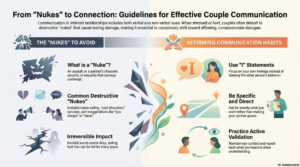
1. No Communication “Nukes”
A nuke is an assault on a person’s character, adequacy as a human being, basic security, or sexuality. When you drop one of these, you’re treating that person with contempt. A nuke always makes things worse. Here are destructive couple and family communication nukes to avoid.
- Name-calling: calling someone stupid, idiot, loser, jerk, or lazy, etc.
- Threats of abandonment: like “I want out” or “I hate you.”
- Lectures: “How many times have I told you this,” or “Didn’t anyone ever teach you how to ?”
- Cold shoulders: hostile silences, not saying hello or goodbye, or pretending someone isn’t there.
- Interrupting: “I don’t care what you have to say” or “You listen to me!”
- Martyrdom: playing the victim by saying, “You’re ruining my life,” or “What have I ever done to deserve the way you’re treating me?”
- Sarcasm or contempt: veiled hostility, making faces, or humiliating someone.
- Negative reminders: “I told you so.”
- Exaggerations: “You never help,” or “You always leave your clothes on the floor,” or “You never listen to me.”
- Throwing “the kitchen sink”: Dumping a bunch of pent- up issues on someone all at once.
You’ve probably used communication nukes and been nuked by others, so you know how hurtful these are. We never forget some mean things that people say to us—especially when they come from the people we’re closest to. We can still feel the hurt years later.
Action Step #20: No Communication Nukes!
Make a list of communication nukes you’ve experienced (or used) in the past and discuss these with your partner. Agree that using communication nukes will be completely off-limits in your partnership. If either of you feels tempted to use a nuke in an argument or discussion, it’s a warning sign you need to take time out to cool off. As tempting as it is to “get in the last word,” a nuke creates sometimes irreversible hurt. If you use a nuke, apologize sincerely as soon as you can, even though harm has already happened. An insincere apology is just another nuke!
2. Affirming Partner Communication
When you and your partner communicate in kind ways, you experience the benefits of partnership—support, recognition, belonging, affection, good ideas, and encouragement. Here are positive communication guidelines:
- Use “I” statements rather than “you” statements, for example, “I’m disappointed that you didn’t talk to me when we were out” instead of “you didn’t talk to me all evening!”
- Acknowledge positive things the other person says or does.
- Look directly at your partner when you’re talking.
- Be direct but compassionate in expressing your feelings and thoughts.
- Let the other person be responsible for themselves— don’t speak for them.
- When you say something positive, be specific about what you mean. Specifics carry a lot more weight than generalities.
- Ask for exactly what you want. Don’t make your partner guess what you need.
Action Step #21: Couple Communication Exercise
- Listen to your partner throughout this exercise and repeat back everything you heard him or her say. Let them know the positive things you learned about them or thought of during the exercise.
- One person talks for one minute about an interest he/she has and why it’s important to them. For example, you might explain to your partner how you enjoy caring for plants because they make the house fresher and happier, and how you raise tomatoes in a window pot in order to use in salads.
- When the first person finishes, the partner repeats everything he/she heard and provides positive feedback about the interest their partner shared. He/she can also mention something good it shows about their partner. (For example, when your partner responds to your interest in plants, they tell you they notice and appreciate the effort you make to keep your home pleasant and attractive. They also recognize the work involved in taking care of plants and how much they enjoy them and the fresh tomatoes.)
- The first person thanks their partner for listening carefully and understanding. The speaker tells their partner how much it means to them when their partner notices and appreciates what they shared.
- The other partner then completes the steps above and the first responds.