Guideline #8: Your Non-Negotiable Relationship Requirements
January 22, 2026
Congratulations, you’re ready to connect with a potential partner! You’ve examined your life, prepared your life foundation, built a support network, analyzed your relationship field research, and completed your old relationship business. As you review partner candidates, consider each personal quality and dimension we’ve covered.
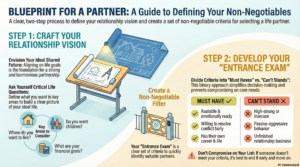
In this chapter you will place down two essential pieces of your partnership puzzle: your relationship vision and goals and your non-negotiable requirements for a partner.
My name is Lane Lasater, a retired clinical psychologist. In gratitude for the life I have been given, I am sharing everything I learned during my career and personal life on my website http://www.LaneLasater.com and on my YouTube Channel Life Roadmaps from a Retired Psychologist https://www.youtube.com/@lane205 Each post contains my written material, an AI generated graphic, a 15-17 minute audio summary, and a 5-7 minute video summarizing the material. You can download a fillable and printable PDF workbook that contains all the exercises that I developed to accompany the material here: Finding a Life Partner Fillable Workbook
“We start a relationship with someone not only because of how great they are but how great they make us feel. And because they have granted us this extraordinary gift—a chance to experience love, joy, compassion, and security—it is our exclusive privilege to make them feel wonderful about themselves, especially during days when they, themselves, don’t feel so wonderful.”
Kamand Kojouri
Your Relationship Vision and Goals
Ideally, our life partner should want similar things. They may have different personal goals but, overall, have similar economic and social aspirations to you in order to avoid constant conflicts over these issues. Your dreams and goals merged with your partner’s form the basis of the partnership agreement you’ll develop during your trial run, and bringing your visions into alignment releases all the power of two people using their effort, creativity, and knowledge toward achieving common goals. As you invest your combined efforts and thoughtfully adapt together to changed circumstances, life will continue to challenge you, but the outcome is often more wonderful than what you originally envisioned.
Action Step #16: Develop Your Relationship Vision and Goals
In your relationship journal, describe what you want in each of the following areas.
- Where do you want to live?
- What are your career objectives?
- Do you want to have children, and if so, how many and when?
- What is your philosophy for raising children?
- What core values do you live by?
- How do you include spirituality or religion in your life?
- What are your political values and how important are they to you?
- What are your financial goals?
- What hobbies or interests do you enjoy?
- What diet do you follow, and how do you maintain health and wellness?
- What relationship do you want with the people who raised you, siblings, and relatives?
- How are you involved in your community?
My Relationship Vision When I Met Nancy
I want to live in Colorado (where I grew up) because of the sunshine, overall climate, and access to hiking, backpacking, and skiing. I’m looking for an active outdoor woman who enjoys these activities and is willing to live in Colorado. I’d like to have two children and create a peaceful and stable home life with my partner. Creating a loving environment with accountability and good boundaries is very important in contrast to the family I grew up in.
As a psychologist, I plan to work in community and private agencies and ultimately begin a private practice. I want a partner committed to psychological growth who has a career that complements mine. I take part in moderate religion and spirituality and want to introduce our children to spiritual principles and practices for living. Financially, I want to earn enough to help our children with their educations, prepare for retirement, and have a pleasant home and the opportunity for some travel. Being of service to my community and volunteering are important.
I’m committed to a healthy lifestyle and eliminating unhealthy habits. I want a friendly relationship with my parents, siblings, and relatives, and with my future partner’s family and relatives, but don’t want to be over-involved with either family. I want a relationship that provides the strength and security so we can face whatever challenges may come our way with courage, integrity, intelligence, and a sense of humor.
Develop Your “Entrance Exam”
Your “entrance exam” is a set of requirements you’ll look for in a potential partner. It includes non-negotiable criteria that stem from your vision and goals, your field research, and your most important relationship needs. You’re the gatekeeper who decides who gets into your life, so your entrance exam lets you readily identify potential partners to get to know better and bypass people who aren’t candidates. Your entrance exam for your partner has two non-negotiable categories of personal characteristics: “must have” and “can’t stand.”
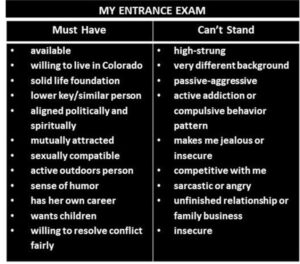
During my relationship search, I learned that if I began a relationship with a woman who didn’t have all my “must have” qualities or had any of my “can’t stand” criteria, within a short time I was unhappy and obsessed with those very characteristics or lack thereof. I was deluding myself when I told myself, “I can get used to it!” You won’t know whether someone meets your entrance exam when you first meet, but you know exactly what you’re looking for and can act decisively as you learn more.
Only put truly non-negotiable criteria on your list, and when you find someone who meets your entrance exam, go for it! But if you realize someone doesn’t meet your entrance exam, it’s best to end the relationship right then and move on. If your relationship field research is complete, you don’t need more evidence.
I needed my entrance exam on my first call with Nancy. As described earlier, when I called to ask her out, she told me she was seeing someone but said, “We can be friends.” The first item in my “must have” list was “available.” So, I took a deep breath and told her I wasn’t interested in a friendship. After a long pause, Nancy told me that her relationship wasn’t a committed one—whew! If she wasn’t available, I wasn’t going any further.
Action Step #17: Develop Your Entrance Exam
Develop your entrance exam by listing your non-negotiable “must haves” and “can’t stands.”
Don’t Compromise on What You Know You Need
Each exercise you’ve completed in this book helps you get clear about your deepest relationship wants and needs. You aren’t perfect and won’t find a perfect partner, but for Smart Happy Love, honor your non-negotiable criteria. Don’t go beyond the first contact if someone isn’t a potential partner, because starting a relationship that’s anything other than a trial run is asking for trouble and usually a waste of time and emotional energy. Even a one-night stand puts you at risk of getting sidetracked from your partnership goal.
Don’t Kid Yourself!
When you enter a long-term romantic partnership with someone, they bring everything about themselves into your life (and you into theirs), including health, finances, family, debts, friendship network, criminal history, addictions and bad habits, children, and ex-spouses or significant others.
I suggest discussing the information you have about a potential partner with a trusted family member or therapist who understands the qualities you’re looking for and why. We all have blind spots about our deepest needs and hopes about love and sex. Because you’ve documented your non- negotiable criteria in your entrance exam, a neutral ally can help you see if you’re kidding yourself about something or someone.
Can’t People Change If They Don’t Meet My Entrance Exam?
Don’t count on it! For example, you meet someone and early in the relationship they don’t tell you the truth or the whole truth. Is a onetime lie or omission evidence of a deeper character flaw? This kind of trait runs deep. If someone lies, they have the invisible history that precedes that—they are hundreds or thousands of choices into being someone who lies. People can change for the better, but they don’t change because we want them to and they don’t change on our timetables.
In my experience, if someone doesn’t meet your entrance exam criteria the day you meet them, they probably won’t be a potential partner for you (with rare exceptions). Ideally, the person you’re seeking has been working just as hard as you have to prepare for life partnership. As discussed under the levels of sexual relationships, often people unwittingly enter a false start sexual relationship and end up heartbroken because the person they thought was perfect was not available (even if they wanted to be). The person had work to do on their life foundation or hadn’t finished a previous relationship. Once you are sure you’ve established availability and they meet your exam criteria, you can move on to the next stage.
Ready for a Trial Run
Key Takeaways from This Chapter
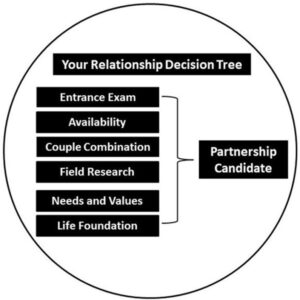
- Use everything you’ve learned about your needs and relationship dynamics to screen potential partners and make each relationship decision intentional.
- Once you know what you’re looking for, don’t carry out more relationship field research—partnership trial runs only.
- After you connect with your potential partner, you still have the partnership trial run ahead so you truly know what you’re getting into.
- Use public information tools available to learn about your potential partner with their permission.
- You deserve a life partner who’s worked just as hard to prepare for partnership as you have.