
Guideline #3: Identify Your Deepest Values and Needs
January 16, 2026
When you start a new relationship, you also enter a relationship (directly or indirectly) with that person’s parents, siblings, and extended family (and vice versa). Even though you might not meet or spend time with these people during the early stages of the relationship, they represent unique personalities, a culture and values system with certain habits, strengths, and weaknesses, and specific family genetic health propensities. These people on both sides of the romantic encounter are invisible participants in your relationship, and how their history and values conflict with or support your own can strongly influence how the relationship works out.
My name is Lane Lasater, a retired clinical psychologist. In gratitude for the life I have been given, I am sharing everything I learned during my career and personal life on my website http://www.LaneLasater.com and on my YouTube Channel Life Roadmaps from a Retired Psychologist https://www.youtube.com/@lane205 Each post contains my written material, an AI generated graphic, a 15-17 minute audio summary, and a 5-7 minute video summarizing the material. You can download a fillable and printable PDF workbook that contains all the exercises that I developed to accompany the material here: Finding a Life Partner Fillable Workbook
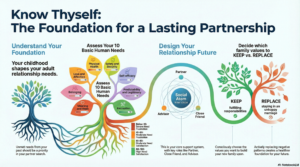
Click here for an audio summary of this post.
“To thine own self be true.”
Shakespeare
Basic Human Needs
The family you grew up in is the logical place to start your self- examination as you prepare for life partnership. The education you received from parents and other family members gives you unique skills, knowledge, values, abilities, attitudes, and beliefs. But families differ in terms of how well they’re able to foster a child’s foundation for well-being, so some of us arrive at adulthood out of balance. If your family couldn’t fully foster your foundation (like mine and Nicholas’ in the previous post), consider how that affects your needs during your search.
A useful way of assessing your childhood family environment is to reflect on how well you could meet your basic needs. Ideally, your childhood environment helped you meet the following 10 needs.
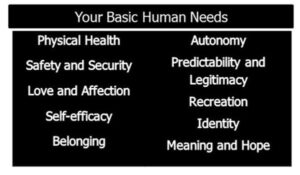
Most of these needs are self-explanatory. Self-efficacy is feeling the power to change your life for the better. Legitimacy means having human rights and receiving fair and just treatment. Identity means defining and knowing your strengths, limitations, philosophy, and morality. When we can’t meet basic human needs, we naturally experience fear, anger, sadness, grief, or guilt. If need frustration continues, we become vulnerable to addictions or compulsive behavior patterns as we attempt to compensate, and long-term need frustration can lead to stress disorders, illness, and ultimately chronic disorders.
Action Step #4: Complete the Childhood Basic Human Needs Survey
Were you able to meet your basic human needs while growing up? In your relationship journal, rate the truth for you at age 10 of each statement below. Use a 0–10 scale, where 0 = very untrue and 10 = very true. Then add up your scores.
- I had good physical health.
- I felt safe.
- I felt loved by my family members.
- I received the care and affection I needed.
- I felt valued.
- I felt comfortable and able to be myself.
- I felt I could improve my life through my efforts.
- What I wanted was important to others.
- I could plan with confidence.
- I understood myself well.
Your Scores
- Your total basic human needs score can range from 0 to 100.
- Isolated single-digit scores suggest individual need frustration.
- Totals below 40 suggest severe need frustration.
- Totals in the 41–60 range suggest moderate need frustration. Totals in the 61–85 range suggest moderate need satisfaction. Totals of 86–100 show that your needs were very well met.
Your childhood pattern of basic human need satisfaction or frustration shapes you somewhat as an adult, so consider this in your relationship choices. If you couldn’t meet certain needs growing up, make meeting these needs a priority when finding a relationship. This will allow you to be your best self.
For example, if you grew up in an atmosphere of severe conflict like me, a relationship providing stability and security without a lot of anger and drama was very important for my well-being. Another example of need frustration is when a parent (or parents) over-controls a child’s freedom to explore and make personal choices, violating his/her need for autonomy. This often precipitates significant rebellion during adolescence, with the young person reclaiming autonomy in sometimes self-defeating ways.
Action Step #5: What Basic Human Needs Are Your Priority?
In your relationship journal, identify the basic human needs you want to make sure you meet in your intimate relationship.
Your Support System Is a Relationship Resource
Your social support system is a wonderful resource during your partnership search and throughout life. When something goes wrong in our primary relationship, we turn to these people to lick our wounds and help pull ourselves back together. The people in your support system want the best for you and can help you sort out the relationship questions that come up during your journey. Psychiatrist J. L. Moreno created a straightforward and visual tool called a “social atom” to display your support system relationships (The Essential Moreno).
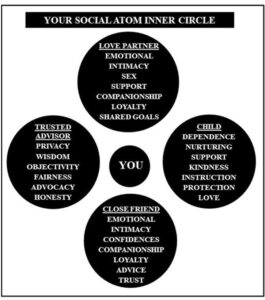
Starting with your inner circle and expanding outwards in circles of decreasing intimacy, your social atom illustrates needs you meet with people in the main social systems you are part of. In your inner circle, you have roles for “love partner,” “close friend,” “trusted advisor,” and, after you start a family, “child.” An additional circle for your intermediate network might have roles for “recreational friend,” “business partner,” “professional mentor,” “spiritual advisor,” “parents,” and “close family members.” In your extended network, you might have roles for “spiritual community friends,” “other relatives,” “neighbors,” “special interest friends,” “professor or teacher,” and “client or customer.”
We often feel comfortable in a social environment which mirrors the pattern of relationships we experienced as a child. We naturally attempt to fill these familiar roles when we enter a new social or work environment, with each role in our support system meeting a specific need. When all relationship roles in your inner circle and intermediate circle are filled, you feel secure and complete, and you rely upon these people for day-to-day intimacy, support, advice, and recreation. Our central relationship roles normally meet several needs for us. When you have a social atom role opening, you naturally seek to fill this space.
Action Step #6: Fill in Your Social Atom Inner Circle
In your relationship journal, draw and fill out the inner circle of your social atom. Identify the person who fills each role for you, such as love partner or close friend. Different close friends may help you meet different needs. If you have role openings now, draw a blank line in that circle. Beneath each role, list the essential needs that role fills for you. When you find a person who’s a candidate for your life partner, things go more smoothly when there’s a good fit (or at least comfort) between you and the people in his/her network, and vice versa. When your social systems don’t mesh well, it isn’t necessarily a deal killer, but this requires negotiating how much time you’ll spend individually and jointly with each other’s social networks.
Your Most Important Values
In values, actions always speak louder than words. When we enter a partnership, we consciously or subconsciously wish to carry on certain values we grew up with, and leave others behind.
Action Step #7: Identify Your Important Family Values
In your journal, list important family values (both positive and negative) you grew up with. Then list family values you want to build in your partnership and/or new family under two headings:
- Important values I learned as a child, and
- Important values I want for my family.
The next example describes Tyler’s family circumstances and the values he wishes to
Tyler’s Value Priorities
Tyler grew up with successful parents, but his home life was unhappy. Both his parents were ambitious teaching physicians who had grown apart from each other. Because they each grew up in single-parent homes, they weren’t willing to face the trauma of breaking up the marriage. Tyler learned later that they both had long-term affairs. His mother and father tried to be close to Tyler and his sister, but their alienation from each other took the joy out of family activities. At home, his father would spend his evening reading and listening to classical music while his mother drank and watched television. Tyler and his sister felt closer to their nanny. Tyler envied friends who were close to their parents and spent as much time as he could at their homes.
Values Tyler Learned as a Child and Those He Wants for His Family
- Fulfill your responsibilities and honor your promises.
- Stay with your marriage for the children even if you’re unhappy—Replace with: if a marriage or relationship is destructive, change it for the better or end it.
- Career and financial success are more important than relationships and happiness—Replace with: balance family relationships and happiness with financial and career
- Perform satisfying work that contributes to the world.
- Put up a good front no matter how you feel—Replace with: be honest with safe people so they can effectively guide and support me in my life.
- Isolation and drinking are the way to relax and cope with stress—Replace with: learn to meet life’s challenges and have fun and relax through hobbies and family
Action Step #8: Describe Your Family Characteristics
Each family is unique, so identify key characteristics about your family. You’ll use these for reference later as you assess the fit with your partner’s family. Here is one family example.
- Protestant hardworking
- close extended family union people
- serve in the armed forces politically moderate drink to relax
- outdoor oriented
- Norwegian and German background
Action Step #9: Summarize Your Family History and Values
In your relationship journal, discuss what you’ve learned as you completed the exercises on basic human needs, your social atom, essential values, and family characteristics in this chapter. What does this tell you about what kind of partnership will work best for you? Identify patterns from your family history you want to continue and those you want to avoid. Here’s my example.
My Family History and Values Summary
My parents were cattle ranchers, and I grew up in a rural area. Everyone in the family worked hard outdoors taking care of our animals and business. My parents were generous, principled, and idealistic people, and I’ve endeavored to follow their example through my life. Tragically, they were star-crossed lovers who couldn’t figure out how to live peaceably with each other. The atmosphere in the family could be calm one moment and terrible the next. Much later, I recognized that their drinking made their conflicts much worse, and I learned that alcoholism was a problem going back several generations on both sides of my family. As a result, there was a lot of conflict, hurt, and uncertainty at home, so I yearned to create a peaceful and secure partnership and family environment.
I arrived at adulthood with healing to do before I was ready for partnership. I sought therapy for depression in my twenties, not understanding then that my drinking made my depression worse. The same year I got engaged to Nancy, I went to therapist Merle Fossum in Saint Paul, Minnesota, an expert in alcoholic families (Facing Shame: Families in Recovery). Merle helped me recognize and accept I was an alcoholic and fortunately I stopped drinking permanently.
Maintaining my recovery and a stable home environment became the number one priority in my life.
I didn’t learn effective couple communication and family problem-solving skills growing up, and I didn’t know what kind of partner was right for me. I’d always taken my father’s side in my parents’ arguments, so this led to deep conflicts with my mother when I was a child and teenager. When I started dating, I felt untrusting of women and afraid of abandonment. Because the women I dated were kind to me, and through Nancy’s love, I learned to trust and emotionally surrender to our life partnership. This is one of the most beneficial and important decisions I’ve ever made.
Key Takeaways from This Chapter
- Patterns from your childhood need satisfaction, family values, and social support system carry into adulthood.
- Look for environments and people that help you meet any needs that were frustrated during childhood.
- The people in your social atom are the support system for your relationship search and your future partnership.
- Consider your and your potential partner’s family strengths and challenges in deciding what relationship will work for you.
- If you didn’t learn effective relationship skills growing up, make learning these a priority now.