
Guideline #21: Maintain Family Well-Being Through the Ups and Downs of Life
February 18, 2026
Life will continue to present challenges, so in this post I describe two more critical parent coping skills—using the personal instrument panel and the well-being checklist. These help you and your co-parent identify and solve problems and maintain your strength and spirits no matter what.
This is an excerpt from my book Purposeful Parenting Handbook: Guidelines for Raising Capable, Confident, and Accountable Children.
My name is Lane Lasater, a retired clinical psychologist. Each post contains my written material, an AI generated graphic, a 15-17 minute audio summary, and a 5-7 minute video summarizing the material.
Critical Parent Coping Skill 5: Use the Personal Instrument Panel and Well-Being Checklist
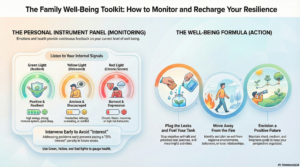
Your emotions, moods, reactions, and health provide continuous feedback about your well-being. When you experience pain, distress, fatigue, irritability, or illness, your system is signaling that something needs attention. Like an instrument panel in an airplane gives a reading for each aircraft system, your instrument panel (below) gives you an efficient reading on overall well-being.
The Personal Instrument Panel
The following is a short course on reading one’s personal instrument panel or that of a co-parent or child and taking constructive action using the well-being formula.
- Green Light: Feel good, high energy, positive, resilient, immune system strong, sleep and eat well.
- Flashing Yellow Light: Mild psychological distress—inefficiency, anxiety, discouragement, and worry.
- Yellow Light: Mild physiological and behavioral distress—frequent headaches, neck-aches, backaches, colds or flu, upset stomach, low energy and lethargy, decreased physiological resistance. Behavior such as conflicts with others, overeating, cigarette smoking, heavy coffee drinking, occasional over-drinking, and neglecting exercise and rest.
- Flashing Red Light: Chronic physiological and psychological distress and loss of productivity—moderate depression, anger, anxiety, feeling overwhelmed, burnout, obsessive worry, insomnia, frequent illness. Behavior patterns such as alcohol abuse, compulsive working, dangerous driving, other risk taking.
- Red Light: Chronic physiological conditions, severe depression or anxiety, heart disease, arthritis, cancer, high blood pressure, other severe illness, and decreased immune function.
If the signals on your or another family member’s instrument panel signal a yellow or red light, act now to head off these problems. Intervene earlier rather than later. A general truth in making challenging parenting choices is pay now or pay later with 25% interest.
Once we know where a problem is coming from, it becomes clear what to do to overcome it. The Well-Being Formula is a checklist I developed to use in coping with family challenges. If your own or a family member’s instrument panel is lighting up, this provides a quick review to identify where the problem may be coming from.
Six Elements of the Well-Being Formula (WBF)
After a description of each element of the WBF below, you can use it to do a personal check-up or suggest one to another family member. If you identify areas to improve—you know what to do—Develop a Daily/Weekly Action Plan.
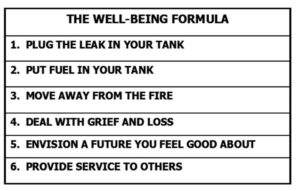
1.“Plug the leak in your tank” refers to changing negative self-statements like those you looked at through Rational Problem Solving. When you think negatively, you create negative feelings and act badly. If you are not feeling happy, ask yourself: “Am I saying negative things to myself in general, or in regard to a specific situation?” If you have a negative internal dialogue, no matter how much positive comes into your life, it is overcome by your negative beliefs and attitudes.
What action do you need to take to plug the leak in your tank?
2.“Put fuel in your tank” means developing a daily/weekly self-care plan. As human beings, we all need the same things, in slightly different proportions perhaps:
- Rest
- Healthful diet and Exercise
- Fresh air and sunshine
- A sense of belonging
- People who care about and support your goals
- Meaningful activities to express your Real Self
- Recreation and fun
Are you doing everything you need to do to put fuel in your tank? If not, then you have the basis for an action plan.
What action do you need to take to put fuel in your tank?
- “Move Away from the Fire” reminds you to avoid negative people, negative environments and negative behavior. If you are in a relationship with someone who is mean to you this messes up all the good things you try to do. If you smoke cigarettes, marijuana, or over drink alcohol, these have a negative impact on you. You can’t get ahead emotionally. Sometimes, you can’t get out of a bad situation immediately. The important thing is to see that a certain relationship or certain behavior stands in the way of your happiness. Then start planning to improve the situation.
Once you see what something negative costs you, decide to change. Even if all you can do is start to change. Remember the stages of human behavior change—go through the stages at your own pace. A person who stops smoking or drug use doesn’t do it in one day.
They recognize what they need to do.
- They decide to change.
- They find the resources they need.
- They act.
- They continue that action over a period of time.
- They set their lives up to maintain that change.
- When you decide to change, you feel better right away because you are taking charge of your life.
What action do you need to take to move away from the fire?
- “Deal with Grief and Loss.”
- Talk about your loss and grief with others.
- Keep a journal.
- Allow yourself to cry in safe circumstances.
- Talk with others who have been through a similar loss.
- Take good care of yourself even when you don’t feel good.
What action do you need to take to deal with grief and loss?
- “Envision a positive future.” Keep three categories of goals in your life at all times that you constantly update and renew:
- Keep a weekly to do list of things to take care of. This helps you prioritize and organize your time. Some of these daily, weekly tasks have to do with self-care, and dealing with issues covered in 1-4 above. Other weekly tasks advance your longer-term plans.
- Make two medium-term goals three to six months ahead.
- Make one longer-term goal one year or more ahead.
Keep your short, medium and long-term goals up to date.
- “Provide service to others.” Once you get your life in order, you have something to share with others. Giving service to others helps in two ways.
- We forget about our own problems get ourselves back in perspective.
- We see the positive impact of our actions on others.