Guideline #2: Get Your Life Together (Mostly)
January 15, 2026
Your Life Foundation
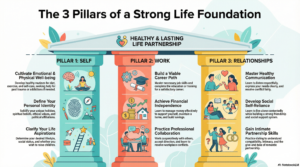
Before we can build a life partnership, we need to mature and get to know ourselves as fully as possible. This prepares us for the responsibilities of long-term commitment. To illustrate the preparatory tasks we need to accomplish, I use the image of three developmental pillars forming our life foundation— self, work, and relationships. These pillars encompass the multiple developmental tasks we make progress on as adolescents and emerging adults. Development of these dimensions then continues less dramatically throughout the rest of our life.
My name is Lane Lasater, a retired clinical psychologist. In gratitude for the life I have been given, I am sharing everything I learned during my career and personal life here on my website http://www.LaneLasater.com and on my YouTube Channel Life Roadmaps from a Retired Psychologist https://www.youtube.com/@lane205 Each post contains my written material, an AI generated graphic, a 15-17 minute audio summary, and a 5-7 minute video summarizing the material. You can download a fillable and printable PDF workbook that contains all the exercises that I developed to accompany the material here: Finding a Life Partner Fillable Workbook
Click here for an audio summary of this post.
“No human relation gives one possession in another—every two souls are absolutely different. In friendship or in love, the two side by side raise hands together to find what one cannot reach alone.”
Khalil Gibran
Assessing your life foundation and support system (and making repairs as needed) is an essential step in your readiness for life partnership. There’s a lot to consider in this chapter, so take your time. If your foundation is already solid—great! But some of us (me included) must work to strengthen our life foundations. I had to invest time and effort (including therapy) before I had my foundation in place at age 31. Fortunately (looking back), a woman I asked to marry me when I was 25 recognized my unfinished family business and declined. I was crushed and hurt then but eventually understood that she was right, which spurred me to continue seeking help and working toward maturity and health. I list below the central developmental tasks for each of the life foundation pillars. Read these carefully before assessing your own progress with these in the next action step.
Self-Development Tasks (SDTs)
The five self-development tasks below help you establish and practice self-care and routines for your physical and inner well-being. Note that SDTs 1 and 2 refer to developing a recovery plan, if needed, for emotional challenges such as unstable self-worth, difficulty trusting, PTSD, or addictions. Undertaking recovery from these issues is a complex process which I describe in depth under the heading of Transcending Family Trauma on my Home Page menu. That series of posts and my YouTube channel course calle “Transforming Family Trauma” https://www.youtube.com/@lane205 outlines the process and resources of recovery that enabled me to stop drinking permanently and to make peace with emotional issues derived from childhood experiences.
SDT 1: Develop a recovery plan, if needed, for emotional challenges resulting from childhood experiences or later events. You need a recovery plan and possibly professional help if you’re facing problem emotional adjustments resulting from childhood or adult experiences, including relationship breakups or divorces, other losses, traumatic events, and unemployment. Childhood traumatic events can continue to affect us throughout adulthood until we learn to face and overcome them with professional help and using the resources and information of self-help groups. The following are common indicators that stem from traumatic experiences.
- unstable self-worth
- unresolved emotions
- difficulty trusting
- depression
- anxiety
- anger
- complex post-traumatic stress disorder (PTSD)
SDT 2: Develop a recovery plan, if needed, for addictions.
You need a recovery plan and possibly professional help if you’re struggling with an addiction, including:
- alcohol and drug abuse
- over- and under-eating and bulimia
- compulsive sexual behavior
- compulsive spending, and
- compulsive gambling
SDT 3: Develop and practice a daily plan of diet, rest, exercise, and self-care to maintain your energy, health, and well-being.
In emerging adulthood, it’s important to identify and balance your fitness, dietary, and self-care needs. Establishing firm patterns and routines can help optimize your health and level of functioning for the rest of your life.
SDT 4: Define and practice interests and hobbies, personal spiritual/religious beliefs and practices, and political/ethical values and affiliations.
During early adulthood, we try out lifestyles, hobbies, recreational activities, intellectual interests, spiritual practices and beliefs, and friendships. These trial patterns gradually solidify into our adult identities. Some of us grow up with a spiritual/religious tradition and political/ethical values we embrace and make our own. Others can’t fully accept the traditions and values (or absence thereof) we grew up with and develop alternative beliefs, values, and practices. Your core beliefs and values guide you in finding a compatible life partner.
SDT 5: Define your economic and social aspirations, lifestyle, and geographic preferences, and begin deciding whether you wish to have and raise children.
To strengthen your foundation, you need to be clear about your desired economic status, social status, and lifestyle, and the culture and climate you wish to live in. It’s important to think about whether you want to create a family, which will be an important element of the partnership vision you’ll develop later with your partner.
Work Development Tasks (WDTs)
These tasks are building blocks to achieve fulfilling work that can fund your desired lifestyle. Being able to support yourself financially is an essential aspect of personal power in relationships because it gives you the option to leave an unhealthy relationship if you need to.
WDT 1: Master the tools and experience required in the workplace using the mechanical, technical, writing, speaking, digital, and soft skills necessary to perform and advance in your field.
WDT 2: Organize your time and effort effectively to accomplish home, college or job duties.
WDT 3: Work cooperatively with others, including accepting direction and performance evaluation, resolving work conflicts, and taking part in diverse work teams.
WDT 4: Choose a career interest through job and life experiences and plan and complete (or undertake) education and/or training that provides a satisfactory career path.
WDT 5: Manage your money to support yourself, maintain a home, afford your lifestyle, build a positive credit history, and establish savings for unexpected events or emergencies.
Relationship Development Tasks (RDTs)
These relationship development tasks prepare you for intimate partnership and satisfying friendships and work relationships.
RDT 1: Listen to and respond respectfully to others and communicate your ideas, feelings, and needs.
RDT 2: Practice courtesy, maintain appropriate personal and professional boundaries, and learn to resolve conflict fairly.
RDT 3: Learn to be self-reliant and to live alone while widening your friendship circle, planning and carrying out satisfying social and recreational activities, and building your social support system.
RDT 4: Learn the social and dating skills for romantic and sexual relationship interactions and discussing intimate topics and needs.
RDT 5: Take part in practice relationships to understand the give and take between romantic partners, recognize another person’s intimate needs, gain insight into compatibility, and learn to resolve intimate conflicts.
Action Step #2: Assess Your Life Foundation Developmental Tasks
In your relationship journal, for each of the 15 life development tasks above, rate your progress from 0 to 20, where 0 = little accomplished, 5 = some tasks begun but recognize the need for progress, 10 = some tasks accomplished, 15 = most tasks accomplished, and 20 = fully accomplished. (Note: for the SDT 1 and 2 “if needed” items that don’t apply for you—rate yourself a 20.)
Understanding Your Scores
The maximum score for each pillar of your life foundation is 100, and it’s 300 for all three pillars. These scores are a snapshot of your developmental foundation and let you identify life areas that require more focused effort. You won’t (and don’t need to) fully complete each task before starting a life partnership, but it’s important you and your potential partner have these tasks well underway.
Building your life foundation takes concentrated time and energy, so if you need more time to solidify or repair (if needed) your life foundation, that’s fine. As I mentioned earlier, I needed repair work on my self pillar and wasn’t ready for a long-term partnership until I was 31.
Solidify your foundation now because bypassing this won’t work and costs time, suffering, and money later. We can of course improve ourselves at any age, but if you and your partner start a life partnership with one or more foundation pillars substantially incomplete, it throws the couple-ship off balance and won’t provide stability for the path ahead. Tongue-in-cheek conventional wisdom states, “Two dead batteries can’t start the car.”
As you solidify your life foundation, it’s reasonable to expect that your future partnership candidate is working just as hard to solidify his/her life foundation (even though you haven’t met them yet, and although they may not be thinking about it in this way). When the time comes, you’ll look for a person with a reasonable (not perfect) life foundation.
Action Step #3: Analyze Your Life Foundation
Examples of foundation scores and analysis immediately follow these instructions.
In your relationship journal, note your score and progress for each pillar and your total life foundation score.
- Note the tasks (if any) you need to focus
- Set clear goals and identify specific, manageable action steps you’ll take for each task that requires more work (if needed).
- What additional information or resources do you need (if any) to move forward?
Life Foundation Scores and Analysis Examples
Here is my life foundation analysis for when I met Nancy (from today’s perspective), followed by foundation scores and analysis for Brianna, Nicholas, and Amber introduced earlier.
Lane: Almost Ready
Life foundation scores: Self = 65; Work = 80; Relationship = 80; Total score = 225.
- Self: I needed a complete recovery plan for childhood emotional adjustments and alcohol abuse. To accomplish this, I needed therapy, alcohol rehab, and self-help support. Although I understood a lot about myself, from today’s perspective, stopping drinking was the key to making progress in recovery from my childhood emotional challenges.
- Work: My professional life was going well, but when I stopped drinking, I recovered my integrity. Rather than facing a professional decline or disaster from alcoholism, I could now progress further in my professional sphere.
- Relationships: I felt mostly prepared for a committed partnership. I learned from my relationship field research (guideline #6) what couple combination worked best for me and discovered during our partnership trial run that I needed to improve my relationship problem-solving and communication skills.
Brianna: Not Ready Yet
Life foundation scores: Self = 70; Work = 60; Relationship = 60; Total score = 190.
- Self: I ultimately want a committed relationship, but I’m not sure whether I want a family. I’ve fallen in love with Chicago through my AmeriCorps work and don’t want to live in a small city. Helping other people is a great fit for me.
- Work: I’ve decided to become a nutritionist specializing in geriatric care. I’ve researched schools in Chicago and applied to two graduate programs to start next year. In the meantime, I’m still working at the agency where I did my AmeriCorps service and saving money. I’m checking out student loans and scholarship programs I qualify for.
- Relationships: I want to date more until I’m clearer about what I want in a relationship, and I’ve started online dating.
Nicholas: Repair Needed
Life foundation scores: Self = 45; Work = 80; Relationship = 50; Total score = 175.
- Self: My parents’ divorce left me shell-shocked, and I’m scared to get really close to anyone. I’m overeating and can’t seem to get a diet and exercise plan together. I want to deal with my past and unhappy memories. I got the name of a therapist from a friend of mine and set up an appointment to get help to overcome my past and stop overeating. I’m attending Adult Children of Alcoholics (ACOA) 12-step meetings and those help a lot. I’ll see what my therapist recommends.
- Work: I love my work, but I get stressed dealing with couples and families in conflict because they stir up my own issues. I work long hours and grab fast food for dinner, so I’m worn out when I get home and crash in front of the TV.
- Relationships: I fall into convenient relationships that don’t last. I’m lonely but scared to get too vulnerable. I plan to take a break from dating while I get started in therapy, and once I feel more solid within myself, I want to start online dating.
Amber: Abandoned
Life foundation scores: Self = 60; Work = 75; Relationship= 50; Total score = 185.
- Self: I’m furious with Ryan for abandoning Emilia and me and can’t believe I chose him. Ryan, as usual, is not cooperative. My therapist has really opened my eyes to a lot of things and told me about a divorce recovery group. I’m reading up on co-dependency and domestic violence, and I’ll figure out what other help I need as I learn more.
- Work: I enjoy my job and my performance reviews are good. I’m taking specialized training in working with women inside the criminal justice system from traumatic family backgrounds. Financially, I have to pay off the credit card debt that Ryan left me with. I have worked out a monthly payment I can afford with two credit card companies that will eliminate this debt over the next two years.
- Relationships: Ryan doesn’t pay child support regularly, so I have to spend more money to take him back to court—that infuriates me! I’m not ready to date and have to figure out how I let myself get into this situation. I never want to go through anything like this again, but ultimately, I want to find someone who’ll be a good stepfather to Emilia and I’d like to have another child.
Key Takeaways from This Chapter
- Building your life foundation gives you the self- knowledge, skills, and resources for life partnership and other adult tasks.
- As you assess your foundation, you identify any developmental tasks or skills you need to focus on in preparing for a long-term relationship.
- Invest the time and resources needed now to prepare for partnership; otherwise, unfinished developmental tasks become an increasing burden and obstacle to progress.
- Your potential partner is someone who has worked just as hard as you to build a solid life foundation.
- Develop a plan to complete any needed work toward building your life foundation, using clear goals and manageable steps.