
Guideline #18: Learn Rational Problem Solving
February 17, 2026
As human beings, we are always learning. In dealing with parenting challenges, we need to understand which parenting strategies are effective and what parenting choices make the situation worse. This class is based upon thinking and behavior. That means we look at what we believe and how these beliefs affect our behavior.
We may use parenting behaviors like getting mad, making ultimatums, withdrawing, threatening, or guilt with our children. Over time many of our parenting beliefs, choices and actions become unconscious and automatic. We are not even aware of the choices we make. We need to step back from our automatic parenting beliefs, actions and habits and look at our attitudes and actions.
This is an excerpt from my book Purposeful Parenting Handbook: Guidelines for Raising Capable, Confident, and Accountable Children. My name is Lane Lasater, a retired clinical psychologist. My website is www.LaneLasater.com
Each post contains my written material, an AI generated graphic, a 15-17 minute audio summary, and a 5-7 minute video summarizing the material.
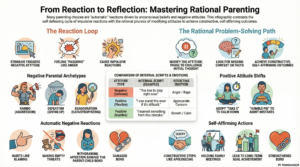
Critical Parent Coping Skill #2: Learn Rational Problem Solving
Unfortunately, some of what we believe about parenting is not true, or completely wrong. It may affect your thinking and feelings but is invisible to you.
Beliefs
A belief is what you consider true about something. You acquire parenting beliefs through experience, watching others, from what you learned growing up, and what you read. Some beliefs become distorted such as:
- My family has to look good in the community
- If my child doesn’t get good grades and get into a good college, he or she won’t be successful in life
- I can protect my children from all the risks of modern life
- If my child makes a mistake, his/her life is ruined
- I have to take over for my child if he/she is not meeting their responsibilities
- My child has to avoid the mistakes I made in my own life
Attitudes
An attitude is the total summary of our beliefs about a particular topic. The resulting attitude resulting for a parent who believes that he or she must protect their children from the world might be “Vigilance.” This attitude leads to an over learned “reaction,” of overprotection, that we tend to use automatically, without thinking. In this example, a person who has the attitude of vigilance might show the reaction of searching a teenager’s room to find out if the child is using drugs without discussing the concern with the child first, destroying trust between them.
An attitude is everything we believe about something, such as:
- School
- Teachers
- Money
- Sex
- Health and habits
- Alcohol and Drugs
- Rules
Reactions
Parenting beliefs and attitudes become connected with emotional reactions. Reactions are automatic emotional and behavioral responses. These can be either positive or negative. A positive reaction many of us have is how we treat our child if he/she is hurt. We automatically know to be tender and patient with them. We don’t have to think about it, and it reflects an attitude of Love, respect, caring and concern.
But many of us have also developed negative parental reactions, like getting mad when our child doesn’t do what they said they were going to, or decides we don’t agree with. We may jump into negative reactions when our beliefs get challenged. Examples of negative parental reactions are:
- Anger or criticism
- Arguing
- Fear
- Blaming
- Withdrawing affection
- Name calling
- Passing Judgment
- Making empty threats
Rational Emotive Behavior Therapy
Rational Emotive Behavior Therapy (REBT) was developed by Psychologist Albert Ellis (https://www.amazon.com/Guide-Rational-Living-Albert-Ellis. REBT allows you to challenge parenting beliefs that contribute to ineffective or destructive parenting behavior. REBT shows how negative attitudes lead to self-defeating behavior. REBT gives you a tool to cope with everyday parenting problems. You can’t change things that have already happened, but you can change your attitude about these events.
Stimulus—Something happens.
Attitude–You develop a negative attitude about this.
Passion—You develop a negative feeling because of your attitude.
Reaction—You act in a self-defeating way to handle the situation.
An Example of Rational Problem Solving
Stimulus—Your 14-year-old daughter comes home at 8 p.m. without calling to tell you where she is or that she would miss dinner.
- Attitude–You tell yourself this behavior is totally unacceptable
- Passion–You get very mad.
- Reaction—You shout at her when she comes in the door and demand to know where she’s been. She says she was at a friend’s house and goes to her room and slams the door.
Creating Self-Affirming Behavior
With Rational Problem Solving, you modify attitudes (negative self-statements) that lead to self-defeating reactions.
To continue the above example, the next step is to modify your Negative Attitude.
- Modify Negative Attitudes—As you experience the tense atmosphere after this confrontation, you realize you hadn’t clearly spelled out your expectation about when she should be home. You remember she told you earlier in the week she had a Language Arts project she is working on with a team of students.
- Identify Options–You decide to apologize for getting mad and shouting.
- Take Correct Action—You apologize and tell her you’d like to have a family meeting to discuss what happened. She agrees to meet.
Negative Attitudes
Negative Attitudes create negative passions like getting mad, despair, shame, and fear. These negative attitudes often lead to self-defeating behavior. Common negative attitudes we all engage in are:
- Helpless victim—This situation is 100% bad and there is no way out.
- Defeatism—I can’t endure this situation any longer and I’ll never be happy.
- Rambo—This is the worst thing ever and it’s up to me to set it right.
- Exaggeration—We go to extremes— “This family is falling apart.” or “You don’t care about what we have done for you.” or “You’re going to mess up your whole life.”
- Making Demands— “I can’t stand this and it has to stop.” Or “I want this situation resolved right now.”
Positive Attitudes are flexible and reasonable beliefs that lead to appropriate negative emotions and positive behavior options. For example:
- Grin and Bear It–I can stand it even though it’s uncomfortable and difficult.
- Oops—You made a mistake, but that doesn’t make you a bad person.
- OK OK–I’ll do what I need to do to straighten out this situation.
- Humble Pie–I learned something important from this experience.
- Take 5: I can’t think clearly right now. I need to calm down before I do or say anything.
Appropriate, Yet Uncomfortable Emotions
Appropriate, yet uncomfortable emotions, like regret, sadness, loss and wishes, result from realizing family goals are temporarily blocked or delayed. Appropriate, yet uncomfortable emotions lead to self-affirming behavior and encourage you to take constructive action to reach your goals.