
Guideline #17: Use Situation Analysis
February 17, 2026
This post introduces Situation Analysis, the first of six Critical Parent Coping Skills. Coping skills to help you recognize, avoid and cope with unexpected family developments. That is, RECOGNIZE situations in which you are likely to engage in ineffective parenting patterns, AVOID these situations when appropriate, and COPE more effectively with a range of family challenges and behaviors.
The five Critical Parent Coping Skills covered in the next few chapters are:
- Use Situation Analysis
- Learn Rational Problem Solving
- Handle Loss and Grief
- Use Your Influence Effectively
- Balance Family Power and Responsibility
- Use The Well-Being Formula
This is an excerpt from my book Purposeful Parenting Handbook: Guidelines for Raising Capable, Confident, and Accountable Children.
My name is Lane Lasater, a retired clinical psychologist. In gratitude for the life I have been given, I am sharing everything I learned during my career and personal life on my website http://www.LaneLasater.com and on my YouTube Channel Life Roadmaps from a Retired Psychologist https://www.youtube.com/@lane205
Each post contains my written material, an AI generated graphic, a 15-17 minute audio summary, and a 5-7 minute video summarizing the material.
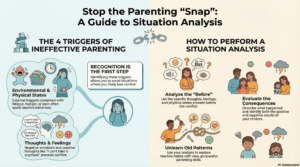
Critical Parent Coping Skill #1: Situation Analysis
To help you overcome negative parenting behavior, you need to recognize situations where you are likely to do or say something you regret. Situation Analysis (SA) involves identifying your thoughts, feelings and circumstances that precede family problems. SA helps you understand causes of negative parenting behavior. For example, not getting enough sleep, feeling irritable and snapping at your child is an example of SA. The four elements of Situation Analysis are:
- Environment—What are specific environmental triggers that lead to ineffective parenting behavior?
- Feelings—Negative feelings like hurt, anger, embarrassment, loneliness, depression, and anxiety commonly lead to ineffective parenting choices.
- Thoughts—Specific thoughts often precede ineffective parenting patterns such as “I have to take control of this situation.” “I can’t stand this.” Or “I can’t take it anymore.
- Physical—When you are hungry, tired or in physical pain, you are more likely to engage in negative parenting.
Using Situation Analysis
The example from Juan’s life below shows you how to do a Situation Analysis.
Robert’s Miserable
Robert was tired and cranky Friday after a long week working in his construction contracting business. He planned to get to bed early because he promised his wife he would help her re-tile the bathroom over the weekend. As Juan got home, his 17-year-old son Dustin and Dustin’s friend Joe were leaving in Dustin’s car. The boys said were headed out to “chill.” Robert knew Justin had to be at his McDonald’s job early the next morning. He told Justin to be home early. It didn’t happen that way.
Dustin and Joe drove to the park where they smoked a joint and had a beer. Two friends, Natalie and Gina, drove by and stopped when they saw the boys. Natalie had some tequila, and to keep the party going, Dustin went to the store to get margarita mix and they started drinking tequila. They shared a lot of laughs and lost track of time. Before they knew it, it was midnight and everyone was drunk and stoned.
Dustin knew he had to get home. Though he knew he shouldn’t drive, he took his car anyway. He made it home, but scraped the side of his car on a guardrail. Robert was lying awake wondering where Dustin was. He got up when Dustin came home. He smelled the alcohol and wanted to know where Dustin had been. He could tell Dustin was drunk—the third time this had happened. Robert shouted that Dustin was becoming a drunk just like Robert’s father. Dustin told him to “go F himself.” Robert shoved Dustin. Now Robert had joined Dustin in his problem.
Complete a Situation Analysis. Identify your thoughts, feelings and circumstances before and after an ineffective parenting choice.
Your Parent Situation Analysis
Instructions: For a recent situation, write down all the circumstances surrounding your parenting pattern. Describe the circumstances that preceded the situation, how you felt, what you were thinking, and what you wanted to happen (environmental, emotional, cognitive, physical).
Describe completely what happened, who was involved, the positive and negative consequences of your choices, and anything you did that you didn’t feel good about or didn’t do that you needed to do.
What did you learn about your parenting patterns from your situation analysis? Parenting is complex because we have to “unlearn” old, ineffective behavior and “learn” new skills.