
Guideline # 10: Develop a Partnership Agreement
February 4, 2026
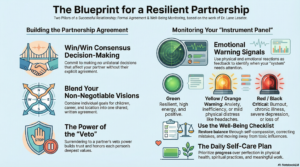
Successful partnerships operate on consensus (win/win) decision-making, so once you’ve committed to each other, neither of you should make a unilateral decision that affects your partner without their agreement. Depending upon your life experience, it’s quite a leap of faith to surrender to your partner’s veto power, as it was for me.
My name is Lane Lasater, a retired clinical psychologist. In gratitude for the life I have been given, I am sharing everything I learned during my career and personal life on my website http://www.LaneLasater.com and on my YouTube Channel Life Roadmaps from a Retired Psychologist https://www.youtube.com/@lane205 Each post contains my written material, an AI generated graphic, a 15-17 minute audio summary, and a 5-7 minute video summarizing the material. You can download a fillable and printable PDF workbook that contains all the exercises that I developed to accompany the material here: Finding a Life Partner Fillable Workbook
“Love does not consist of gazing at each other, but in looking outward together in the same direction.”
Antoine de Saint-Exupery
Consensus Decision-Making
Even though my life partner Nancy had agreed before we married that she was willing live in Colorado, two years into our relationship, I found a job opportunity in Texas which I saw as important for my career. Moving to Texas from Minnesota was not part of our agreement, but because it felt so crucial to me, I tried to push the decision through. Nancy steadfastly refused to go along with this, so finally we went to marriage counseling. After several intense meetings, Nancy consented to move to Texas, but told me that if I ever tried to force a unilateral decision like that again, she would end the relationship. When it came time to leave that job, she held me to our agreement, and we moved to Colorado.
Over the years, I found that surrendering to my partnership with Nancy and consensus decision-making was absolutely the best thing I’ve ever done. We learned we could trust each other to honor each other’s deepest needs and values, and two heads are definitely better than one.
Action Step #23: Develop a Partnership Agreement
Using your relationship vision and goals from action step #16, blend your relationship vision with your partner’s into your combined vision and goals. Each of you specified on your entrance exam what’s truly non-negotiable, so be as clear as possible in both directions about exactly what each person wants. If you cannot agree on these big issues, it may be wise to seek professional help. Ultimately, unless you can arrive at a compromise both people can accept, this may mean the partnership is not viable.
For example, agree up front if you both want to have children, how many and when, and (as in Nancy’s and my case) where you want to live. If you don’t agree to these things up front, they may prove impossible to resolve later. The same applies to how you will incorporate children from previous relationships into the partnership. Update your partnership agreement as needed.
Maintaining Well-Being Through the Ups and Downs of Life
Life will continue to present challenges, so in this chapter I introduce two coping tools—your instrument panel and the well-being checklist—to help you and your partner identify and solve problems and maintain your strength and spirits no matter what.
Your emotions, moods, reactions, and health provide continuous feedback about your well-being. When you experience pain, distress, fatigue, irritability, or illness, your system is signaling that something needs attention. Like an instrument panel in an airplane gives a reading for each aircraft system, your instrument panel (below) gives you an efficient reading on overall well-being.
Green light: Feel good, high energy, positive, resilient, immune system strong, and sleep and eat well.
Yellow light: Mild psychological distress—inefficiency, anxiety, discouragement, and worry.
Orange light: Mild physiological and behavioral distress— frequent headaches, neck pain, backaches, colds or flu, upset stomach, low energy and lethargy, and decreased physiological resistance. Other warning signals are behavior such as conflicts with others, overeating, cigarette smoking, heavy caffeine use, occasional over-drinking, and neglecting exercise and rest.
Red light: Chronic physiological and psychological distress and loss of productivity—moderate depression, anger, anxiety, feeling overwhelmed, burnout, obsessive worry, insomnia, or frequent illness. Other warning behavior patterns are alcohol or drug abuse, compulsive working, dangerous driving, or other physical risk-taking.
Black light: Chronic physiological conditions, severe depression or anxiety, heart disease, arthritis, cancer, high blood pressure, other severe illness, and decreased immune function.
Action Step #24: Monitor Your Instrument Panel
Irritability is a frequent instrument panel warning signal for many of us, so if you feel irritable, ask yourself if you’re tired, lonely, hungry, angry, stressed, or worried? If your instrument panel lights up, use the well-being checklist below to identify what’s bothering you and develop a plan to get back on track. What’s your instrument panel telling you?
Action Step #25: Use the Well-Being Checklist
When you get warning signals on your instrument panel, use the following well-being checklist to identify how to restore emotional and physical balance.
Be compassionate with yourself. Watch out for negative self-talk. Negative thoughts lead to negative feelings, which lead to negative behavior. When you’re unhappy, first ask yourself, Am I saying negative things to myself? If you’re constantly criticizing yourself and predicting the worst outcome for every situation, you’ll walk around feeling ashamed, inadequate, and scared. Get a book of daily affirmations at your local bookstore and read it every day— these really help. Also, practice being compassionate with yourself by writing compassionate messages in your relationship journal.
- “I didn’t know how to do it ”
- “I’m learning through ”
- “I’m taking action to solve the ”
- “I’ve done my best and trust things will work ”
Write three ways you criticize yourself and three kind things you can say to yourself instead.
Correct your mistakes. Did you hurt someone or let them down—by being insensitive, irritable, or selfish, not following through, or not meeting your responsibility? These actions weigh on you until you take responsibility, apologize when you need to, and change your behavior. Are there any mistakes you need to correct? How and when will you do it?
Follow a daily self-care plan. Move forward with daily self-care goals at your own pace. You don’t have to accomplish these goals perfectly—just aim for “progress, not perfection.” List your daily/weekly self-care actions for each area below in your relationship journal.
- Physical health (diet, exercise, rest, and medical, dental, or other professional care).
- Emotional well-being (friendships, support groups, workshops, journal writing, or therapy).
- Spiritual well-being (reading, meditation, spiritual practices, retreats, or spending time in nature).
- Close relationships (time set aside for family members and close friends).
- Meaning and accomplishment (performing long-term work and achieving goals that provide excitement and purpose).
- Recreation and fun (laughter, playing, being in nature, sports, games, and entertainment).
Move away from toxic influences. Keep away from toxic people, negative environments, destructive media and situations that bring you down. If you can’t get out of a bad job situation right away, make a plan to leave the situation, even if all you can do is start the change. When you decide to take action, you feel better right away because you’ve empowered yourself. What action do you need to take to move away from toxic influences?
Be grateful. No matter what problems you encounter, usually, some things are going right—you have a job, a caring partnership, your health, a place to live, or you can appreciate the beauty in life, art, literature, and nature. Remember the good things to keep your dark days in perspective. Life itself is a wonderful gift. List what you’re grateful for and use it to remind you when things get tough.
Design a positive future. Short- and long-term goals support you in navigating life’s drudgery and challenges. Plan something fun to reward yourself for what you accomplish each day and give yourself larger rewards occasionally. Have a plan for the important things you want to accomplish during life and partnership, and the next steps you’ll take to accomplish each of these.
Serve others. As you learn and grow in your partnership, you have more to share with others. Any kind of volunteer work helps because you feel the satisfaction of helping someone remember that you’re part of a larger whole forget about your problems, get your life back in perspective, and see the positive impact of your actions on others What service can you provide?
Key Takeaways from This Post
- Your partnership agreement identifies your shared vision and goals for your relationship.
- All partnership decisions need to be win/win consensus based.
- Update your agreement as needed to consider fresh developments and changed circumstances.
- Use your instrument panel and the well-being checklist to maintain individual well-being, and support each other through both good and challenging events.
- When people commit themselves to common goals, this releases wonderful power, so make the most of it.