
Guideline #10: Create Conditions for Conflict Resolution
February 14, 2026
All families must learn to resolve conflict fairly. As a family therapist, I discovered that many of us make the same mistakes over and over in conflict situations. We don’t resolve the conflict, and can also make things worse, often much worse. Through trying personal experiences, I developed the following conflict resolution guidelines for couples and families.
This post is from my book Purposeful Parenting Handbook: Guidelines for Raising Capable, Confident, and Accountable Children.
My name is Lane Lasater, a retired clinical psychologist. In gratitude for the life I have been given, I am sharing everything I learned during my career and personal life on my website http://www.LaneLasater.com and on my YouTube Channel Life Roadmaps from a Retired Psychologist https://www.youtube.com/@lane205
Each post contains my written material, an AI generated graphic, a 15-17 minute audio summary, and a 5-7 minute video summarizing the material.
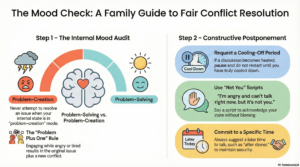
Conflict Resolution Guidelines
- Be in a Problem Solving vs. a Problem Creation Mood. Problems get resolved when all parties are in a problem-solving vs. a problem-creation mood. You probably know immediately what your internal state is, so the first guideline is this: don’t attempt problem solving when you’re in a problem-creation mood. If you do—you end up with the original problem plus one. Here are some suggested responses you can use to postpone the discussion until a you are in a better place.
- “I’m not in a good place to talk right now.” A classic situation with families is when someone arrives home from work or school after a really tough day. Just as they walk in the door, the partner or parent wants to talk to them about an important issue. This frustrates the person arriving home tired and cranky. You know what happens. He/she responds poorly, sometimes with a nuke or insensitive comment, and inadvertently creates an additional problem. The constructive response is to say, “I’m not in a good place to discuss this now, but can we talk about this after dinner?”
- “I’m angry and can’t talk right now, but it’s not you.” A second version of this is when someone comes home angry or frustrated about a situation at work or outside the home. They know that if they interact with anyone, including their partner or a child, they’re likely to take their anger out on an innocent bystander—another family member. So, tell the other person you can’t talk right now, but it has nothing to do with them. This way, they won’t feel insecure, and you’ll fill them in later when you calm down.
- “I’m still not ready to talk after we took a time out.” When you and a family member have a discussion that gets heated, as discussed above, it’s best to take a cooling-off period for a specified time. But people sometimes restart the discussion before they’ve truly cooled off, so they end up digging a deeper hole. It helps to have the option to ask for a further cooling-off period before re-starting the discussion if needed. If one person truly can’t get him/herself cooled off, then consider getting professional help and let you’re the family know the specific action you’re taking to get back into a better place before trying to solve the problem.
At the beginning of a family counseling session, I would ask everyone, “Are you in a problem-solving mood?” If someone was not, we needed to figure that out first to avoid creating a fresh problem.