
Getting In Shape For Recovery
December 29, 2025
Preparation and Training Make a Huge Difference
You began your recovery when you sought information about changing your life. You’ve gathered additional information from this website and other sources. You may recognize yourself in the survival patterns described. Understanding and facing these powerful patterns is a big step forward and now is a perfect time to prepare to join the millions of people finding balanced and satisfying ways of life, free of family survival patterns and addictive behavior. You can achieve this freedom too!
In an earlier post, I described the seven stages of behavior change: recognition, hope, clarity, decision, preparation, action, and maintenance. You’ve made progress with recognition, hope, clarity, and decision. Now it’s time for preparation. As you prepare, you gather strength and resources to transform your lifelong survival patterns into a freedom lifestyle. Like training for a 10-K or marathon, you strive to improve your form and increase your stamina for the upcoming challenge. Begin your recovery conditioning using the recovery processes described in this chapter: “Caring for Your Inner Self” and “Designing a Personal Recovery Plan.” When you have these started, you’ll be ready to carry out the action tasks described in subsequent posts.
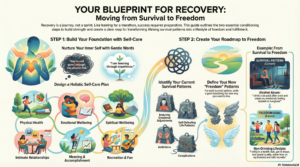
This post gives you suggestions about how to prepare yourself for your successful recovery journey.
My name is Lane Lasater, a retired clinical psychologist. In gratitude for the life I have been given, I am sharing everything I learned during my career and personal life here on my website http://www.LaneLasater.com and on my YouTube Channel Life Roadmaps from a Retired Psychologist https://www.youtube.com/@lane205 Each post contains my written material, an AI generated graphic, a 15-17 minute audio summary, and a 5-7 minute video summarizing the material. A printable and fillable PDF “Exercises to Support Recovery from Family Trauma Syndrome” with each exercise I describe in my videos can be downloaded here: Transcending Family Trauma Workbook
“Thoughts become words, words become actions, actions become habits, and habits become destiny.”
Patanjali, 11th Century Indian Mystic
Caring for Your Inner Self
Eric Berne described our inner selves as having parent, adult, and child parts (Transactional Analysis in Psychotherapy). Our parent self includes our ability to make positive or negative judgments and choices. Our adult self includes knowledge, competence, and problem solving. Our child self encompasses emotions, intuition, creativity, humor, spontaneity, sexuality, and spirituality. During recovery, we expand beyond the limits of the survival selves we developed and broaden our perspective, develop new knowledge and skills, and connect to feelings, intuition, and creative potential.
Through this book, you’ve examined your life with additional information. You may recognize how your childhood family met certain needs, but didn’t provide other crucial elements for your well-being. The deprived, hurt, rejected, ashamed, frightened, sad, angry, or lonely boy or girl of your childhood remains with you and his/her negative emotions and memories can block your positive possibilities. To heal, you learn to “re-parent” your child-self during recovery (Healing the Child Within) as you do with any young children you care for. When you nurture and protect the little boy or girl within you, your child-self can provide energy, spontaneity, creativity, spirituality, and fun. These child qualities can gradually transform your life into a joyful and worthwhile experience. The following recovery tools help you nurture your inner child as you build strength and overcome unstable self-worth and painful memories.
Gentle Words for Yourself
Unfortunately, many of us speak to ourselves internally in the same harsh ways people spoke to us as children. This self-criticism perpetuates our childhood shame and unstable self-worth. Be aware of what you say to yourself during your recovery because your child self believes what you say, even if it’s exaggerated or completely false. If we say degrading, critical, or frightening things to ourselves, we feel ashamed, inadequate, or scared. Therapists Mary and Robert Goulding say, “If you tell yourself ghost stories, don’t be surprised when you can’t sleep at night.”
When you substitute forgiving, encouraging, and hopeful internal dialogue, your child self feels safe, lovable, competent, and brave. During recovery, practice interrupting your self-criticism and saying something compassionate to yourself instead such as, “I didn’t know how to do it differently,” “I’m learning through experience,” or “I’m trying out new options as best as I can.” Compassion words work. Reading a daily affirmation book you relate to can help.
Recovery Exercise #16: Your Self-Care Plan
What do you need to do regularly to feel happy, healthy, and calm? Set some self-care goals to work toward at your own pace. Don’t expect yourself to accomplish these goals immediately or perfectly. These are objectives to orient toward and accomplish as you’re able. List activities in each of the following areas you would like to do for yourself on a daily or weekly basis.
- Physical health care including diet; exercise; rest; massage and bodywork, and medical, dental, or other professional care
- Emotional well-being including contacting friends, self-help groups, workshops, journal writing, or psychotherapy
- Spiritual well-being including daily readings, yoga, meditation, prayer, church attendance, or communing with nature
- Intimate relationships daily or weekly time set aside for family members and close friends
- Meaning and accomplishment long-term goals and aims in your work and personal life that provide a sense of excitement and direction in your daily life
- Recreation and fun laughter, playing, being out in nature, and withdrawing from problem-solving activity
Reread your self-care plan regularly. Monitor your progress, but be forgiving if it takes longer than you expect. Most of us spend several years getting our self-care plan fully in place. Update your plan when you need to.
Recovery Exercise #17: Develop Your Recovery Plan
Successful projects start with a clear picture of the present situation and a vision of your goal. Write what you’ve learned about your survival patterns to give yourself the baseline against which to measure your progress. Then you can design exactly how you want things to be instead.
Below is a list of enduring emotional adjustments, self-defeating life patterns, addictions, and complications we’ve covered. Note each pattern and complication that applies to you in your recovery journal.
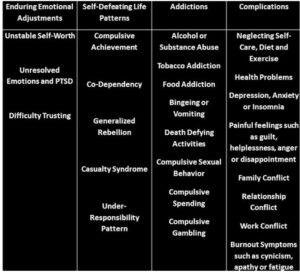
For each issue, write a brief description of how that pattern appears in your life now. This is a snapshot of your “survival” pattern. Then describe the pattern of living you want to replace the old pattern, even if you don’t know exactly how you’ll accomplish this. This is a snapshot of your “freedom” pattern. An example recovery plan follows the list.
This exercise requires effort and thought and may take some time to complete, but your written personal plan is extremely important. Writing things down is a powerful tool for change, and once you have your plan, it’s a helpful reminder of your recovery goals.
Zach’s Recovery Plan
Zach became depressed after he lost his job as a sales rep. He worried about his career, his marriage, and his drinking. He identified four survival patterns he wished to replace with freedom patterns: (1) unstable self-worth, (2) unresolved emotions, (3) casualty syndrome, and (4) alcohol abuse.
- Unstable Self-Worth “I feel like a failure because I just lost my job. I spend so much time down and doubting myself I can’t get organized to look for work, and I have zero energy. I’m doing something seriously wrong in my life. I’m not contributing much to the world. I feel unworthy of my wife’s love. It’s like I’m getting away with something because she believes in me. When she realizes I’m a failure, I’m afraid she’ll leave.”
Goal: Stable Self-Esteem “I like where I am in my life, what I’m doing and that I’m an excellent partner. I trust myself and if something goes wrong, I know I’ve done my best and don’t have to blame myself. I deserve to be with someone as special as my wife, and I accept her respect for me. I’ve found a satisfying job that lets me use my talents. I have energy and enthusiasm and I contribute to the world being decent, straightforward, and positive with people and meeting my responsibilities.”
- Unresolved Emotions “I’ve felt lonely and angry off and on ever since my parents divorced when I was twelve. I knew they weren’t getting along, but I wanted them to stay together. My mother kicked my dad out because he wasn’t taking his share of responsibility for the family. He only worked occasionally, and she mostly supported us. I felt ashamed because in a small town everyone knew about it and gossiped about us.
“Before the divorce, my dad things with me like fishing and camping. Afterwards, he moved away, and I only saw him a few times a year. He felt I was on Mom’s side because I decided I wanted to live with her. I haven’t felt close to him since, and that hurts. I never talked about my feelings to either of them.”
Goal: Feel at Peace with the Past “My parents’ divorce paralyzed me as a kid because I felt abandoned by my dad and ashamed my family was falling apart. I’m not responsible for their choices. I realize their divorce had nothing to do with me. I’ve expressed my hurt about what happened and I’m ready to move on. I know what I went through is the same as other children from divorced families. I’ll talk to my parents separately about what happened and see if it’s possible to start new relationships with them.”
- Casualty Syndrome “I don’t seem to know what’s right for me. I thought my new job was what I wanted, but I lost it because my boss expected me to develop my market area more quickly than I realistically could. I knew from friends before I took the position that he was impossible to please, but I needed a job and was afraid nothing else would turn up. As I look back, I was naïve to think that it would work out.”
Goal: Self-Responsibility “I know what kind of work situation is right for me. I don’t do my best in critical and competitive environments. I’m learning what I need to do professionally and accept that I must learn certain things through experience. I trust my way of selling products, which is to build relationships with people who’re interested in my product rather than hustling people who aren’t ready or interested. I’ll hold out for a position that’s right for me, even though it sucks to be unemployed.”
- Alcohol Abuse “I drink a six-pack of beer after work and watch TV all evening. On weekends, I drink while doing chores in the morning and then have a beer open for the rest of the day. By late afternoon, I’m buzzed. My wife hates this because I don’t feel like doing anything in the evening or I’m too drunk to go out. Sunday, I drink beer watching football and end up wasting the entire day and getting sloshed. By Monday morning I feel bad physically and worthless because I threw the weekend away when I could have accomplished things around the house.”
Goal: Non-Drinking Lifestyle “I’m at risk of becoming an alcoholic. My grandfather was an alcoholic, and I probably have a genetic risk. I’ll feel good about myself and my life without drinking. If I drink at all, I end up drunk. I want to join a health club and swim after work to get in shape. Then I’ll be able to do something constructive in the evening like read, work in the garage, or spend time with my wife. On weekends, I know I can get a lot done. I’ll finish fixing the motorcycle I’m rebuilding, and take road trips. I’ll go out with my wife without being half drunk.”
Like Zach, you can design a recovery plan for yourself. It’ll serve you well! With your self-care plan and personal recovery plan in place, you’re ready for the obstacle course.
Image 10 portrays this moment.
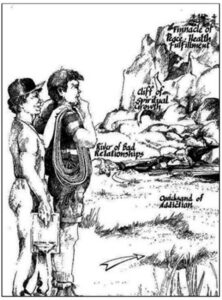
Ready for The Obstacle Course: With support, training, and conditioning, you’re fully prepared to enter the recovery obstacle course. The course presents difficult terrain and natural hazards, but the satisfaction of achieving your goals justifies the risks. Go for it!
Key Takeaways from this Chapter
- The odds are against us if we take on our entrenched survival patterns without information, support, and guidance.
- With all these recovery resources, the task is still challenging but doable. As with any complex project, planning, preparation, training, and resources are the keys to your success.
- Because recovery is a marathon, not a sprint, your daily self-care plan steadily builds your strength, hope and support system and empowers you to face each new challenge.
- The process of behavior change provides a clear map of where you’ve been and exactly where you want to go.
- When we set recovery goals, we don’t have to know exactly how we’ll achieve these things, but take faith from the fact that millions of people just like us have recovered from similar challenges.