
Exercises to Support Recovery from Family Trauma Syndrome
December 16, 2025
In this post I describe for you 23 exercises and self-assessments that I developed to help people move through the stages of behavior and emotional change during recovery from Family Trauma Syndrome. Throughout my posts I offer detailed descriptions of the lives of people recovering from these patterns, and step-by-step suggestions to assist you in moving from self-defeating behavior to emotional and behavioral freedom. My goal is to help you identify which behavior patterns affect you and how these work.
Many of these exercises and self-assessments I developed as I gained understanding of my recovery process from childhood family trauma and alcoholism and the challenges I encountered as I maintained recovery through the ups and downs of life. These exercises come directly from my book entitled Transcending Family Trauma, and complement the posts on my website www.LaneLasater.com and my YouTube channel “Recovery Roadmaps from a Retired Psychologist.” These exercises help you move through the Seven Stages of Behavior Change that I introduced in an earlier post.
My name is Lane Lasater, a retired clinical psychologist. In gratitude for the life I have been given, I am sharing everything I learned during my career and personal life here on my website http://www.LaneLasater.com and on my YouTube Channel Life Roadmaps from a Retired Psychologist https://www.youtube.com/@lane205 Each post contains my written material, an AI generated graphic, a 15-17 minute audio summary, and a 5-7 minute video summarizing the material. A printable and fillable PDF “Exercises to Support Recovery from Family Trauma Syndrome” with each exercise I describe in my videos can be downloaded here: Transcending Family Trauma Workbook
Below is the AI audio summary of this post.
Exercises to Help you Move Through Recognition, Hope, Clarity and Decision in the Stages of Behavior Change
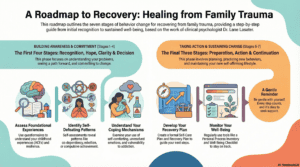
The first 15 exercises and self-assessments help you move through the first four stages of Behavior Change. 1) Recognition happens when you see that a problem or set of problems applies to you; 2) Hope develops when you learn how other people have overcome similar problems; 3) Clarity occurs as you comprehend exactly how your problems developed and how they continue; 4) Decision is your firm commitment to take the actions necessary to overcome these challenges.
Recovery Exercise #1: Complete the ACEs questionnaire. (Previous Post)
Recovery Exercise #2: Complete the Child and Youth Resilience Questionnaire.
Recovery Exercise #3: Your Basic Human Needs While Growing Up and Now.
Recovery Exercise # 4: Your Childhood Behavioral Strategies
Recovery Exercise #5: How You Use Discounting
Recovery Exercise #6: Your Self-Comforting
Recovery Exercise #7: Your Self-Worth
Recovery Exercise #8: Your Unresolved Emotions and PTSD
Recovery Exercise #9: Compulsive Achievement Self-Assessment
Recovery Exercise #10: Co-Dependency Self-Assessment
Recovery Exercise #11: Generalized Rebellion Self-Assessment
Recovery Exercise #12: Casualty Syndrome Self-Assessment
Recovery Exercise #13: Under-Responsibility Pattern Self-Assessment
Recovery Exercise #14: Your Vulnerability to Addiction
Recovery Exercise #15: Your Use of Escapes
Exercises to Help you Move through Preparation, Action and Continuation in the Stages of Behavior Change
The remaining 7 exercises help you as you move through the remaining three stages 5) Preparation involves gathering the resources and support you need to face the losses, confusion, and uncertainty required for growth and change; 6) Action takes place over a long period and in small increments as you self-consciously stop old behavior and practice new patterns of action; 7) Continuation requires managing your life to support your new self-affirming lifestyle and choices through the ups and downs of live and avoid creating additional problems.
Recovery Exercise #16: Your Self-Care Plan
Recovery Exercise #17: Develop Your Recovery Plan
Recovery Exercise #18: Your Addiction History
Recovery Exercise #19: Your Personal Process Inventory
Recovery Exercise #20: Your Recovery Guidelines
Recovery Exercise #21: Develop Your Entrance Exam
Recovery Exercise #22: Monitor Your Instrument Panel
Recovery Exercise #23: Use the Well-Being Checklist
I understand that these exercises can be difficult or painful to deal with so be gentle with yourself as you move through them and make sure to have a safe person, self-help group, or therapist to support you. Just face as much as you can for today, knowing that every step counts. In my next post I discuss how to deal with difficult emotions and memories.