Guideline #1: Complete Each Stage of Your Life Partner Search
January 14, 2026
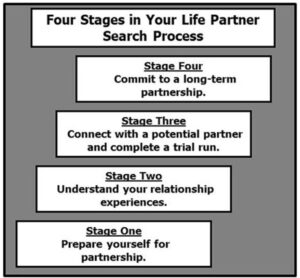
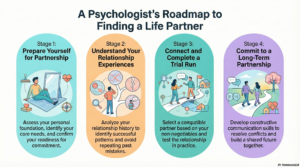
There are four progressive stages during the life partner search process, and my first guideline encompasses all of these. Because your search is unique, and because many of us as young adults are still figuring out our love lives, careers, and lifestyles, some information and exercises in this book will apply more directly to where you are in the process now. If you’re further along, you’ll be able to move quickly through earlier relationship exercises, but each one highlights information and distinctions to consider in your relationship choices.
My name is Lane Lasater, a retired clinical psychologist. In gratitude for the life I have been given, I am sharing everything I learned during my career and personal life here on my website http://www.LaneLasater.com and on my YouTube Channel Life Roadmaps from a Retired Psychologist https://www.youtube.com/@lane205 Each post contains my written material, an AI generated graphic, a 15-17 minute audio summary, and a 5-7 minute video summarizing the material. You can download a fillable and printable PDF workbook that contains all the exercises that I developed to accompany the material here: Finding a Life Partner Fillable Workbook
“If one sees the personality not as an apparatus that is essentially constructed by the time childhood is over, but as always in its essence developing, then life at 25 or 30 or at the gateway to middle age will stimulate its own intrigue, surprise, and exhilaration of discovery.”
Erik Erikson
Stage One: Prepare Yourself for Partnership
During stage one, you’ll assess your life foundation and repair it as needed, identify your deepest needs and values, evaluate your social support system, and decide whether you’re ready for a life partnership. When your own life foundation is solid, you are then prepared to find a person who has created his/her own solid foundation.
Information and exercises for guidelines 1, 2, 3, and 4 apply to the first stage.
Guideline #1: Complete each stage in your life partner search.
Guideline #2: Get your life together (mostly).
Guideline #3: Identify your deepest needs and values.
Guideline #4: Navigate the love landscape.
Stage Two: Understand Your Relationship Experiences
During stage two, you’ll weigh the following aspects of romantic relationships to avoid dead ends and make relationship choices that uniquely suit you.
Information and exercises for guidelines 5, 6 and 7 apply to this stage.
Guideline #5: Explore couple combinations and dynamics.
Guideline #6: Analyze your relationship field research.
Guideline #7: Know when to say goodbye.
Additionally, you’ll consider each of the following as you write your relationship history and identify successful and unsuccessful patterns from your past loves.
- relationship availability
- levels of sexual relationship
- low-key vs. high-strung partners
- under-function and over-function in couples similar and different relationships
- the pros and cons of different couple combinations for you
Stage Three: Connect with a Potential Partner and Complete a Trial Run
When you complete unfinished business from your past relationships and know you can cope with being alone when you must be, you can choose among potential partners without feeling desperate. You’ll form your relationship vision and identify the qualities of a partner to help you achieve your dreams, and vice versa. Then, your “entrance exam” guides you in selecting a compatible person who can meet your needs and support your goals. Focusing on non-negotiable requirements helps you choose someone you can thrive and live peacefully with. Together you’ll complete a partnership trial run to see how the relationship works out in practice. Information and exercises for guidelines 8 and 9 apply to this stage.
Guideline #8: Identify your non-negotiable partner requirements.
Guideline #9: Complete a partnership trial run.
Stage Four: Commit to a Long-Term Partnership
During this last stage of your partnership search, you’ll practice using constructive couple communication strategies as you and your partner respond to each other’s needs, work out personal differences, and resolve inevitable conflicts in living. You’ll learn to use the well-being checklist as you cope with the inevitable challenges life presents while you create your couple destiny together. Information and exercises for guideline 10 apply to this stage.
Guideline #10: Develop a partnership agreement.
Your Situation Now and Relationship Goal
When you start a complex project, it’s always more effective to describe your starting point and then define your ultimate relationship goal. Your vision for a lifelong relationship is the “North Star” you can always orient toward on your journey. Below, I introduce three people searching for a life partner whom you’ll follow throughout this series—Brianna, Nicholas, and Amber. To protect individual privacy, these are composites of actual people with certain details changed. Here are their relationship situations and goals:
Brianna: Clarifying My Life Direction
Relationship Situation: Not Ready to Commit. Brianna had several trial relationships during college and when she finished her degree in biology, she dated David in the small Illinois city where they grew up. Soon, Brianna recognized she and David had quite different life aspirations. He wasn’t interested in going beyond the familiar boundaries of their community, but Brianna wanted to explore the wider world. So, she joined AmeriCorps and was assigned to move to Chicago to work with underprivileged families. She subsequently broke up with David and wanted to get clear about her career plan before she was ready to choose a partner.
Relationship Goal: “When I know what I’m doing with my life and where I want to live, I’ll look for someone who fits into that plan. Meanwhile, I want to be on my own in a big city and try different relationships and experiences to learn what kind of man is right for me.”
Nicholas: Facing Unfinished Emotional Business
Relationship Situation: Repair Needed. When he was a teenager, Nicholas lived through his alcoholic parents’ painful divorce. This traumatic experience left him wondering if he would ever be capable of a long-term relationship. After the divorce, Nicholas lived with his father in a suburb of Washington, D.C., and barely saw his mother after she moved to Philadelphia. Because he felt distant and alienated from her, Nicholas was vulnerable with women and afraid of abandonment.
In college, Nicholas had several brief sexually driven encounters, but nothing lasted. He took a pre-law curriculum, and after law school specialized in family law. He joined a small firm in Arlington, Virginia, and focused his work on helping couples and families resolve conflict through mediation. Nicholas loved this work. He had temporary relationships with three female attorneys, but these seemed to lead to power struggles over trivial matters and didn’t work out.
Relationship Goal: “I know I’m not ready for a long-term relationship because I have too much emotional baggage. It’s hard for me to trust women, even though I’m lonely, so I feel vulnerable and tentative about being involved. If I can get emotionally balanced inside, I want to get married and have a family. Right now, I know I’d just create another disaster like my parents’ marriage.”
Amber: Starting Over
Relationship Situation: Abandoned. Amber met Ryan at the University of Montana while out partying. Ryan’s occasional cocaine use hadn’t really bothered Amber. They did well in the college environment and got married right after graduation. Then they moved to California because Amber had always wanted to live near the ocean and learn how to sail. Amber became a probation officer and Ryan worked as a construction supervisor. They had one daughter together, Emilia. When she was still a toddler, Ryan would often come home drunk and high after partying with friends. His behavior clashed with Amber’s work as a probation officer, and she didn’t want Emilia exposed to this. When she confronted Ryan, he shoved and hit her. Though Amber suspected he was having an affair, it still stunned her when Ryan suddenly announced he was moving out to live with another woman. Abandoned at 25 with her young child, Amber had to rebuild her life.
Relationship Goal: “It was so stupid of me to get into this situation. I hate Ryan’s irresponsibility and indifference to Emilia and how this is hurting her. I’ve hired an attorney and filed for divorce, and she recommended I see a therapist. When I get through this, I want to find a man who can be a suitable partner and a good stepfather to Emilia.”
Action Step #1: Describe Your Relationship Status and Goal
Now it’s time for your first relationship action step. Describe your current situation and your relationship goals. Keep this goal in mind as you use the exercises and action steps through this book to chart your path. All the exercises can be found in the Smart Happy Love Workbook that you can download here. Finding a Life Partner Fillable Workbook
Key Takeaways from This Chapter
- There are four progressive stages during the process of finding and creating a life partnership.
- As you move through these stages, you prepare yourself for partnership, understand your needs, values, and previous relationships, find a partner and complete a partnership trial run, and then create a partnership agreement together.
- Each action step (exercise, quiz, or reflection) you complete through this book allows you to place down a piece of the larger relationship puzzle.
- Review or repeat earlier exercises whenever you need to.
- Keep your relationship goals in mind as you move through the process.