
A Wealth of Resources Supporting Recovery
December 29, 2025
You Have Many Places to Turn for Help
Because you’re viewing this post, you’ve demonstrated your willingness to work toward the life you want and deserve. Accomplishing the remaining steps to recovery just requires your continuing effort, courage, time, and faith, in human proportions. If you act daily to improve yourself and your life, you can achieve a personal transformation, even though you control only your choices, not other people, places, or things.
Our past attempts to change our survival patterns usually failed because, unsupported and uninformed, we often became discouraged or overwhelmed as we confronted a lifetime accumulation of behavior, habits, and emotions. For many of us, our uninterrupted survival behavior patterns gradually or rapidly lead to disaster—unhappiness, illness, or complications from unresolved emotions and PTSD; self-defeating life patterns and addictions, or premature death from health complications, addiction, or despair.
Our survival behavior patterns were desperate solutions based on the extremely limited childhood choices available. Ideas such as, “I’ll find a shortcut,” “I can get away with it,” “I’ll win the lottery,” “I can find someone to take care of me,” or “I’ll do it by myself” have got to go. We must realistically restructure attitudes, behavior, beliefs, and relationships during recovery, not suddenly or dramatically, but through day-by-day choices and growth. Our progress is sometimes so subtle we can’t detect it. But gradually we sense the changes happening inside and ultimately recognize we’ve created different lives for ourselves.
Survival patterns are intricate, invisible, and powerful. By the time we recognize them and start recovery, we may have used these strategies thousands of times. It’s quite a challenge to change such over-learned patterns, and we need specific knowledge, skills, and support with which to transform these behaviors into strengths. Fortunately, recovery information and resources are now readily available. This chapter describes central recovery tasks and explains how to use self-help groups and multi-dimensional psychotherapy as resources for recovery.
This post describes the wide range of resources now available to support you in your recovery.
My name is Lane Lasater, a retired clinical psychologist. In gratitude for the life I have been given, I am sharing everything I learned during my career and personal life here on my website http://www.LaneLasater.com and on my YouTube Channel Life Roadmaps from a Retired Psychologist https://www.youtube.com/@lane205 Each post contains my written material, an AI generated graphic, a 15-17 minute audio summary, and a 5-7 minute video summarizing the material. A printable and fillable PDF “Exercises to Support Recovery from Family Trauma Syndrome” with each exercise I describe in my videos can be downloaded here: Transcending Family Trauma Workbook
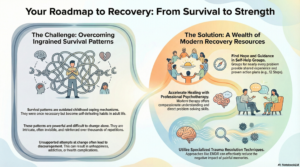
“You’re responsible for the effort and forces greater than you determine the outcome.”
Anonymous
Recovery Tasks
You need to accomplish nine general tasks to accomplish during recovery. You don’t have to do these in a certain order. You’ll probably work on each task many times at deeper intellectual and emotional levels during recovery, but when you complete them, you can say, “I’m at peace with the past. I feel good about the person I am today and I’m excited about my future.” Here are important recovery tasks.
- Understand your life process.
- Take responsibility for yourself.
- Learn about and feel your emotions.
- Heal from painful experiences.
- Identify and replace self-defeating life patterns.
- Discover and practice productive patterns.
- Replace addictions with positive alternatives.
- Plan for your future happiness.
- Maintain your recovery.
In subsequent posts, I present guidelines about how to prepare for recovery and to design and carry out your recovery plan.
The following story illustrates Barbara’s recovery from unstable self-worth and food addiction.
Barbara’s Recovery
I’m 23 now and feel good about my life. I began recovery three years ago. I’d felt bad about myself ever since childhood. I’m the oldest child in my family and got a lot of attention and affection until I was three. Then my brother was born, and my parents, particularly my father, turned all their attention to him. I see now that this wounded me, and I decided there must be something wrong with me. I tried hard to get my father’s approval by doing well in school and sports, but he still favored my brother.
By high school, I felt depressed. I dated a boy my freshman year and had my first sexual experience with him, even though I didn’t feel completely ready. Shortly after that, he left me and started going out with one of my friends. I felt humiliated and angry and like I didn’t belong anywhere. I started overeating after that and gained 40 pounds. I finally talked to my doctor because I felt so bad about myself. She recommended I see a therapist, which I did.
In therapy, I recognized my father somehow couldn’t affirm me just because I was a girl. With my therapist’s support, I’ve joined Food Addicts Anonymous. I’ve lost most of my extra weight and I’m following my food plan. I feel ready to date again, but I’ll take my time about being sexual.
The Self-Help Revolution
Recovery information and self-help groups weren’t widely available only a few years back. People trying to recover often sought help from professionals who didn’t understand addictions and troubled family dynamics or used limited psychotherapy theories and techniques. As a result, many people floundered or failed as they tried to recover. Fortunately, all that has changed and now we have wonderful resources that dramatically improve our chances for success in recovery.
The self-help revolution began with Alcoholics Anonymous in the 1930s. Now, self-help information and support groups are available for most human problems on the Web, in community meetings, and in online meetings. If we struggle with addictive patterns like food addiction, alcoholism, sex addiction, or gambling, illnesses like cancer or heart disease, losses like divorce or the death of a child, or destructive behavior like child abuse or family violence, we can readily find guidance, hope, and support from others who have faced and overcome the same problems.
Self-help groups help us make sense of our experiences and gain hope. It’s inspiring to see, hear, and learn from other people who’ve faced challenges like ours as they go through their own recoveries. We learn we’re not bad people because of our problems. AA and other substance and behavioral addiction self-help groups show those of us trying to recover how the dynamics of addiction are more powerful than unaided individuals. This relieves the shame many of us feel about being “weak” or “immoral,” feelings which can push us back to addiction.
Groups like Food Addicts Anonymous, Overeaters Anonymous, Sex Addicts Anonymous, and Gamblers Anonymous help members understand that addiction was a way of coping with feelings we didn’t know how to face any other way. Al-Anon and Alateen help people who grew up in troubled families understand they’re not “sick” or “crazy,” but are experiencing normal reactions and adjustments to abnormal situations.
Many self-help groups follow the AA “Twelve Steps,” which break recovery down into specific actions to accomplish daily. The foremost action in overcoming any addiction is not engaging in the addictive behavior for any reason. AA wisdom says, “If you don’t want to get drunk, don’t take the first drink, one day at a time,” and Food Addicts Anonymous (FAA) says, “Don’t take the first bite of any addictive food.” The 12 steps guide people through six phases for recovery: (1) acknowledging and accepting the truth about our difficulties, (2) becoming willing to accept help from a power greater than ourselves which can be other recovering people or spiritual beliefs, (3) learning lessons from the past and acting to change ourselves for the better, (4) righting the harm we’ve done to ourselves and others to the best of our ability, and (5) developing a realistic and satisfying new way of life, (6) sharing our experience and understanding to help others who are seeking to overcome similar challenges.
Twelve-step groups are spiritual ways of living. They ask each person to define a “power greater than ourselves” as a resource for dealing with life. People’s definitions of their “higher power” range from viewing the group as a higher power, trusting natural laws, accepting a traditional religion-based view of a higher power, or remaining atheist or agnostic while surrendering to clear guidelines for living without addiction.
Self-help groups stress taking responsibility for your own life and recovery, but you don’t have to do it alone. You can ask for help from others, but you supply the elbow grease. Those of us who grew up in troubled families find acceptance, guidance, and encouragement in recovery support groups. You can find emotional support and choose to never be lonely again, so consider joining a self-help group as a resource during your recovery.
Recovery Oriented Psychotherapy
Sigmund Freud created the first formal psychological helping relationship with psychoanalysis, which emphasized the critical development importance of the first five years of life. Each psychological theory and technique developed since Freud has contributed to our understanding of how people and lives develop. A single approach, however, often doesn’t sufficiently explain and help people change the complex survival behavior patterns used by children and adults from troubled families. Multi-dimensional psychotherapy integrates major discoveries from psychotherapy, family therapy, neuropsychology, cognitive psychology, and the study of addictions into the helping process.
Each of the following dimensions of change is essential to guide and support people recovering from unstable self-worth, problem emotional patterns and addictive behavior:
Opportunities for new relationship learning. The relationship between a psychotherapist and client is the foundation of helpful change. We need helpers who care about us and are warm and direct. We learn about successful relationships by solving any conflicts that arise between ourselves and our helpers. Psychotherapy provides a kind of “re-parenting” in which we receive undivided and compassionate attention. This is a healing alternative to our often difficult relationships with our parents.
Practice in compassionate self-understanding. As we understand ourselves and receive respect in psychotherapy, we learn to treat ourselves in new, strengthening ways. We understand ourselves more compassionately in terms of family limitations rather than through dehumanizing diagnostic terms like “neurosis” or “personality disorder,” which many people feel imply being “sick,” “weak,” or “bad.” Dr. Ken Burns describes how to change negative internal dialogue in which we discount ourselves, exaggerate events, jump to conclusions, personalize, or say harsh and degrading things to ourselves. We gradually recognize and change critical self-statements into realistic and supportive internal messages (Feeling Great: The Revolutionary New Treatment for Anxiety and Depression).
Direct problem solving and new skill development. Survival behavior patterns are often invisible to those of us caught up in them. We need logical explanations and direct feedback about what action to take. A person addicted to alcohol or some other substance needs to hear directly that alcohol or drug use threatens his or her health and safety (and often that of others), driving loved ones away, and that it would be in his or her best interest to stop drinking or drugging. But self-understanding alone doesn’t lead to behavior change. We need support and careful teaching as we develop and practice new, more effective skills. To recover, an addicted person needs to learn ways to relax without their addiction, how to express painful feelings, and how to build genuine self-respect and self-worth.
Support in facing painful life experiences. Feelings of grief, anger, hurt, disappointment, and shame arise during recovery as we remember and recount painful events. We require safety and understanding to face these feelings and move on. Powerful emotions also accompany new realizations or decisions during recovery. For instance, we may recognize that we never felt safe as children, and experience grief about not having the chance to be carefree and innocent. As we give up addictions, we may feel anger and grief that escapes we relied on for solace or fun are no longer available.
Encouragement for self-responsibility and self-care. Our growth during recovery is directly proportional to the efforts we make. We need encouragement and guidance to take responsibility and instruction on specific tasks assists our learning process. We learn positive self-care skills, including nutrition, exercise, health care, recreation, relaxation, and spiritual self-development.
Two Trauma Resolution Approaches
Two specific psychotherapy approaches that I have direct experience with can effectively complement and support the integration and mastery of painful life events and traumatic experiences: Eye Movement Desensitization and Reprocessing (EMDR), and Multi-Modal Experiential Psychotherapy.
Eye Movement Desensitization and Reprocessing (EMDR)
Psychologist Francine Shapiro (https://amzn.to/3yCfxL3) discovered this approach when she observed that moving her eyes left and right several times reduced disturbing memories. She formalized this approach and established a worldwide network of therapists and researchers who have refined this technique (called bi-lateral stimulation and now including modalities beyond eye movements) to help millions of people reduce the negative effects of traumatic experiences. Many studies validate EMDR as effective for trauma reduction.
How EMDR Works
The positive impact of EMDR results from stimulating the left and right brain hemispheres in an alternating fashion through eye movements or using sound or vibration. These left and right stimuli appear to “wake up” targeted traumatic memories originally stored haphazardly in the brain. Properly applied, EMDR helps the person integrate memories in a more positive way, and gain an expanded perspective on very disturbing events, so negative affects like anxiety and anger decrease. As part of an overall recovery program, EMDR can help with depression, panic attacks, specific fears and phobias, childhood abuse and neglect, compulsive behavior patterns, nightmares, PTSD, and the symptoms of traumatic brain injury.
Multi-Modal Experiential Psychotherapy
Purely verbal psychotherapy approaches often prove insufficient for persons dealing with severe trauma. Multi-Modal Experiential Psychotherapy refers to a range of techniques originating with psychodrama, developed by Psychiatrist J.L. Moreno (The Essential Moreno). The essence of the experiential psychotherapy approach is that instead of “talking about” feelings, traumatic events or relationships, these feelings, events, and relationships are re-enacted in a group to facilitate deep emotional access and the expression of grief, anger, and other powerful emotions.
A person can thus tell his or her story in a way that facilitates both emotional resolution and behavior change. The process allows persons to receive support from others who have shared similar experiences and to accept nurturing and develop compassion for themselves. Experiential psychotherapy approaches are most effective for people who have stabilized their lives and established addiction recovery. Effective grief and trauma resolution reduces the probability of addiction relapse and can create a general improvement in health, vocational and social functioning.
Criteria for Participation in Experiential Psychotherapy
- The ability and commitment to refrain from self-destructive and violent behavior.
- Three months of continuous abstinence for persons recovering from alcoholism, chemical dependency, or from eating disorders or sexual addiction.
- Sufficient ego and personality strength to tolerate the emotional intensity of this type of work.
Considering Professional Help
Through this book, you’ve completed self-assessments of your well-being, including your basic human needs, your self-worth, your unresolved emotions, evaluating your addiction risk, and your use of escapes. If you experienced basic human need frustration as a child, grew up in a troubled family, struggle with self-defeating life patterns, are at high risk for addiction, or have developed one or more addiction, professional help can be a big asset to recovery.
If you’ve previously faced your challenges alone, consider giving yourself compassionate support. You don’t have to be in deep trouble to benefit from the help of a professional, but certain symptoms suggest a definite need for professional help: (1) suicidal feelings or actions, (2) prolonged depression or anxiety, (3) violent or aggressive behavior, and (4) health complications. Use your best judgment in deciding when to seek help and what help is right for you.
James’ Therapist Change
James felt he wasn’t making progress with the therapist he had been seeing for two years. The therapist primarily listened to James with occasional comments. He felt more depressed than ever. He sensed the therapist didn’t understand troubled families and provided little direction. When James joined a self-help group for adults from troubled families, and learned about survival behavior patterns, he recognized he needed a helper who had specific training and personal experience with recovery techniques and action.
You’re Responsible
We may have the childhood illusion that we’ll find someone to take care of us. The truth of adult life is other people will help us along the way, but won’t carry us. If we surrender responsibility for ourselves, we’re vulnerable to being victimized. The only exceptions to this are those moments in life when we’re so weak, sick, or vulnerable that we must rely upon the compassion and good intentions of others. Most of the time, other people in our lives are there as consultants—and we pay the price if their advice is wrong. Our “consultants” want nothing bad to happen to us, but if it does, we’re responsible. Find the best consultants you can, but make your own final decisions.
Image 9 illustrates this principle.

Fly by Your Own Instruments: Flying our small plane during a threatening storm represents the tough parts of our journey through life. Winds, thunderheads, and jagged peaks can destroy us in our fragile machine if we don’t use all our wisdom and skill to maneuver our way through to clear skies on the other side. We consult by radio with advisors on how to proceed, but only by reading our own instruments, making our best judgments, and using all our skill do we ultimately get through. Please fly by your own instruments!
Your Commitment to Recovery
Personal recovery doesn’t mean “as good as new.” It means we can become happier, freer, wiser, more productive, more grateful, and humbler, even while carrying scars and memories of painful times and painful choices. Review in your mind all that you’ve been through so far. Remember the personal courage, determination, and toughness you’ve mustered to survive your challenges. And remember the people who have made a difference in your life by believing in you or by bestowing kindness. In recovery, you can achieve the deep satisfaction that comes from living according to your values. There are many people out there who can help and support you along the way. Make an unwavering decision to do everything in your power to move beyond your family trauma to a healthy and happy live.
Key Takeaways from this Post
- We now have a tremendous number of sources of information and help to support recovery.
- The self-help revolution has spread around the world, and now there are available support groups for almost every challenge we face as human beings.
- Self-help groups provide information, support, guidance, and myriad examples of people just like you who have faced and overcome the challenges of troubled families, childhood survival patterns that carry into adulthood, painful and traumatic life events, and addictions of all varieties.
- There have been enormous steps forward in the development and availability of psychotherapy and treatment approaches specific to people who grew up in troubled families and who suffer from enduring emotional adjustments, self-defeating life patterns and addictions.
- The foundation of your recovery is your decision—I’ll go to any lengths to understand myself, change my life in the ways I need to, and discover the freedom to live without the burden of archaic survival patterns and their adult aftermath.