The Process of Changing Behavior
December 6, 2025
The Process of Changing Behavior
This post gives you a Map of the process of how to change your behavior patterns, a critical building block in recovery. We now understand clearly the process of how to change behavior patterns. Prochaska and DiClemente first described this while studying cigarette smokers trying to quit. Understanding exactly how people change empowers us, and each step we make toward change becomes a waypoint on the journey toward our recovery goals. This website can lead you through each stage of change as you understand and replace archaic emotional and behavior patterns that no longer work for you.
My name is Lane Lasater, a retired clinical psychologist. In gratitude for the life I have been given, I am sharing everything I learned during my career and personal life here on my website http://www.LaneLasater.com and on my YouTube Channel Life Roadmaps from a Retired Psychologist https://www.youtube.com/@lane205 Each post contains my written material, an AI generated graphic, a 15-17 minute audio summary, and a 5-7 minute video summarizing the material. A printable and fillable PDF “Exercises to Support Recovery from Family Trauma Syndrome” with each exercise I describe in my videos can be downloaded here: Transcending Family Trauma Workbook
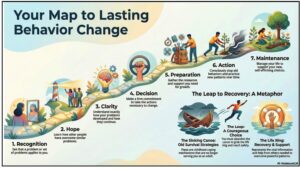
The Seven Stages of Behavior Change
- Recognition happens when you see that a problem or set of problems applies to you.
- Hope develops when you learn how other people have overcome similar problems.
- Clarity occurs as you comprehend exactly how your problems developed and how they continue.
- Decision is your firm commitment to take the actions necessary to overcome these challenges.
- Preparation involves gathering the resources and support you need to face the losses, confusion, and uncertainty required for growth and change.
- Action takes place over a long period and in small increments as you self-consciously stop old behavior and practice new patterns of action.
- Maintenance requires managing your life to support your new self-affirming lifestyle and choices and not creating additional problems.
During recovery, it is helpful to list each problem or concern we face, then rank them in terms of how urgent that concern is. Then we apply these stages sequentially to each problem (or sub-problem) we face, beginning with those challenges that are most destructive or dangerous, and then progressing to the next on the list. We can also work simultaneously on more than one concern, but it is important to allow yourself time and space because lasting change cannot be accomplished without continuing effort. In separate blog posts I provide a Recovery for Life Map explaining:
- How the strengths and stresses of our childhood environments provide the foundations for both helpful and unhelpful adult behavior patterns.
- The ingenious ways we adapted as children to traumatic and adverse experiences and limitations in our families.
- Exactly how adult enduring emotional adjustments, self-defeating life patterns, and addictions develop.
- The many recovery resources now available, help you develop your recovery plan, and focus on your decision and preparation steps for recovery.
- Tools for recovery actions and maintenance of the growth we have achieved.
Images for Recovery
To help people understand the concepts I was teaching, I asked Artist and Educator Janet Gustafson of Boulder, Colorado, to draw images for recovery that I display through these posts. She did a beautiful job in powerfully bringing these images to life. This first image is called Hitting the Rapids.
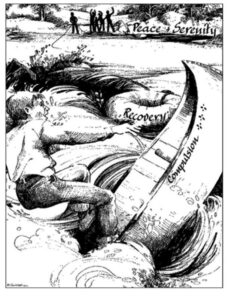
Hitting the Rapids: This canoe on the verge of sinking in raging rapids represents childhood survival strategies that no longer serve us in adulthood. At one time these strategies helped us cope with difficult childhood circumstances, but they no longer work. The negative consequences of enduring emotional adjustments, self-defeating life patterns, and addictions have now become a torrent. The life ring represents recovery information and support from others, which we need to overcome these powerful patterns. To reach the ring, we must abandon the waning security of the canoe and leap to the life ring. This means coming to terms with painful reality and facing powerful emotions. But through the leap, we can receive the help of others and reach the shore.
How to Use this Website
Always respect your personal learning style, but here are specific suggestions on to get the most out of it.
Get the big picture. Choose different blog posts to get an overview of the process and steps for moving beyond family trauma and adverse experiences. It’s helpful to know the lay of the land when you get into unfamiliar territory.
Keep a recovery journal. Record your work for each exercise as you go through the book. This provides a record of what you’ve learned and lets you see the progress you’re making.
Share your work with someone you trust. When you’re ready, tell someone you feel safe with that you’re working through the book. You might ask them to complete some exercises for comparison. If you don’t have anyone you feel comfortable discussing your exercises with, consider finding a therapist to get the benefit of more support and dialogue.
Keep at it. A short-term approach won’t work. There’s no quick and easy way to recover—just do your homework. But each step you take counts and your work day-by-day moves you forward steadily on your path to happiness and freedom.
The most important message of recovery is hope.
- Troubled family systems expose us to great stress, but as children we couldn’t protect ourselves and accordingly developed survival behavior adaptations and emotional defenses that frequently become lasting habits.
- Many of us who experienced adverse and traumatic childhood experiences arrive at adulthood with enduring emotional adjustments and self-defeating life patterns that hamper our lives and put us at increased risk for addictions.
- Clearly understanding the dynamics and impact of troubled families helps guide your path to recovery.
- Following the steps of behavior change gives you a map to follow you as you complete the process of transforming your life.
- Millions of people, just like you, have moved beyond childhood trauma and adverse childhood events to create meaningful and fulfilling lives and relationships.