
Understanding Family Trauma Syndrome
November 28, 2025
In this post I introduce you to what I describe as Family Trauma Syndrome. Through my own recovery from childhood family trauma and alcoholism, and through my professional work guiding people of all ages toward recovery from traumatic experiences, I identified a pattern that I call “family trauma syndrome.” This term encompasses three types of problems many adults from troubled families face: enduring emotional adjustments, self-defeating life patterns, and chemical and behavioral addictions.
My name is Lane Lasater, a retired clinical psychologist. In gratitude for the life I have been given, I am sharing everything I learned during my career and personal life here on my website http://www.LaneLasater.com and on my YouTube Channel Life Roadmaps from a Retired Psychologist https://www.youtube.com/@lane205 Each post contains my written material, an AI generated graphic, a 15-17 minute audio summary, and a 5-7 minute video summarizing the material. A printable and fillable PDF “Exercises to Support Recovery from Family Trauma Syndrome” with each exercise I describe in my videos can be downloaded here: Transcending Family Trauma Workbook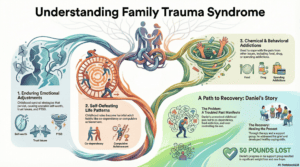
1. Enduring Emotional Adjustments
Enduring emotional adjustments began as we adapted to childhood environments where we had few behavior options and couldn’t escape. We naturally bring these coping strategies with us into adulthood, long after the need for them—survival—exists. Thus, we unintentionally re-create the limitations of our childhood environments. Here are common enduring emotional adjustments for adults from troubled families:
- Unstable self-worth
- Unresolved emotions, Post Traumatic Stress Disorder (PTSD), and complex PTSD (C-PTSD—from chronic stress exposure)
- Difficulty trusting ourselves and others
2. Self-Defeating Life Patterns
We naturally carry forward as adults the childhood family survival roles we played, and these behaviors frequently become self-defeating life patterns which are difficult to recognize and change, even when they no longer serve our best interests. The following behavior patterns are widespread among those of us who grew up in troubled and traumatic families.
- Compulsive Achievement—we’re always striving for the next victory or success, often at the expense of health, relationships, and well-being.
- Co-Dependency—we repeatedly invest time, energy, and affection in people who don’t (or can’t) reciprocate what we offer, and neglect our own needs.
- Generalized Rebellion—we chronically struggle with and attempt to reform organizations or dysfunctional systems and make ourselves scapegoats.
- Casualty Syndrome—we enter unhealthy relationships or job situations naively or passively, and inadvertently set ourselves up to be manipulated, disappointed, victimized, or abandoned.
- Under-Responsibility Pattern—we learn to manipulate or charm our way through life, not following through on commitments or fully meeting adult responsibilities.
3. Chemical and Behavioral Addictions
Because enduring emotional adjustments and self-defeating life patterns create additional pain and problems for us, we’re quite vulnerable to developing chemical or behavioral addictions, including:
- alcohol, drug, and cigarette addiction
- food addiction, including bingeing, self-starvation, and bulimia
- sexual addictions such as pornography, illicit affairs, or hiring sex workers
- compulsive spending
- gambling addiction
Case Example:
All case examples shared in this website consists of composites of several real people, with significant details changed in order to respect and protect their confidentiality.
Daniel’s Behavior Crisis
Daniel’s life illustrates how one person overcame unstable self-worth, unresolved emotions, co-dependency, and food addiction during recovery.
Daniel trembled visibly as he recalled a confrontation with his 13-year-old son, Ryan, the night before. “Ryan came home very late, and when I confronted him, he swore at me. I lost it and almost slugged him.” The intensity of his anger toward Ryan shocked Daniel. He wanted to get his rage under control before he created a catastrophe.
The Roots of Daniel’s Behavior
As Daniel grew up, his parents constantly argued about his father’s compulsive achievement. Daniel felt lonely and unaccepted by his father, who traveled for work. He tried to counsel his parents to improve the situation, but his efforts to help failed. Then, when Daniel was a teenager, his mother passed away from a heart attack, and he had to take a lot of responsibility for his younger brothers. He arrived at adulthood feeling unwanted, unworthy, and lonely, and comforted himself with food. His bingeing on high fat, high sugar junk food became an addiction, and now he was quite overweight.
Daniel’s co-dependency led him to marry a woman who was irresponsible and not prepared for the commitment of marriage and raising Ryan. As in childhood, Daniel took most of the responsibility in the family, and when his wife abandoned the family, Daniel was alone with responsibility for Ryan.
After the divorce, Daniel devoted himself to taking care of Ryan. He wanted to give Ryan everything he’d missed during his own childhood, but when his son rebelled, it threatened Daniel’s unconscious wish to have his son validate him. Daniel tried to control Ryan, but this only hardened this teenager’s normal quest for autonomy.
Daniel’s Recovery Tasks
Ryan’s rebellion forced Daniel to let his son take more responsibility for his choices and become more independent. But facing his son’s emancipation triggered Daniel’s unacknowledged grief from losing his mother as a teenager and other painful childhood events. As he recognized and shared his childhood pain in therapy, Daniel gradually let go of over-controlling Ryan, who rebelled less intensely. As part of Daniel’s self-care, he joined the (OA) Overeaters Anonymous. This gave Daniel a spiritual support system and black and white eating plan that excluded his addictive foods. Over the next few months, Daniel lost 50 pounds and for the first time in his life, felt hopeful about the future and his ability to make positive choices.