
Maintaining Your Recovery
January 5, 2026
Recovery goes on for life, but we don’t always have to work so hard. A time comes when we realize we’re living freer, happier, and more fulfilling lives. We recognize we’ve gone beyond the limits of our childhood environments and become masters of ourselves, excited about our future possibilities. We recognize that our distress and that life challenges pushed us to grow, change, and learn. Many people in recovery describe how grateful they about how their lives developed because without suffering they would never have discovered and taken advantage of all the resources of recovery.
My name is Lane Lasater, a retired clinical psychologist. In gratitude for the life I have been given, I am sharing everything I learned during my career and personal life here on my website http://www.LaneLasater.com and on my YouTube Channel Life Roadmaps from a Retired Psychologist https://www.youtube.com/@lane205 Each post contains my written material, an AI generated graphic, a 15-17 minute audio summary, and a 5-7 minute video summarizing the material. A printable and fillable PDF “Exercises to Support Recovery from Family Trauma Syndrome” with each exercise I describe in my videos can be downloaded here: Transcending Family Trauma Workbook
“We must let go of the life we have planned, so as to accept the one that is waiting for us.”
Joseph Campbell
Facing the Ups and Downs of Life
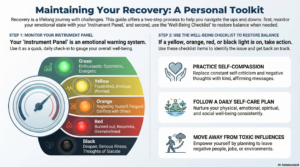
Life will continue to present challenges, so in this chapter I introduce two coping tools—your instrument panel and the well-being checklist—to help you and your partner identify and solve problems and maintain your strength and spirits, no matter what. The next two exercises can serve you throughout life to make it through whatever challenges you face.
Action Step #22: Monitor Your Instrument Panel
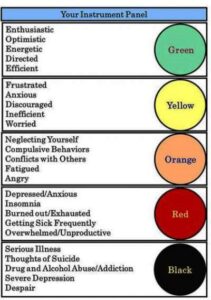
Irritability is a frequent instrument panel warning signal for many of us, so if you feel irritable, ask yourself if you’re tired, lonely, hungry, angry, stressed, or worried? If your instrument panel lights up, use the well-being checklist below to identify what’s bothering you and develop a plan to get back on track. What’s your instrument panel telling you?
Action Step #23: Use the Well-Being Checklist
When you get warning signals on your instrument panel, use the following well-being checklist to identify how to restore emotional and physical balance.
Be compassionate with yourself. Watch out for negative self-talk. Negative thoughts lead to negative feelings, which lead to negative behavior. When you’re unhappy, first ask yourself, Am I saying negative things to myself? If you’re constantly criticizing yourself and predicting the worst outcome for every situation, you’ll walk around feeling ashamed, inadequate, and scared. Get a book of daily affirmations at your local bookstore and read it every day—these really help. Also, practice being compassionate with yourself by writing compassionate messages in your relationship journal.
- “I didn’t know how to do it differently.”
- “I’m learning through experience.”
- “I’m taking action to solve the problem.”
- “I’ve done my best and trust things will work out.”
Write three ways you criticize yourself and three kind things you can say to yourself instead.
Correct your mistakes. Did you hurt someone or let them down—by being insensitive, irritable, or selfish, not following through, or not meeting your responsibility? These actions weigh on you until you take responsibility, apologize when you need to, and change your behavior. Are there any mistakes you need to correct? How and when will you do it?
Follow a daily self-care plan. Move forward with daily self-care goals at your own pace. You don’t have to accomplish these goals perfectly—just aim for “progress, not perfection.” List your daily/weekly self-care actions for each area below in your relationship journal.
- Physical health (diet, exercise, rest, and medical, dental, or other professional care).
- Emotional well-being (friendships, support groups, workshops, journal writing, or therapy).
- Spiritual well-being (reading, meditation, spiritual practices, retreats, or spending time in nature).
- Close relationships (time set aside for family members and close friends).
- Meaning and accomplishment (performing long-term work and achieving goals that provide excitement and purpose).
- Recreation and fun (laughter, playing, being in nature, sports, games, and entertainment).
Move away from toxic influences. Keep away from toxic people, negative environments, destructive media, and situations that bring you down. If you can’t get out of a bad job situation right away, plan to leave the situation, even if all you can do is start the change. When you decide to act, you feel better right away because you’ve empowered yourself. What action do you need to take to move away from toxic influences?
Be grateful. No matter what problems you encounter, usually, some things are going right—you have a job, a caring partnership, your health, a place to live, or you can appreciate the beauty in life, art, literature, and nature. Remember the good things to keep your dark days in perspective. Life itself is a wonderful gift. List what you’re grateful for and use it to remind you when things get tough.
Design a positive future. Short- and long-term goals support you in navigating life’s drudgery and challenges. Plan something fun to reward yourself for what you accomplish each day and give yourself larger rewards occasionally. Have a plan for the important things you want to accomplish during life and partnership, and the next steps you’ll take to accomplish each of these.
Serve others. As you learn and grow in your partnership, you have more to share with others. Any kind of volunteer work helps because you:
- feel the satisfaction of helping someone
- remember that you’re part of a larger whole
- forget about your problems
- get your life back in perspective, and
- see the positive impact of your actions on others
What service can you provide?
Daily Recovery Practices
The last stage in the process of behavior change is maintenance—actions that maintain and enhance all the efforts you’ve made. These daily habits are common sense orienting points to help you get through each day without extra hardship (or the risk of going back to addictions or other survival patterns). These habits help a lot, and you can always add more daily practices to help you focus on the big picture—being the best person you can and not taking unnecessary detours. Below are a few suggestions.
Start and end the day with quiet time. Take a few minutes in the morning to check in with yourself and plan your day and be grateful to be alive. Think about challenges you’ll face today and visualize yourself handling them smoothly. Read and contemplate something inspiring from a book of quotations or prayers, a spiritual book, or daily affirmation. Late in the day, review how things went and write anything you need to do tomorrow. Give thanks for the good people and things in your life.
Remain teachable. A friend in recovery mentions this saying often. It’s a perfect reminder that we don’t know everything. Sometimes we’re just plain wrong or kidding ourselves, and we all have blind spots. When we learn something we didn’t plan on, it helps keep us humble.
“How important is it?” When we react to other peoples’ unacceptable behavior, like aggressive drivers on the highway, or people who act like they’re better than us, we’re at risk of creating additional problems. We’re most likely to let other people’s actions provoke us when we’re out of balance. Recovery wisdom says, “Let the tailgaters pass.”
“Seek progress, not perfection.” We accomplish big things by doing our best one day at a time. Give yourself credit for the good things you do today. If you make a mistake, be compassionate with yourself, learn from it and plan how to make things better.
“Take responsibility.” It’s tempting to make excuses and blame someone or something else for our problems and mistakes. We all do it! Other people will do things that hurt and disappoint us but, when we look closely, we recognize we often had some part in creating our difficulties. Focus on your choices and actions rather than what others do. Most of us have plenty to do to stay on track. Improving yourself keeps you busy, so you don’t have to meddle in other people’s affairs.
“Surrender to Win.” Focus on what you can control (your choices and behavior) as suggested by the Serenity Contemplation: “Grant me the serenity to accept the things I cannot change, the courage to change the things I can, and the wisdom to know the difference.”
Tolerate uncertainty. A common anxiety we all face is wondering if everything will work out. When we’re afraid, we’re often tempted to force a solution. This usually prolongs the situation, or because our timing isn’t right, makes things much worse. Being patient and doing nothing is sometimes the best (but hardest) choice.
Endure discomfort. When we hurt someone and apologize, we may want them to forgive us right away. However, they’re still hurt and aren’t ready to forgive and trust immediately. If we give them time and space to heal, people will often become ready to be close and trust again. If they don’t, do what you can to make things right and let them go in peace.
Trust the process. Even though you do your best using all your resources to cope with change, you’ll still encounter losses, tragedies, and setbacks along the way. Grief is a universal part of being human when people we love get sick, get injured in accidents, or pass away. With all your recovery resources, you can endure the grief process, doing your best to maintain your balanced life choices and accept the support of others.
Remember the truths of your recovery. While some people can enjoy potentially addictive substances and behavior responsibly, you may not one of those people. If you’re vulnerable to addiction, this applies to all addictive substances and behavioral addictions. You need help and support to maintain your recovery. You’re human and will make mistakes and can forgive yourself for your mistakes because you’re genuinely working to create an alternative way of living. It’s not your job to straighten out other people.
A New Destiny in Recovery
When we brought our childhood survival patterns into our adult lives, we unwittingly created further unhappiness and additional problems. This pain and distress ultimately compelled us to seek additional information and support. As we understand and replace these patterns, a new world opens. Our vision about who we truly are and what life is right for us may change during recovery.
When we reached out for help, we received answers and support that allowed us to overcome our challenges. These same principles apply to everything in life. Life in recovery is still challenging, but we can face each challenge as it comes, clear-headed and fully resourced. You are part of the vast community of people finding life beyond family trauma. I earnestly hope this book has supported you as you overcome your challenges and develop the life you want and deserve.