Today’s Complex Relationship Environment
January 13, 2026
Modern life is amazingly complex. It’s no wonder it takes years for many of us to prepare for life partnership and be clear about what kind of partner we want and need. Unfortunately, training for intimate relationships isn’t part of most high school or college curricula, so we’re left to our own devices to navigate this complicated realm.
Psychologist Dr. Erik Erikson was the first theorist to describe how people continue to grow and mature throughout life. Erikson identified a central task for emerging adults between ages 18 and 40 as “intimacy vs. isolation.” He theorized that during this stage of development, a person would explore intimacy with romantic partners. Many of us spend our twenties searching for a mate with whom we can create a family and raise children while simultaneously advancing our careers and expressing creativity through art, music, or sports.
My name is Lane Lasater, a retired clinical psychologist. In gratitude for the life I have been given, I am sharing everything I learned during my career and personal life here on my website http://www.LaneLasater.com and on my YouTube Channel Life Roadmaps from a Retired Psychologist https://www.youtube.com/@lane205 Each post contains my written material, an AI generated graphic, a 15-17 minute audio summary, and a 5-7 minute video summarizing the material. You can download a fillable and printable PDF workbook that contains all the exercises that I developed to accompany the material here: Finding a Life Partner Fillable Workbook
“Who, being loved, is poor?”
Oscar Wilde
Societal Trends in Romantic Relationships
Current marriage patterns, correlations between education level and marriage, and divorce patterns among emerging adults affirm how targeted information and guidance about intimate relationships during our twenties is essential to our long-term success. Census data shows dramatic changes in societal patterns, with people marrying later, fewer younger adults getting married, and more emerging adults living with an unmarried partner.
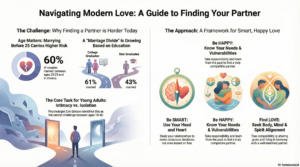
An Institute for Family Studies Report highlights a “marriage divide” in recent data between college graduates and those without a college education. Among adults aged 18–64, “61% of college graduates were currently married compared with only 43% of those without a college education.” Wilkinson & Finkbeiner, a family law firm in San Diego, compiled many illuminating statistics about divorce. Their findings suggest it may be wise to use your early twenties to gain relationship experience, as committed relationships begun before age 25 are statistically less likely to work out:
“48% of those who marry before the age of 18 are likely to divorce within 10 years, compared to 25% of those who marry after the age of 25; 60% of couples married between the age of 20–25 will end in divorce; and those who wait to marry until they are over 25 years old are 24% less likely to get divorced.”
This series of posts describes the universal patterns and dynamics in love relationships that operate beneath the complex and rapidly changing family, work, and societal environment that produced these statistics. The rate of divorce for those in their early twenties shows how urgent it is to be just as deliberate and careful about finding your life partner as you are in your education and career plans. The more information and self- knowledge you have to guide your relationship decisions, the better.
What Is Smart Happy Love?
Smart: Intimate relationships are a bundle of wants, needs, expectations, hopes, fantasies, hormones, fears, and instinctual drives, so it’s a minor miracle when one works out. It’s impossible to be emotionally and physically involved with someone without being vulnerable, and one of our deepest fears—abandonment—is always lurking in the background. We shake our heads when we hear about people making unhappy relationship choices. But when a relationship breaks (or cracks) our heart, we often can’t take these things in stride until much later (if ever), after we’ve survived and learned from the experience. Setbacks in love are painful and frightening, but whatever challenges you encounter, you can make things better with practical information and smart constructive action.
In this series, I ask you to study your love relationships and potential partners so you can make decisions that respect both you and the other person. Though you may be familiar with some of these concepts already, engaging with the exercises allows you to reflect in a way that minimizes the impact of fear and other emotions on your decisions. You’ll find this guidance helps you make smart relationship decisions that use both your head and your heart.
Happy: Because losing an intimate relationship is one of the most painful experiences in life, people wounded by love often came to me as a psychologist. As I worked with them over several months, my first goal was to help each person process the hurt and disappointment (and often anger) that accompany a broken relationship. Sometimes, the only thing a person could do was simply take care of themselves day-by- day and let healing slowly take place, even when they felt like they were about to die. Gradually, my clients would feel somewhat restored and a glimmer of interest in dating would reappear, often accompanied by fear of being hurt again.
It’s always tempting to blame others when we’re in pain. People hurt us and let us down, but feeling like a victim accomplishes nothing. I’ve done it too many times, but ultimately, I had to take responsibility for how I got myself into the situation and move on—bruised but somewhat the wiser. Recognizing the part we played (if any) in how we got into painful romances is an important part of the relationship recovery process. Did our choices consciously or unconsciously place us in a position to be hurt? When we examine our relationships objectively and understand how things happened, it’s humbling to recognize our mistakes and blind spots. It also means we can avoid repeating the same painful lessons. Because I’d lived through relationship experiences like those my clients described, I developed the same information and exercises you’ll see later to help my clients better understand their choices. When a person understood the dynamics that shaped a painful relationship, and how things got off track, they gradually felt safe to date again (with fingers crossed).
What kind of relationship will make you both happy long- term and help you and your partner fulfill your life goals? Studying your past relationships lets you identify deep emotional needs and vulnerabilities. Then you can consciously look for a partner who’s able to fulfill those needs and not unnecessarily trigger your vulnerabilities. It took me several serious and sometimes painful romances to learn what I most needed (stability and security) and what I was most vulnerable to (insecurity and abandonment). This knowledge clarified for me certain essential qualities of a woman I could be happy with.
Love: Starting in grade school, we practice loving and being loved as we feel the powerful joy and suffering of school crushes, obsessions with movie and music stars, asking people out, being rejected, and falling in love with unavailable (or uninterested) people. These practice experiences in love introduce us to the powerful emotional highs and lows that govern the romantic realm, and we glimpse without full understanding deeper truths about attraction, compatibility, and our place in the hierarchy of beauty, status, and attraction.
As teenagers and early adults, we discover further dimensions of love—like viewing a cut diamond from different angles. We develop warm friendships where we appreciate another person’s personality, humor, and intelligence and notice the stirrings of attraction. You recognize how uplifted you feel when you’re around them, and you experience a powerful physical yearning and find your thoughts turning to them over and over. Sensing they share your feelings, you declare your interest and they respond in kind. Cautiously, step-by-step, you discover each other, and hopefully, your intuitive sense about this person is confirmed more and more deeply.
This unique chemistry of attraction is an incomparable experience of being human. Ultimately, we discover the joys of touching, holding, kissing, intimacy, and sexuality. The process is sometimes intoxicating and emotionally enthralling and at others, clumsy, humiliating, and horrible. In parallel with these critical love learning experiences, we’re maturing and gradually mastering other dimensions of life, including knowing ourselves and determining how we can fit into the larger world as independent adults.
The life partner you’re seeking is a person you’re aligned with in body, mind, and spirit as you envision and accomplish shared goals. Dictionary.com defines compatibility as “the natural ability to live or work together in harmony because of well-matched characteristics.” Throughout this book, I describe the fundamental dimensions of couple compatibility I’ve identified. My goal is to help you consider each of these dimensions as you and your partner merge the complex and powerful emotions and chemistry of love with the down-to- earth responsibilities, commitments, and challenges of long- term partnership.
There are many aspects to my loving relationship with my life partner, but here are a few qualities of our relationship I treasure.
- enjoying our days together, laughing a lot, and crying sometimes
- setting individual and couple personal and professional goals and supporting each other to achieve them
- raising and launching our two sons into the world
- sharing our love of the outdoors in hiking, skiing, backpacking, bird watching, and kayaking
- growing spiritually in parallel
- sharing friendships with other couples and individuals
- negotiating the difficulties of life and supporting each other through both challenges and victories
Now consider your life and the many dimensions of love you want to attain. I wish all these things and more for you on your relationship journey!
Key Takeaways from This Chapter
- Psychologist Erik Erikson described the central task between ages 18–40 as “intimacy vs. isolation ”
- Emerging adults are waiting longer to marry and enter long-term relationships
- Marriages before age 25 more frequently end in divorce
- Successful long-term relationships blend personalities, complex interpersonal chemistry, and practical partnership responsibility sharing
- Deep and lasting love is a transcendent experience with multiple dimensions